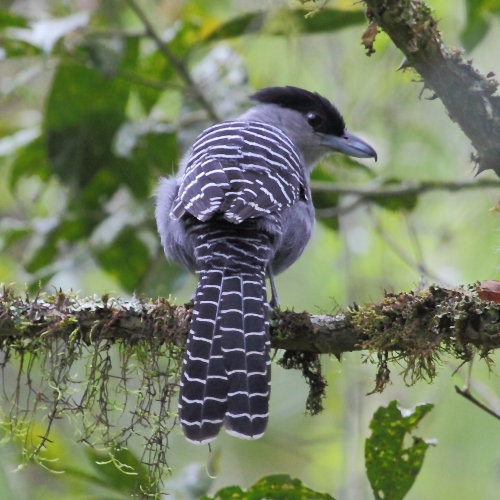
Black Antshrike
Thamnophilus nigriceps
Order: Passeriformes / Family: Thamnophilidae

Wikimedia Commons
About the Black Antshrike
The Black Antshrike, Thamnophilus nigriceps, is a fascinating bird residing in the dense tropical forests of Central and South America. This species belongs to the Thamnophilidae family, known for its ant-following behavior and diverse array of plumages. Within its range, the Black Antshrike serves as both a predator of insects and a crucial part of the forest ecosystem, helping control insect populations. Inhabiting regions from southern Mexico through Panama and into Colombia, this bird thrives in the understory of humid lowland and foothill forests. Its presence is often noted in the Chocó region of Colombia and Ecuador, where it contributes to the rich avian biodiversity. The Black Antshrike's significance extends beyond its ecological role, as it acts as an indicator species for forest health in its range. During the breeding season, which typically spans from February to June, the bird engages in complex vocalizations and displays to attract a mate. Outside the breeding season, it remains rather secretive, moving silently through the underbrush in search of food. Seasonal behaviors of the Black Antshrike include adjusting its diet and foraging strategies in response to shifts in prey availability, which coincide with changes in rainfall and forest dynamics. The Black Antshrike is not only a sentinel of forest integrity but also a subject of interest for ornithologists studying the ecological dynamics of Neotropical forests. Its reliance on dense forest habitats makes it vulnerable to deforestation and habitat fragmentation, underscoring the importance of conservation efforts in its native range. By understanding the habits and habitats of this species, conservationists can better implement strategies to protect these vital ecosystems. Observers often find the Black Antshrike in mixed-species flocks, where it participates in a symbiotic relationship with other insectivorous birds. This behavior highlights its adaptability and intricate ecological relationships within its habitat. In summary, the Black Antshrike is a keystone species whose behaviors and presence provide valuable insights into the health and dynamics of Central and South American forests.
The Black Antshrike belongs to the family Thamnophilidae, within the order Passeriformes. These birds typically live 5-7 years with a maximum recorded of 9 years.
How to Identify a Black Antshrike
The Black Antshrike is a medium-sized bird, distinguished by its predominantly black plumage and subtle white wing markings. Adult males exhibit a glossy black coloration, giving them a sleek appearance, while females display a more subdued brownish-black tone, which aids in camouflage within dense foliage. Juveniles resemble females but are typically duller in color. The bird's stout bill and rounded wings are key features for identification. When perched, the Black Antshrike often holds its wings close to its body and adopts a slightly hunched posture, which can be a helpful field mark. In flight, its silhouette is characterized by short, broad wings and a squared-off tail. This species can be confused with other antshrikes, such as the Barred Antshrike, but differences in plumage patterns and vocalizations aid in distinguishing them. The Black Antshrike's lack of barring and its solid coloration set it apart from similar species. Observers should focus on its habitat and behavior, as it often remains in the understory, unlike some other antshrikes that prefer more open areas.
Having trouble telling birds apart? Upload a photo to our bird identification tool for an instant species match.
Black Antshrike Habitat and Range
Preferred Habitat
The Black Antshrike inhabits dense, humid tropical forests, predominantly in lowland and foothill regions. It thrives in areas with thick understory vegetation, providing ample cover and foraging opportunities. Typical habitats include the rainforests of the Chocó region in Colombia and Ecuador, as well as the lowland forests of Panama and Costa Rica. The species occupies elevations from sea level up to about 1,200 meters. While primarily a forest-dwelling bird, the Black Antshrike occasionally ventures into secondary growth areas, particularly where forest edges meet clearings. It avoids urban environments, showing a strong preference for undisturbed forest habitats. Seasonal habitat shifts are minimal, as the bird remains within the same general area year-round, though it may move to slightly different elevations or microhabitats in response to food availability and climatic conditions.
Geographic Range
The Black Antshrike's range spans from southern Mexico through Central America, including countries like Guatemala, Honduras, and Nicaragua, extending into northwestern Colombia and the western lowlands of Ecuador. It is a resident bird, lacking significant migratory movements, and is most frequently found along the Pacific slopes. Population density is highest in the Chocó region, where the humid environment supports a diverse array of insect prey. While its range is relatively stable, local populations can fluctuate based on habitat availability and environmental pressures. The absence of migration corridors indicates the species' strong ties to its habitat, relying on the consistent presence of dense forests for survival.
Want to know which birds visit your area? Browse our backyard birds by location guides for region-specific species lists.
What Does the Black Antshrike Eat?
The Black Antshrike's diet primarily consists of insects and other arthropods, including beetles, ants, and spiders. It employs a methodical foraging technique, moving slowly and deliberately through the underbrush, often following ant swarms to capture disturbed insects. Its diet may shift slightly with the seasons, focusing on different prey types as availability changes. During the wet season, when insect activity is at its peak, the antshrike takes advantage of the abundance of prey, while in drier periods, it may consume a higher proportion of spiders and other less mobile arthropods. The bird feeds mostly during the early morning and late afternoon, avoiding the heat of midday. Prey size varies, but it typically targets small to medium-sized insects, using its stout bill to snatch them from foliage or the ground.
Black Antshrike Behavior and Social Structure
The Black Antshrike exhibits solitary or paired behavior, rarely forming large flocks. It maintains small territories, which it defends through vocal displays and occasional physical confrontations. During the breeding season, males perform elaborate courtship displays, including fluttering flights and specific vocalizations to attract females. While generally shy and secretive, this species is more vocal during the early morning and late afternoon, which coincides with its peak foraging times. The antshrike's response to predators involves remaining motionless and quiet in dense vegetation, relying on camouflage to avoid detection. It participates in mixed-species flocks, where it benefits from the increased vigilance of other birds, and in return, provides additional eyes for detecting predators. Daily activity patterns include foraging bouts interspersed with periods of rest and preening, ensuring it remains well-groomed and alert.
Black Antshrike Nesting and Reproduction
The Black Antshrike constructs a compact, cup-shaped nest made of twigs, leaves, and spider webs, typically positioned low in dense shrubs or small trees. It prefers secluded spots within the understory, providing protection from predators and harsh weather. A typical clutch consists of two eggs, which both parents incubate over a period of approximately 14 days. After hatching, the chicks remain in the nest for about two to three weeks before fledging. Parental roles are shared, with both male and female participating in feeding and caring for the young. The species generally raises one brood per year, although in optimal conditions, a second brood may be attempted. Nest success varies, often influenced by predation and environmental factors.
Black Antshrike Sounds and Vocalizations
The Black Antshrike's primary song is a series of sharp, whistled notes delivered in a rapid sequence, reminiscent of a repetitive 'wheep-wheep-wheep' sound. This song is often used for territory defense and mate attraction. Its calls are shorter and more abrupt, serving as contact notes between mates or as alarm calls in response to potential threats. The bird's vocalizations are most prominent during the dawn and dusk hours, contributing to the forest's auditory landscape. Compared to other antshrikes, its song is less melodious but more persistent, ensuring its presence is known within its territory.
Interesting Facts About the Black Antshrike
- 1The Black Antshrike can often be found following army ant swarms, taking advantage of disturbed prey.
- 2Despite its secretive nature, the Black Antshrike's territory can be surprisingly large, spanning over 10 hectares.
- 3The species is named for its distinctive nigriceps, meaning 'black-headed,' referring to its striking plumage.
- 4Black Antshrikes are monogamous, forming long-term pair bonds that last multiple breeding seasons.
- 5While primarily insectivorous, the Black Antshrike occasionally consumes small fruits and seeds.
- 6Their nest placement in dense shrubs helps protect their young from predation by snakes and mammals.
- 7The Black Antshrike's vocalizations are crucial for maintaining territory boundaries in dense forests.
Black Antshrike Conservation Status
Currently, the Black Antshrike holds a status of Least Concern according to the IUCN, but its population trend is decreasing due to habitat loss and fragmentation. Deforestation poses the primary threat, particularly in areas where logging and agricultural expansion are prevalent. Conservation efforts focus on preserving large tracts of contiguous forest and establishing protected areas to safeguard its habitat. Historically, the species' population was more stable, but increased human activity has led to significant changes in its range and abundance. Conservationists emphasize the need for sustainable land use practices to ensure the long-term survival of this species.