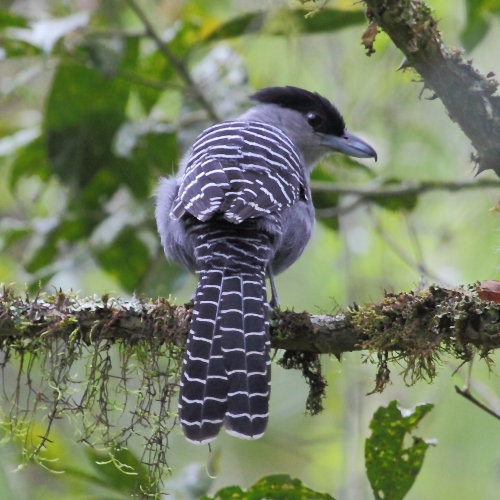
Black-bellied Antwren
Formicivora melanogaster
Order: Passeriformes / Family: Thamnophilidae

Wikimedia Commons
About the Black-bellied Antwren
The Black-bellied Antwren, scientifically known as Formicivora melanogaster, is an intriguing member of the Thamnophilidae family that captivates birdwatchers with its striking appearance and distinctive behaviors. This small passerine bird is primarily found in the dense, humid forests of South America's eastern regions, notably in Brazil's Atlantic Forest biome. These forests are among the most biodiverse and endangered ecosystems globally, making the antwren's habitat crucial for its survival. The Black-bellied Antwren plays an essential role in maintaining the ecological balance of its environment, often acting as an agent of seed dispersal and insect population control, which contributes to the forest's health and regeneration.
This species is of particular interest to ornithologists due to its specialized feeding habits and interactions with other avian species. The Black-bellied Antwren primarily consumes insects, which it skillfully extracts from the foliage and bark, contributing to the regulation of forest insect populations. During the breeding season, which coincides with the rainy months, the male's song becomes a more frequent and complex melody, serving both to attract a mate and to establish territorial boundaries.
The ecological significance of the Black-bellied Antwren extends beyond its immediate habitat. As a forest-dependent species, its presence indicates a healthy ecosystem, and its absence can suggest environmental degradation. Conservationists monitor populations of the Black-bellied Antwren closely, as changes in their numbers can reflect broader environmental trends. This bird's adaptability to different forest layers makes it an important species for studying the impacts of deforestation and climate change on avian communities. Seasonal movements within their range are minimal, but slight shifts may occur in response to food availability and breeding needs.
The Black-bellied Antwren belongs to the family Thamnophilidae, within the order Passeriformes. These birds typically live average 3-5 years, with a maximum recorded of 8 years..
How to Identify a Black-bellied Antwren
Identifying the Black-bellied Antwren involves recognizing its distinct plumage and structure. Adult males are particularly striking with their black underparts, contrasting sharply with their gray upperparts. The females present a more subdued appearance, with brownish upperparts and paler underparts, which provides them with better camouflage in their forested environments. Juveniles resemble the female but are generally duller and lack the crispness of adult plumage.
While observing in the field, one might confuse the Black-bellied Antwren with similar sympatric species such as the Serra Antwren, but the latter exhibits browner tones and lacks the distinct black belly. When perched, the Black-bellied Antwren adopts an upright posture, often flicking its wings and tail, a behavior that can aid in its identification.
In flight, the Black-bellied Antwren's silhouette is small and compact, with rapid wingbeats that are typical of forest-dwelling passerines. Their flight is not sustained over long distances, as they prefer short, flitting movements from branch to branch within the canopy.
Having trouble telling birds apart? Upload a photo to our bird identification tool for an instant species match.
Black-bellied Antwren Habitat and Range
Preferred Habitat
The Black-bellied Antwren thrives in the humid, subtropical forests of eastern South America, particularly within the Atlantic Forest of Brazil, ranging into northern Argentina and Paraguay. This bird primarily inhabits the midstory and understory layers of mature forests, where dense foliage provides ample foraging opportunities and protection from predators.
Though predominantly found in old-growth forests, the Black-bellied Antwren can also adapt to secondary growth areas, provided these offer sufficient cover and food resources. They show a preference for regions with high humidity and dense vegetation, avoiding open areas and heavily disturbed landscapes.
Seasonal shifts in habitat are minimal, as the Black-bellied Antwren is largely sedentary. However, they may move to areas with increased insect activity during certain times of the year to exploit food abundance. Urban areas are generally unsuitable for this species, as they lack the complex forest structure required for their survival.
Geographic Range
The range of the Black-bellied Antwren is primarily concentrated in southeastern Brazil, extending into parts of northeastern Argentina and eastern Paraguay. Within Brazil, it is most commonly found in the states of Espírito Santo, Rio de Janeiro, São Paulo, and Minas Gerais. These regions represent the core of the Atlantic Forest, a biodiversity hotspot that provides the necessary habitat for this species.
The Black-bellied Antwren is not migratory, remaining within its established range year-round. This sedentary nature underscores the importance of conserving its habitat, as any habitat loss could have significant impacts on local populations. Population density is generally higher in areas with well-preserved forest tracts, such as national parks and protected reserves.
While the overall range is relatively restricted compared to some other Neotropical birds, the Black-bellied Antwren's presence can be relatively common within suitable habitats. However, habitat fragmentation continues to pose a threat, potentially leading to isolated populations that are more vulnerable to extinction pressures.
Want to know which birds visit your area? Browse our backyard birds by location guides for region-specific species lists.
What Does the Black-bellied Antwren Eat?
The diet of the Black-bellied Antwren is predominantly insectivorous, with a strong emphasis on ants, beetles, and other small arthropods. Their foraging technique involves gleaning insects from leaves, twigs, and bark, often engaging in acrobatic maneuvers to reach hidden prey. This behavior requires a high level of agility and precision, characteristics that are well-developed in antwrens.
Seasonal changes in diet are primarily linked to the availability of prey. During the rainy season, when insects are more abundant, the Black-bellied Antwren increases its feeding activity, capitalizing on the plentiful food supply to meet the higher energy demands of breeding and chick rearing.
While insects constitute the bulk of their diet, Black-bellied Antwrens occasionally consume small fruits and seeds, particularly when insect availability declines. This opportunistic feeding strategy helps them to survive periods of scarcity, and may also play a role in seed dispersal within the forest ecosystem.
Black-bellied Antwren Behavior and Social Structure
The Black-bellied Antwren exhibits intriguing social and territorial behaviors that are of interest to both birdwatchers and researchers. Typically seen in pairs or small family groups, these birds maintain tight-knit social structures, particularly during the breeding season. Males are highly territorial and will vigorously defend their territory against intruding conspecifics, using both vocalizations and physical displays to assert dominance.
Courtship displays involve elaborate rituals, with the male performing a series of wing and tail movements accompanied by vocalizations to attract the female's attention. Once paired, the bond between mates often lasts throughout the breeding season, with both partners participating in nest building and chick rearing.
While generally sedentary, the Black-bellied Antwren exhibits increased activity during the early morning and late afternoon, times when foraging conditions are optimal. They are less active during the hottest parts of the day, often retreating to shaded areas to conserve energy. In the presence of predators, such as hawks or snakes, these antwrens rely on their cryptic plumage and quick movements to evade detection.
Black-bellied Antwren Nesting and Reproduction
The nesting habits of the Black-bellied Antwren reveal a keen attention to detail and an adept use of forest resources. Nests are typically built by both members of the pair and are usually placed low in shrubs or saplings, well hidden among foliage. The nest itself is cup-shaped, constructed from fine plant fibers, moss, and leaves, providing both camouflage and insulation.
A typical clutch consists of two to three eggs, which are incubated primarily by the female, although the male may assist during feeding breaks. The incubation period lasts about 14-16 days. Once hatched, the chicks are altricial, requiring substantial parental care. Both parents actively participate in feeding and protecting the young, bringing them a diet rich in insects to ensure rapid growth.
Fledging occurs approximately 12-14 days after hatching, though young birds may remain dependent on their parents for several weeks post-fledging. The Black-bellied Antwren typically raises one to two broods per year, depending on environmental conditions and food availability.
Black-bellied Antwren Sounds and Vocalizations
The vocalizations of the Black-bellied Antwren are a key feature for identification in the dense forests where it resides. The primary song is a series of clear, sharp notes delivered in rapid succession, often described as a 'pitz-pitz-pitz' sound, increasing in tempo. This song serves both to establish territory and attract mates, particularly prominent during the breeding season.
In addition to the primary song, the Black-bellied Antwren emits a variety of call notes and alarm calls. These calls are generally softer and less distinct than the song, often used in communication between mates or to signal the presence of predators. During the dawn and dusk periods, their vocal activity peaks, contributing to the rich acoustic tapestry of the forest.
Although not as melodious as some other songbirds, the Black-bellied Antwren's vocalizations are distinctive and play a crucial role in social interactions and territory maintenance.
Interesting Facts About the Black-bellied Antwren
- 1The Black-bellied Antwren is known to participate in mixed-species foraging flocks, enhancing its foraging efficiency.
- 2Despite their small size, Black-bellied Antwrens exhibit fierce territorial behavior, often engaging in vocal duels with rivals.
- 3The Atlantic Forest, home to the Black-bellied Antwren, harbors over 20,000 plant species, many of which are endemic.
- 4The Black-bellied Antwren's nest is often lined with spider silk, which provides strength and elasticity to the structure.
- 5These antwrens are adept at maneuvering through dense vegetation, using their short, rounded wings for agile flight.
- 6Black-bellied Antwrens can be found at elevations ranging from sea level up to 1,000 meters, depending on forest density.
- 7The species' scientific name, Formicivora melanogaster, reflects its ant-eating habits and distinctive black belly.
Black-bellied Antwren Conservation Status
The IUCN currently lists the Black-bellied Antwren as Least Concern, but its population trends indicate potential threats due to habitat loss. Deforestation in the Atlantic Forest, driven by agricultural expansion and urban development, remains the primary threat to this species. Consequently, habitat fragmentation may lead to isolated populations, increasing the risk of local extinctions. Conservation efforts focus on habitat preservation and restoration. Establishing protected areas and forest corridors can help maintain the connectivity of antwren populations. Moreover, raising awareness of the ecological importance of the Atlantic Forest ecosystem is crucial for garnering support for conservation initiatives. Historically, the Black-bellied Antwren's population has remained relatively stable in undisturbed areas, but ongoing habitat degradation presents significant challenges for the future. Continued monitoring and targeted conservation actions are essential to ensure the long-term survival of this vibrant forest dweller.