Black-capped Antwren
Herpsilochmus atricapillus
Order: Passeriformes / Family: Thamnophilidae

Wikimedia Commons
About the Black-capped Antwren
The Black-capped Antwren (Herpsilochmus atricapillus) is a small but notable member of the Thamnophilidae family, dwelling primarily in the tropical and subtropical forests of South America. Found predominantly in the Atlantic Forest biome of Brazil, this species extends its range into parts of northern Argentina and eastern Paraguay. The antwren thrives in dense forest undergrowth, where it plays a crucial role in the ecosystem by controlling insect populations. Despite its diminutive size, typically measuring around 11 cm in length, the Black-capped Antwren is a vigorous forager, navigating the dense foliage with agility. This bird is an essential component of its habitat, contributing to the ecological balance through its predation on insects. In terms of seasonal behavior, the Black-capped Antwren remains largely sedentary, with no significant migration patterns, although some local movements may occur based on food availability and habitat conditions. Its presence is a reliable indicator of forest health, as it tends to inhabit areas with high biodiversity and structural complexity. The bird's preference for undisturbed forest environments highlights its sensitivity to habitat degradation, making it a species of interest in conservation efforts aimed at preserving tropical forest ecosystems. Throughout the year, the Black-capped Antwren engages in active vocalization, which serves both territorial and mating purposes. These vocalizations are most pronounced during the breeding season, usually coinciding with the onset of the rainy season in its range, when insect activity is at its peak, providing ample food resources for rearing young. The Black-capped Antwren's role in its ecosystem underscores the interconnectedness of forest species and the importance of conserving their habitats.
The Black-capped Antwren belongs to the family Thamnophilidae, within the order Passeriformes. These birds typically live typically 3-5 years, with some individuals living up to 7 years..
How to Identify a Black-capped Antwren
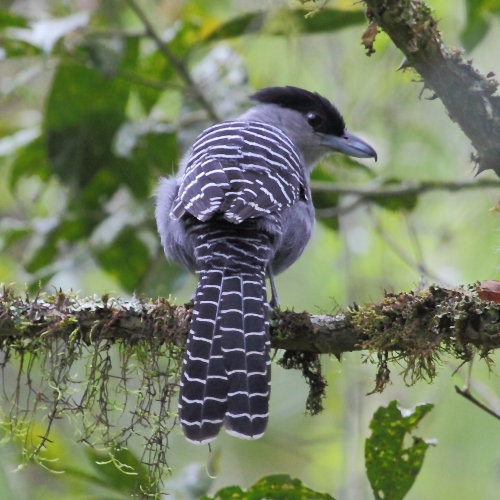
Identifying the Black-capped Antwren involves noting its characteristic black cap, contrasting sharply with its white underparts and grayish back. Males and females exhibit sexual dimorphism, with males displaying a more pronounced black cap and females having a slightly duller appearance. Juveniles resemble adults but have less defined plumage. The wings feature subtle white edging, which can be a useful field mark when the bird is in flight. Compared to similar species, the Black-capped Antwren's consistent head pattern and vocal behavior help distinguish it. When perched, the bird often adopts a horizontal posture, aiding in camouflage among branches. The flight of the Black-capped Antwren is typically short and direct, reflecting its preference for dense, cluttered habitats where agility is paramount. In the field, observers should look for the bird's quick, darting movements through underbrush and listen for its distinctive calls, which often precede a sighting.
Having trouble telling birds apart? Upload a photo to our bird identification tool for an instant species match.
Black-capped Antwren Habitat and Range
Preferred Habitat
The Black-capped Antwren inhabits primary and secondary tropical forests, showing a strong preference for dense undergrowth and forest edges. It thrives at elevations ranging from sea level up to 1200 meters, finding refuge in subtropical moist lowland forests and occasionally venturing into more open areas with sufficient cover. This species is absent from urban environments, favoring undisturbed or minimally disturbed habitats that provide abundant insect prey. During the rainy season, antwrens may adjust their habitat use slightly, moving closer to wetter areas where prey is more plentiful. Although primarily a forest-dweller, the Black-capped Antwren is adaptable within these ecosystems, taking advantage of a variety of microhabitats.
Geographic Range
The Black-capped Antwren's range is concentrated in the Atlantic Forest of eastern Brazil, extending into northern Argentina and eastern Paraguay. This region, known for its high biodiversity, supports a significant population of these birds. The antwren does not undertake long-distance migrations, but local movements can occur, particularly in response to food availability and environmental conditions. Within its range, the bird is most abundant in well-preserved forest areas, where it can exploit the rich insect fauna. Population density hotspots are found in regions like the Serra do Mar in Brazil, where extensive tracts of suitable habitat remain. Its presence across these countries makes it a species of interest for transnational conservation initiatives focused on the preservation of the Atlantic Forest.
Want to know which birds visit your area? Browse our backyard birds by location guides for region-specific species lists.
What Does the Black-capped Antwren Eat?
The diet of the Black-capped Antwren consists primarily of insects and other arthropods, which it gleans from leaves and twigs in the forest understorey. This bird employs a variety of foraging techniques, including gleaning and hover-gleaning, to capture prey. Seasonal variations in diet are minimal, but the abundance of insects during the rainy season provides ample feeding opportunities. The antwren typically feeds alone or in pairs, occasionally joining mixed-species flocks, which can enhance foraging efficiency. Prey size ranges from small ants to larger beetles and caterpillars, showcasing the bird's ability to exploit a wide range of insect life. Feeding occurs throughout the day, with peaks during the early morning and late afternoon when insect activity is highest.
Black-capped Antwren Behavior and Social Structure
The Black-capped Antwren displays a solitary or pair-based social structure, often staying within well-defined territories. Territorial behavior includes frequent vocalizations to assert presence and deter rivals. During the breeding season, males may engage in courtship displays involving song and wing-fluttering. Flocking behavior is generally limited to participation in mixed-species flocks, which provide protection and increased foraging opportunities. In response to predators, the antwren employs rapid, evasive movements and seeks cover in dense foliage. Daily activity patterns involve active foraging interspersed with periods of rest in sheltered areas. Vocal communication is a key aspect of its behavior, supporting both territorial defense and mating.
Black-capped Antwren Nesting and Reproduction
The Black-capped Antwren constructs cup-shaped nests using plant fibers and moss, typically positioned low in trees or shrubs to remain concealed from predators. Preferred nesting sites are within dense thickets, providing shelter and security. Clutch size ranges from two to three eggs, with both parents involved in incubation, which lasts about 15 days. After hatching, the young fledge in approximately 12-14 days, during which time they are intensively fed by both parents. The typical breeding season aligns with the rainy season, optimizing food availability for the demanding tasks of rearing young. The species usually raises one brood per year, although favorable conditions may lead to attempts at a second.
Black-capped Antwren Sounds and Vocalizations
The Black-capped Antwren's song is a series of rapid, high-pitched notes, often described as a 'tsee-tsee-tsee' sequence. This song serves both territorial and mate-attracting functions. The bird also produces distinct call notes, including sharp 'chip' sounds used in communication with a mate or as an alarm signal. Alarm calls are more abrupt and often repeated in quick succession when a threat is perceived. During the dawn chorus, the Black-capped Antwren's vocalizations can be heard prominently, adding to the vibrant acoustic landscape of the forest. The bird's vocal repertoire is a key identification tool for birders, especially in dense habitats where visual detection is challenging.
Interesting Facts About the Black-capped Antwren
- 1The Black-capped Antwren's distinctive song can be heard up to 100 meters away in dense forest.
- 2Despite being small, this antwren plays a crucial role in controlling insect populations in its habitat.
- 3The species' preferred dense forest habitats are among the most biodiverse ecosystems on Earth.
- 4Black-capped Antwrens are often observed joining mixed-species flocks, enhancing their foraging success.
- 5Their nests, expertly camouflaged in foliage, are rarely detected by predators.
- 6Territorial pairs of Black-capped Antwrens engage in frequent vocal duets, strengthening pair bonds.
- 7The antwren's adaptability within its habitat allows it to exploit various microenvironments.
Black-capped Antwren Conservation Status
The Black-capped Antwren is currently listed as Least Concern by the IUCN, with stable population trends overall. However, habitat loss due to deforestation poses a significant threat. Conservation efforts focus on preserving the Atlantic Forest, which is critical to the species' long-term survival. Reforestation projects and protected area expansions are essential strategies in maintaining healthy populations. Historical population changes have largely mirrored the extent of forest cover, underscoring the importance of habitat preservation. Continued monitoring and habitat protection are vital to ensure the Black-capped Antwren remains a vibrant part of its ecosystem.