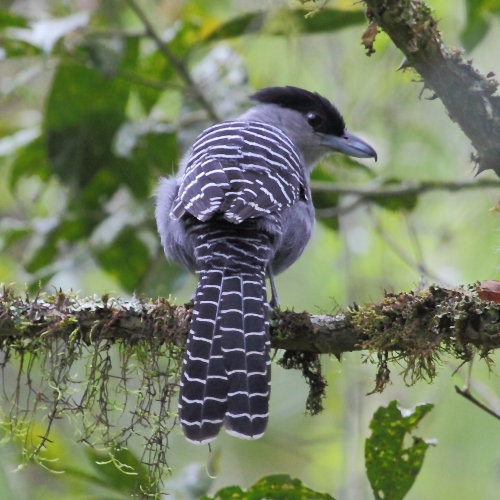
Black-chinned Antbird
Hypocnemoides melanopogon
Order: Passeriformes / Family: Thamnophilidae

Wikimedia Commons
About the Black-chinned Antbird
The Black-chinned Antbird (Hypocnemoides melanopogon) is a small, elusive bird from the Thamnophilidae family, known for its presence in the subtropical and tropical regions of South America. This bird is primarily found in the dense undergrowth of humid lowland forests and swampy areas, particularly along riverbanks and flooded forest floors. It is a year-round resident of countries such as Brazil, Venezuela, Colombia, and Peru.
The ecological role of the Black-chinned Antbird is significant in the understory of these forests, as it participates in controlling insect populations. By feeding on a variety of insects, it helps maintain the balance of the ecosystem. This bird is often observed foraging in mixed-species flocks, enhancing its feeding efficiency and reducing predation risks.
Seasonal behaviors of the Black-chinned Antbird include slight shifts in habitat preference, often moving to higher ground during the rainy season to avoid flooding. During the breeding season, which aligns with the wettest months in its range, the male becomes more vocal and territorial, defending its breeding area with repeated calls. This seasonal change in behavior highlights the bird's adaptability to its environment's cyclical nature.
The Black-chinned Antbird's presence in these rich biodiverse areas underscores its importance as an indicator species for the health of tropical forest ecosystems. Conservationists pay close attention to its population trends as a measure of habitat integrity and the overall impact of deforestation in its range.
The Black-chinned Antbird belongs to the family Thamnophilidae, within the order Passeriformes. These birds typically live average 4-5 years with a max recorded of 7 years..
How to Identify a Black-chinned Antbird
The adult Black-chinned Antbird is easily identified by its slate-gray upperparts and a distinctive black chin and throat, which contrast sharply with its white belly. The wings are dark with lighter edged feathers, creating a subtle pattern that aids in camouflage within the dense foliage. The eyes are dark, contributing to its stealthy appearance.
Juvenile Black-chinned Antbirds resemble adults but lack the pronounced black chin, instead displaying a more muted gray in the throat area. The sexual dimorphism in this species is not pronounced, with males and females appearing similar in plumage.
In terms of confusion with similar species, the Black-chinned Antbird can be distinguished from the similar-looking White-flanked Antbird by its lack of white flanks and the more pronounced black throat patch. When observing its flight silhouette, note its short, rounded wings and a slight tail flicking motion, a common trait among antbirds, which contributes to its low, undulating flight pattern.
When perched, the Black-chinned Antbird maintains a horizontal posture, often seen clinging to vertical stems or moving among thick vegetation. Its movements are deliberate and methodical, as it frequently pauses to scan for prey or listen for movement.
Having trouble telling birds apart? Upload a photo to our bird identification tool for an instant species match.
Black-chinned Antbird Habitat and Range
Preferred Habitat
The Black-chinned Antbird inhabits the subtropical and tropical moist lowland forests of the Amazon Basin. It thrives in areas with dense understory vegetation, often near water sources such as streams or swampy areas. This bird favors elevations typically ranging from sea level up to about 500 meters, although it rarely ventures into more elevated regions.
During the rainy season, when riverbanks swell and forest floors may flood, the Black-chinned Antbird may shift slightly to higher ground or areas with less water coverage. Its preference for dense and humid forest environments means it is seldom found in urban or heavily disturbed areas.
Unlike some adaptable species that can thrive in urban settings, the Black-chinned Antbird's requirement for thick vegetation and a specific moisture regime confines it to more pristine forested landscapes. This specialization makes it a key species for monitoring the health of its native habitats.
Geographic Range
The Black-chinned Antbird is a resident of the northern and central parts of South America. Its range spans Brazil, Venezuela, Colombia, Peru, and parts of Bolivia. It does not migrate but remains within its mostly continuous range throughout the year.
Within this expansive range, the bird is particularly concentrated in the vast Amazon Basin, where the availability of dense forests and optimal humidity levels provide ideal living conditions. The bird's distribution is closely tied to the presence of lowland rainforest and swampy areas, where it finds the understory habitat it requires.
Population density hotspots for the Black-chinned Antbird are found in the Brazilian states of Amazonas and Pará, where forest conditions are still largely intact. Areas along the Amazon River and its tributaries provide the most suitable environments, ensuring the bird's survival and reproduction.
While not considered migratory, local movements within its range may occur in response to seasonal changes in water levels and food availability, enabling the bird to exploit varying resources throughout the year.
Want to know which birds visit your area? Browse our backyard birds by location guides for region-specific species lists.
What Does the Black-chinned Antbird Eat?
The Black-chinned Antbird primarily feeds on insects, which it finds by foraging through the dense undergrowth of its forested habitat. Its diet consists mainly of ants, beetles, spiders, and other small arthropods. During the wet season, when insect activity is high, the antbird may also consume caterpillars and other larval forms.
Foraging occurs predominantly in the early morning and late afternoon, when insect activity is most pronounced. The bird employs a technique known as 'sallying', where it makes short, quick flights from a perch to capture prey in flight or glean it from foliage.
Seasonal diet changes are minimal, as the bird's tropical habitat provides a relatively constant supply of insects year-round. However, in periods of heavy rain, the bird may focus more on terrestrial insects flushed out by the increased moisture.
The Black-chinned Antbird's foraging strategy involves moving slowly and methodically through the understory, scanning leaves and branches for signs of prey. This behavior not only allows it to catch prey efficiently but also minimizes its exposure to predators.
Black-chinned Antbird Behavior and Social Structure
The Black-chinned Antbird is known for its solitary or paired lifestyle, often seen foraging alone or as a mated pair. During the breeding season, males become particularly territorial, using vocalizations to delineate their territory and ward off rivals.
Courtship displays are subtle, involving mutual feeding and close following between pairs. These displays strengthen pair bonds and ensure coordinated efforts in raising young. Unlike some antbird species, the Black-chinned Antbird does not form large flocks but may join mixed-species foraging groups, especially outside the breeding season.
Response to predators involves a combination of stealth and retreat. When threatened, the Black-chinned Antbird often freezes, relying on its cryptic plumage to blend into the background. If necessary, it will retreat to denser cover with quick, low flights.
Daily activity patterns revolve around foraging and territory defense. The bird is most active during the cooler hours of the morning and late afternoon, resting during the heat of midday. Its consistent vocal activity during these periods serves both to communicate with mates and deter potential intruders.
Black-chinned Antbird Nesting and Reproduction
Black-chinned Antbirds construct cup-shaped nests, intricately woven from plant fibers, leaves, and spider silk. These nests are typically placed low in the understory, often suspended from a branch or hidden among dense foliage to conceal them from predators.
The typical clutch size ranges from two to three eggs, with both parents sharing incubation duties. The incubation period lasts about 14 to 16 days, during which the parents take turns keeping the eggs warm and protected.
After hatching, the young Black-chinned Antbirds remain in the nest for approximately 10 to 12 days before fledging. During this time, both parents are actively involved in feeding the chicks, bringing them a steady diet of insects to ensure rapid growth.
Parental roles are shared, with both the male and female participating in feeding and protecting the young. The species typically raises one or two broods per year, depending on environmental conditions and food availability. This focus on biparental care enhances the survival rate of the offspring, contributing to the stability of the population.
Black-chinned Antbird Sounds and Vocalizations
The Black-chinned Antbird's primary song is a series of clear, whistled notes that rise and fall in pitch, often described as 'peee-chew-peee-chew'. This song serves both as a territorial marker and a mating call, particularly active during the breeding season.
In addition to its song, the bird emits various call notes, such as sharp 'chip' and 'click' sounds, used in communication between mates or to alert others of potential threats. The alarm calls are more rapid and higher-pitched, indicating immediate danger.
The dawn chorus includes contributions from the Black-chinned Antbird, whose song stands out in the early morning soundscape of the forest. Compared to other antbirds, its song is relatively simple but effective in carrying through the dense vegetation.
These vocalizations are essential for maintaining social bonds and defending territories, especially in the visually obscured environments where this species dwells.
Interesting Facts About the Black-chinned Antbird
- 1The Black-chinned Antbird measures about 12.5 to 14 cm in length, making it a small yet agile forest dweller.
- 2Despite its name, the Black-chinned Antbird does not rely solely on ants for food but has a varied insectivorous diet.
- 3This species is known for its ability to thrive in the dense undergrowth, where it moves adeptly among tangled vines and branches.
- 4The Black-chinned Antbird's call plays a crucial role in its communication, often heard before the bird is actually seen.
- 5In mixed-species flocks, the Black-chinned Antbird benefits from increased foraging success and reduced predation risk.
- 6The cup-shaped nests of the Black-chinned Antbird are remarkably well-camouflaged, blending seamlessly with the surrounding foliage.
- 7While primarily a forest bird, the Black-chinned Antbird occasionally ventures into swampy areas, showcasing its adaptability.
Black-chinned Antbird Conservation Status
The Black-chinned Antbird is currently listed as Least Concern by the IUCN, with stable population trends across its range. However, habitat destruction due to deforestation poses a significant threat, as these birds rely heavily on intact forest ecosystems. Conservation efforts focus on preserving large tracts of rainforest and encouraging sustainable land management practices. Protected areas within the Amazon Basin serve as crucial refuges for the species, helping mitigate the impacts of habitat loss. Historically, the Black-chinned Antbird has maintained relatively stable populations, benefiting from the extensive forest cover of its range. Continued monitoring and habitat conservation are essential to ensure its long-term survival in the face of ongoing environmental pressures.