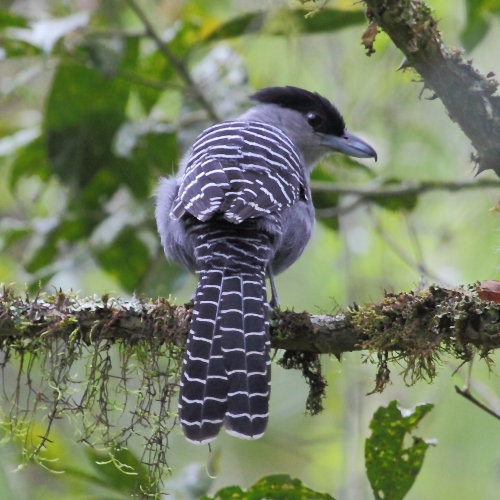
Black-crested Antshrike
Sakesphorus canadensis
Order: Passeriformes / Family: Thamnophilidae

Wikimedia Commons
About the Black-crested Antshrike
The Black-crested Antshrike, Sakesphorus canadensis, is a captivating bird found predominantly in the tropical and subtropical regions of South America. This bird is a member of the Thamnophilidae family, which includes various antbird species known for their specialized foraging behaviors. The Black-crested Antshrike boasts a uniquely contrasting appearance with its black crest, which provides a striking visual against its otherwise barred plumage. This species thrives in dense undergrowth and forest edges, where its behaviors and song play integral roles in the surrounding ecosystem. The presence of the Black-crested Antshrike in these habitats is vital for controlling insect populations, as the bird consumes a variety of arthropods that would otherwise proliferate unchecked. Geographically, this species inhabits a range that extends from the lowland forests of Venezuela and the Guianas to the riverine woods of Brazil, often favoring areas that offer a mix of open and densely vegetated terrains. Its habitats include the lush Amazonian rainforests, where it remains active throughout the year. The Black-crested Antshrike is not migratory, maintaining a consistent range year-round. During the breeding season, typically coinciding with the rainy months, the bird exhibits heightened territoriality and vocal activity. Males can often be heard delivering their distinctive calls, which serve both to attract mates and to assert dominance over their established territories. In these tropical environments, the Black-crested Antshrike plays a crucial ecological role, not only as a predator of insects but also as an indicator of forest health. Its ability to thrive in secondary growth areas highlights its adaptability, although primary forests remain its preferred habitat. The bird's presence often signals a well-balanced ecosystem, as it requires a variety of microhabitats to flourish.
The Black-crested Antshrike belongs to the family Thamnophilidae, within the order Passeriformes. These birds typically live average 6-8 years, with a maximum recorded of 10 years..
How to Identify a Black-crested Antshrike
Identifying the Black-crested Antshrike in the field requires close attention to its distinct physical features. Adult males are particularly notable for their bold black crest, which stands out against a backdrop of barred black and white body plumage. Females, while similar in size, display a more subdued coloration with a mix of brownish tones interspersed with bars, lacking the prominent black crest of males. Juveniles resemble females but are typically duller, with less defined barring. When perched, the Black-crested Antshrike typically adopts an upright stance, often flicking its tail in a characteristic manner. In flight, its silhouette is fairly compact, with rounded wings that allow for agile movements through dense foliage. It can be confused with similar species, such as the Barred Antshrike, but the Black-crested Antshrike's distinctive black crest and sharper contrast in plumage aid in distinguishing it. Observers should note the bird's behavior as well, as its methodical foraging patterns and habitat preferences can provide additional identification clues.
Having trouble telling birds apart? Upload a photo to our bird identification tool for an instant species match.
Black-crested Antshrike Habitat and Range
Preferred Habitat
The Black-crested Antshrike primarily inhabits tropical and subtropical forests, thriving in areas with dense undergrowth and forest edges. It can be found at elevations ranging from sea level to about 1,500 meters, with a preference for lowland regions. This species often favors riverine forests and areas with secondary growth, where a variety of plant species provide ample cover for foraging and nesting. It is less commonly found in urban settings, although it may venture into gardens or parks that offer sufficient vegetation. Unlike many bird species, the Black-crested Antshrike does not undergo significant seasonal habitat shifts, maintaining a consistent presence in its preferred environments throughout the year.
Geographic Range
The Black-crested Antshrike's range encompasses a significant portion of northern South America. Its breeding and year-round territories include Venezuela, the Guianas (Guyana, Suriname, French Guiana), and northern Brazil, particularly in the Amazon Basin. The species is also present in parts of Colombia and eastern Ecuador, where it inhabits suitable forested areas. While the Black-crested Antshrike is generally considered non-migratory, it may exhibit local movements in search of optimal foraging grounds, especially during seasonal changes in insect abundance. Within its range, population density is highest in areas with a mix of primary and secondary forests, where its preferred habitats are abundant.
Want to know which birds visit your area? Browse our backyard birds by location guides for region-specific species lists.
What Does the Black-crested Antshrike Eat?
The diet of the Black-crested Antshrike primarily consists of insects and other arthropods, which it skillfully extracts from the dense vegetation of its forested habitat. This bird is an opportunistic forager, employing a methodical approach as it moves through the undergrowth, often probing leaf litter and bark for hidden prey. Its diet includes caterpillars, beetles, spiders, and occasionally small lizards or frogs. Seasonal variations in insect availability may prompt slight changes in its diet composition, but the Black-crested Antshrike remains primarily insectivorous throughout the year. It typically forages during daylight hours, with increased activity in the early morning and late afternoon when temperatures are cooler and prey is more active.
Black-crested Antshrike Behavior and Social Structure
The Black-crested Antshrike exhibits a range of intriguing behaviors that reflect its adaptability and ecological role. This species is typically monogamous, forming strong pair bonds that last through multiple breeding seasons. Males are territorial and actively defend their chosen areas through vocal displays and physical posturing. During courtship, males engage in elaborate displays, showcasing their crest and plumage to attract a mate. Although generally solitary or found in pairs, the Black-crested Antshrike may join mixed-species foraging flocks, benefiting from the collective vigilance against predators. Its response to threats involves a combination of vocal alarms and evasive maneuvers through dense foliage. Daily activity patterns are characterized by periods of intense foraging interspersed with rest, particularly during the hottest parts of the day.
Black-crested Antshrike Nesting and Reproduction
The Black-crested Antshrike constructs its nests with careful attention to both location and materials. Nests are typically built low to the ground in dense shrubbery or small trees, where they remain concealed from predators. The structure consists of twigs, leaves, and fibers, woven into a compact cup shape. Clutch size generally ranges from two to three eggs, with both parents sharing incubation duties over a period of approximately 14 to 16 days. Once hatched, the chicks are altricial, requiring constant care and feeding by both parents. Fledging occurs about 10 to 12 days after hatching, although the young may remain dependent on parental support for several weeks. The species typically raises one to two broods per year, depending on environmental conditions and food availability.
Black-crested Antshrike Sounds and Vocalizations
The vocal repertoire of the Black-crested Antshrike includes a distinctive primary song that is characterized by a series of sharp, rhythmic notes delivered at a steady pace. These songs serve both territorial and mate attraction purposes. The bird's call notes are shorter and harsher, often used in communication between mates or to signal alarm. During the dawn chorus, the Black-crested Antshrike's calls become more frequent, contributing to the symphony of forest sounds. Its vocalizations are comparable to the sound of a rapidly tapping drum, a quality that makes its presence known even when the bird itself remains hidden in dense cover.
Interesting Facts About the Black-crested Antshrike
- 1The Black-crested Antshrike's striking black crest is not only a visual display but also aids in species recognition among antbirds.
- 2Unlike many forest birds, the Black-crested Antshrike can thrive in secondary growth areas, showing adaptability to changing environments.
- 3This species is often found in mixed-species flocks, benefiting from the collective vigilance and diverse foraging opportunities.
- 4Females of the Black-crested Antshrike lack the prominent crest of males, highlighting sexual dimorphism in this species.
- 5The Black-crested Antshrike's diet includes a variety of arthropods, making it an essential player in controlling insect populations.
Black-crested Antshrike Conservation Status
The Black-crested Antshrike is currently listed as Least Concern by the IUCN, with stable population trends observed across much of its range. The primary threats to this species include habitat loss due to deforestation and land conversion for agriculture. Conservation efforts focus on preserving and restoring forest habitats, particularly in areas where deforestation is most prevalent. While the species has shown resilience by adapting to secondary growth forests, continued habitat degradation could pose future challenges. Historical population changes have been relatively minimal, but ongoing monitoring is necessary to ensure this striking bird remains a vibrant part of its ecosystem.