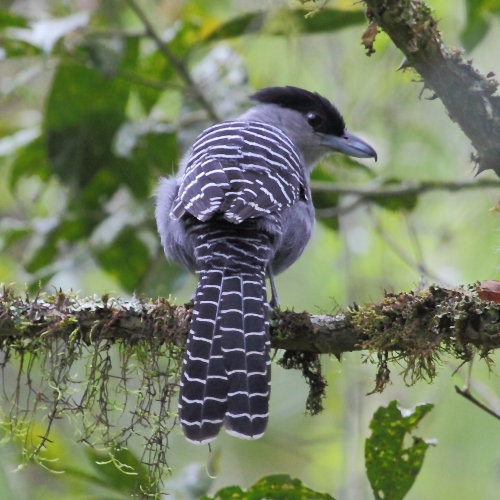
Black-hooded Antwren
Formicivora erythronotos
Order: Passeriformes / Family: Thamnophilidae

Wikimedia Commons
About the Black-hooded Antwren
The Black-hooded Antwren (Formicivora erythronotos) is a small, striking bird endemic to the Atlantic Forest of southeastern Brazil. This species is notable for its stark black-and-white coloration, which provides both camouflage and distinction among the dense foliage of its habitat. The Atlantic Forest, a biodiversity hotspot, provides a unique environment for this antwren, which contributes significantly to the region's ecological complexity. The Black-hooded Antwren plays a role in insect population control, feeding on a variety of arthropods found amidst the leaf litter and underbrush.
Occupying a limited geographic range, this bird is primarily found in the lowland forests of Rio de Janeiro and São Paulo. Conservationists regard the Black-hooded Antwren as an indicator species, whose health often reflects the overall state of its forest environment. Due to its restricted habitat and the ongoing pressures of deforestation, the antwren is classified as endangered. Its survival is closely tied to the preservation and restoration of the Atlantic Forest, making it a focal point for conservation efforts.
Seasonal behaviors of the Black-hooded Antwren are influenced by the rainy and dry seasons typical of its tropical climate. During the rainy season, when insect activity peaks, these antwrens become more active and visible as they forage extensively to meet the increased nutritional demands of breeding and raising young. In contrast, the dry season sees a slight reduction in their activity as food availability decreases. The Black-hooded Antwren is an essential part of its ecosystem, maintaining insect populations and serving as prey for larger predators, thus contributing to the intricate web of life in the Atlantic Forest.
The Black-hooded Antwren belongs to the family Thamnophilidae, within the order Passeriformes. These birds typically live typically around 3-6 years, with some living longer..
How to Identify a Black-hooded Antwren
The Black-hooded Antwren is a small passerine, measuring approximately 12 cm in length. Adult males exhibit a distinctive black hood that contrasts sharply with their white underparts and black wings. The wings are also marked with white wing bars, providing an unmistakable identification feature. Females, while sharing the same general pattern, have more subdued coloration, with grayish tones replacing the stark black on the head. Juveniles resemble females but with even paler tones, making age and sex differentiation straightforward with careful observation.
Despite its distinctive appearance, the Black-hooded Antwren can sometimes be confused with other small antwrens, such as the Unicolored Antwren (Myrmotherula unicolor), which lacks the black hood. Observers should note the bird's flight silhouette, which is rapid and low, often darting between dense vegetation. When perched, the antwren often adopts a slightly upright posture, allowing for clear views of its contrasting plumage.
Field identification is facilitated by their active nature and tendency to forage in mixed-species flocks. The bird's subtle differences in plumage and behavior from similar species require keen observation, particularly in low light conditions typical of their forest understory habitat.
Having trouble telling birds apart? Upload a photo to our bird identification tool for an instant species match.
Black-hooded Antwren Habitat and Range
Preferred Habitat
The Black-hooded Antwren is intimately tied to the Atlantic Forest, favoring dense undergrowth and secondary growth within lowland forests. Its preferred habitat includes areas with thick leaf litter, which provide ample foraging opportunities. Elevation for this species typically ranges from sea level to about 1000 meters, with a strong preference for areas that offer dense canopy cover and abundant insect life.
Though primarily a forest-dwelling species, the Black-hooded Antwren is occasionally observed in more open areas adjacent to forests, particularly when searching for food during the more demanding breeding season. Unlike many other birds, it does not frequent urban or heavily disturbed areas, instead requiring intact forest ecosystems to thrive.
Seasonal shifts in habitat are minimal, as the bird remains within forested areas year-round, relying on the stable microclimate and resources the forest provides. Its presence is a good indicator of forest health, as it avoids regions that have been heavily degraded or deforested.
Geographic Range
The Black-hooded Antwren's range is limited to southeastern Brazil, specifically within the states of Rio de Janeiro and São Paulo. It occupies a narrow geographical area in the Atlantic Forest, a biome characterized by high biodiversity and endemism. Unlike many other bird species, the Black-hooded Antwren does not undertake long migrations, instead maintaining a resident status within its range throughout the year.
Population hotspots are primarily concentrated in protected areas where forest conservation efforts provide a haven from habitat destruction. These include national parks and reserves where deforestation pressures are mitigated. While its range does not extend beyond Brazil, the Black-hooded Antwren's restricted distribution makes it particularly vulnerable to changes in land use and climate within this region.
Efforts to map its distribution are ongoing, with researchers focusing on identifying new populations and understanding the bird's habitat requirements in finer detail. The conservation of forest corridors is crucial to maintaining genetic diversity and allowing for potential range expansion.
Want to know which birds visit your area? Browse our backyard birds by location guides for region-specific species lists.
What Does the Black-hooded Antwren Eat?
The diet of the Black-hooded Antwren consists primarily of insects and other small arthropods, which it gleans from foliage and leaf litter. This insectivorous diet includes ants, beetles, spiders, and caterpillars, which it captures with rapid, precise movements. The antwren's foraging technique involves probing and flicking through leaves and twigs, a behavior that is well-suited to its dense forest habitat.
Seasonal variations in diet correspond to fluctuations in prey availability. During the rainy season, when insect populations swell, the antwren's diet becomes more diverse, allowing it to consume a broader range of prey items. Conversely, in the dry season, the antwren may focus on more abundant prey types, such as ants, to maintain its nutritional intake.
Feeding occurs primarily during the early morning and late afternoon, coinciding with peak insect activity. The Black-hooded Antwren's small size allows it to exploit microhabitats within the forest understory that are inaccessible to larger birds, ensuring its role as a crucial part of the forest's insect control team.
Black-hooded Antwren Behavior and Social Structure
The Black-hooded Antwren exhibits a range of behaviors that reflect its adaptation to life in dense, tropical forests. It is typically observed in pairs or small family groups, although it often joins mixed-species foraging flocks. This social structure provides increased foraging efficiency and protection from predators, as multiple eyes can detect threats more effectively.
Territorial behavior is pronounced, with males vigorously defending their territories against intruders. They use vocalizations and physical displays to assert dominance and maintain their space within the forest. Courtship displays involve subtle movements and vocal duets between pairs, strengthening pair bonds and coordinating breeding efforts.
Flocking behavior is particularly evident during the non-breeding season when food resources are more scattered. The antwren's response to predators involves quick, agile movements to dense cover, relying on the forest's complexity to avoid detection. Daily activity patterns show peaks during cooler parts of the day, with midday often spent resting or engaging in preening within the shade.
Black-hooded Antwren Nesting and Reproduction
Black-hooded Antwrens construct their nests close to the ground, typically within dense underbrush where they are well-concealed from predators. The nest is a small, cup-shaped structure composed of twigs, leaves, and other plant materials bound together with spider silk, providing both strength and flexibility.
The female lays a clutch of two to three eggs, which both parents incubate over approximately 15 to 17 days. During this period, both male and female share responsibilities, including feeding and protecting the young. After hatching, the nestlings remain in the nest for around 12 to 14 days, during which time both parents actively feed and care for them.
The number of broods per year can vary based on environmental conditions, but typically the Black-hooded Antwren raises one to two broods annually. Parental roles are evenly divided, ensuring that young receive adequate care and protection throughout their early development stages.
Black-hooded Antwren Sounds and Vocalizations
The primary song of the Black-hooded Antwren consists of a series of clear, whistled notes that increase in tempo and intensity. These notes are often described as a rising and falling 'peee-peee-peee', which serves to establish territory and attract mates. Call notes are shorter, sharper, and serve as communication between mates or signals of alarm.
Alarm calls are harsher and more rapid, designed to alert conspecifics to the presence of predators. During the dawn chorus, the Black-hooded Antwren's song stands out due to its clarity and rhythm, often being one of the first to be heard as the forest awakens.
Comparatively, the song lacks the melodious quality found in some other passerines, instead providing a more utilitarian function focused on communication within the dense forest environment.
Interesting Facts About the Black-hooded Antwren
- 1The Black-hooded Antwren was first described in 1835 and remains one of Brazil's most enigmatic bird species due to its limited range.
- 2Despite its small size, the Black-hooded Antwren has a surprisingly loud song that can carry over considerable distances in the forest.
- 3Black-hooded Antwrens are known to join mixed-species flocks, which can include up to 30 different bird species at a time.
- 4Their preferred foraging height is usually below two meters, making them adept at navigating the forest understory.
- 5Both male and female Black-hooded Antwrens participate equally in nest building and chick rearing.
- 6The Atlantic Forest, home to the Black-hooded Antwren, is one of the world's most endangered biomes, with only 15% of its original cover remaining.
- 7The Black-hooded Antwren’s striking plumage provides excellent camouflage in the dappled light of its forest home.
Black-hooded Antwren Conservation Status
The Black-hooded Antwren is classified as endangered by the IUCN, with its population trend currently decreasing. Habitat loss due to deforestation and land conversion for agriculture poses the primary threat to its survival. Conservation efforts focus on habitat protection and restoration, particularly in the Atlantic Forest's remaining fragments. Historical population declines correlate with increased deforestation rates in southeastern Brazil, emphasizing the need for effective conservation strategies. Protective measures include the establishment of reserves and national parks, as well as community-driven reforestation projects aimed at reconnecting fragmented habitats. Public awareness campaigns and scientific research are vital components of ongoing conservation efforts, aimed at ensuring the long-term survival of the Black-hooded Antwren and the rich biodiversity of the Atlantic Forest.