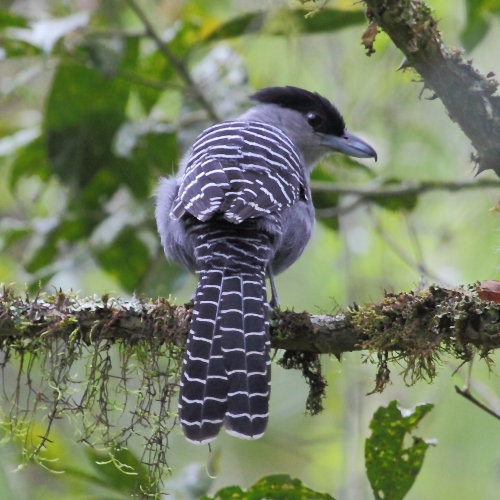
Black-tailed Antbird
Myrmoborus melanurus
Order: Passeriformes / Family: Thamnophilidae

Wikimedia Commons
About the Black-tailed Antbird
The Black-tailed Antbird, Myrmoborus melanurus, is a small but charismatic member of the Thamnophilidae family, thriving in the dense undergrowth of South America's tropical forests. This species is primarily located in the western Amazon Basin, encompassing regions of Peru, Ecuador, Colombia, and northern Brazil. It plays a crucial role in the ecosystem as both a predator of insects and a prey species for larger predators. The antbird's ecological significance is underscored by its role in controlling insect populations, particularly ants and their allies, which it pursues with great agility in the forest understory. Black-tailed Antbirds exhibit a seasonal pattern of activity that coincides with the region's rainy and dry seasons. During the rainy season, which generally spans from November to March, the birds are more vocal and active, engaging in breeding behaviors and territory establishment. The dry season sees a slight reduction in vocalizations, as the birds focus on feeding and maintaining territories. The Black-tailed Antbird's presence is a strong indicator of healthy tropical ecosystems, as it requires specific habitat conditions to thrive. The preservation of its habitat is essential not only for the antbird but also for the myriad of species that share its environment. Researchers and conservationists often use the presence and abundance of this bird as a metric for the overall health of the forest ecosystem. As a species closely tied to the intricate web of life in the Amazon, the Black-tailed Antbird's fate is intertwined with the conservation efforts aimed at preserving these critical habitats.
The Black-tailed Antbird belongs to the family Thamnophilidae, within the order Passeriformes. These birds typically live average 4-5 years, with a maximum recorded of 8 years..
How to Identify a Black-tailed Antbird
The Black-tailed Antbird is a small bird, averaging 14 cm in length. It is easily recognized by its predominantly slate-gray plumage, which contrasts sharply with its black tail and wings. Males and females display subtle sexual dimorphism. Males exhibit a darker, more uniform slate coloration, while females have a slightly browner tone on their back and wings. Juveniles resemble the females but with a more pronounced brown wash across their plumage. These birds have a characteristic upright perching posture that accentuates their elongated tail feathers. In flight, the Black-tailed Antbird reveals its broad, rounded wings, which allow for agile maneuvering through dense foliage. Similar species, such as the White-lined Antbird, may cause confusion in identification; however, the Black-tailed Antbird can be distinguished by its lack of white markings on the wings and its distinctive tail pattern. Observers should note the bird's habit of flicking its tail upwards, a behavior that helps in distinguishing it from other antbird species.
Having trouble telling birds apart? Upload a photo to our bird identification tool for an instant species match.
Black-tailed Antbird Habitat and Range
Preferred Habitat
The Black-tailed Antbird thrives in the humid forests of the Amazon Basin, favoring the dense understory of lowland tropical rainforests. Typically found at elevations below 1000 meters, it prefers areas with thick vegetation that provide ample cover and foraging opportunities. While it predominantly inhabits undisturbed forest environments, it can occasionally be found in secondary growth or forest edges, provided these areas maintain sufficient understory density. Unlike some bird species that venture into urban or suburban environments, the Black-tailed Antbird remains steadfastly tied to its natural forest habitat, relying on its complex structure for both feeding and breeding.
Geographic Range
The range of the Black-tailed Antbird is confined to the western Amazon Basin. It is primarily found in the countries of Peru, Ecuador, Colombia, and northern Brazil. Within these regions, the bird occupies a relatively narrow ecological niche, preferring the lowland rainforests that characterize this part of the continent. The species does not undertake long migrations, instead maintaining a year-round presence within its established territories. Population densities vary across its range, with higher concentrations observed in areas of pristine forest where human impact is minimal. Despite its restricted range, the Black-tailed Antbird remains a common sight in suitable habitats, where it can be heard calling persistently throughout the day.
Want to know which birds visit your area? Browse our backyard birds by location guides for region-specific species lists.
What Does the Black-tailed Antbird Eat?
The Black-tailed Antbird's diet primarily consists of insects, with a particular emphasis on ants, beetles, and other small arthropods. This diet makes it an integral part of the forest ecosystem, controlling insect populations and balancing the food web. The bird employs a specialized foraging technique known as 'gleaning,' where it picks prey off leaves and branches while hopping through the understory. During the rainy season, when insect abundance peaks, the Black-tailed Antbird becomes even more active, expanding its diet to include larger prey items like small spiders and caterpillars. Feeding occurs throughout the day, with peaks in activity during the cooler morning and late afternoon hours.
Black-tailed Antbird Behavior and Social Structure
The Black-tailed Antbird is a territorial species, often seen in pairs or small family groups. It exhibits strong site fidelity, with established pairs defending their territory year-round. Territorial disputes with neighboring antbirds are common, often resolved through vocal displays and occasional physical confrontations. Courtship involves a series of complex vocalizations and displays by the male, who fluffs his plumage and fans his tail to attract a mate. Once paired, the birds remain monogamous throughout the breeding season. The species is known for its responsiveness to predators, using alarm calls to warn others of approaching danger. Daily activity patterns include periods of foraging and resting, with increased vocalization during the early morning and late afternoon.
Black-tailed Antbird Nesting and Reproduction
The Black-tailed Antbird constructs its nest in the dense understory, often choosing sites near the ground in thickly vegetated areas. The nest itself is a simple cup structure, woven from leaves, vines, and grass, providing camouflage in its leafy surroundings. A typical clutch consists of two eggs, which both parents incubate over a period of 14-16 days. After hatching, the young remain in the nest for approximately 12-14 days, during which both parents participate in feeding and caring for the chicks. The species typically produces one to two broods per year, depending on environmental conditions and food availability.
Black-tailed Antbird Sounds and Vocalizations
The Black-tailed Antbird's primary song is a series of sharp, rhythmic notes that increase in tempo and pitch, creating a trilling effect. These vocalizations serve both to establish territory and to attract a mate. The bird also uses a variety of call notes, including short chips and whistles, to communicate with its mate and offspring. Alarm calls are harsher and more abrupt, designed to alert others to potential threats. During the dawn chorus, the Black-tailed Antbird's song is particularly pronounced, as it competes with the cacophony of other forest birds.
Interesting Facts About the Black-tailed Antbird
- 1The Black-tailed Antbird is known to follow swarms of army ants, capturing insects that flee the ant onslaught.
- 2Despite its name, the Black-tailed Antbird spends most of its time in the dense understory rather than near the ground.
- 3During courtship, the male Black-tailed Antbird performs a unique display, fluffing its plumage and fanning its tail.
- 4The species' vocalizations include a complex series of trills, which are used for both communication and territory defense.
- 5The Black-tailed Antbird's nest is often so well camouflaged that it is nearly impossible to spot without careful observation.
- 6This antbird possesses a specialized beak adapted for gleaning insects from foliage, a crucial adaptation for survival.
- 7Despite its small size, the Black-tailed Antbird plays a significant role in controlling insect populations in its habitat.
Black-tailed Antbird Conservation Status
The International Union for Conservation of Nature (IUCN) currently lists the Black-tailed Antbird as a species of Least Concern, though its population trends are subject to change due to habitat loss and degradation. Deforestation in the Amazon Basin poses the greatest threat to its habitat, with agricultural expansion and logging contributing to ongoing declines. Conservation efforts in the region focus on preserving large tracts of continuous forest, which are essential for the species' survival. Historical data suggest that population numbers have remained relatively stable, though continued monitoring is vital to detect potential declines.