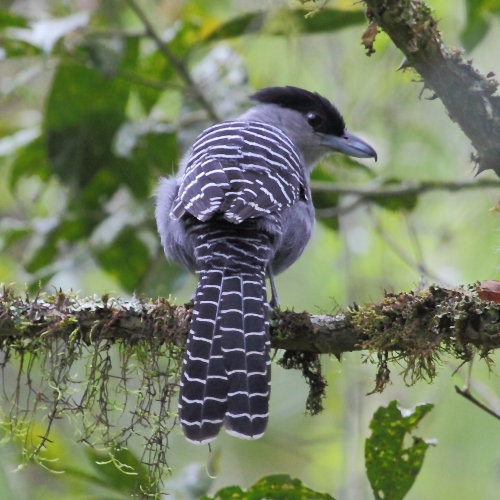
Black-throated Antbird
Myrmeciza atrothorax
Order: Passeriformes / Family: Thamnophilidae

Wikimedia Commons
About the Black-throated Antbird
The Black-throated Antbird (Myrmeciza atrothorax) is a captivating bird found primarily in the lowland tropical forests of South America. Known for its distinctive black throat, this species plays a crucial role in the ecosystem as part of the family Thamnophilidae, which includes many ant-following birds. The Black-throated Antbird inhabits the dense understory of forests in the Amazon Basin, including regions like eastern Colombia, southern Venezuela, and extending into the Brazilian states of Amazonas, Acre, and Pará. These birds thrive in humid, subtropical, and tropical moist lowland forests, where they contribute to the biodiversity and health of their habitat through their insectivorous diet. By consuming a variety of arthropods, they help control insect populations, thus maintaining ecological balance.
During the wet season, which typically spans from November to April, the Black-throated Antbird becomes particularly active, taking advantage of the abundance of insects. This period coincides with the breeding season, during which they engage in intricate courtship displays. The male's role in these displays is vital, as he uses his striking plumage and vocalizations to attract a mate. The Black-throated Antbird's presence is a testament to the rich biodiversity of the neotropical forests, where they often join mixed-species foraging flocks, contributing to the complex interspecies dynamics.
Ecological significance extends beyond their role in insect control. The Black-throated Antbird is considered an indicator species for healthy forest ecosystems. Changes in their population can reflect the overall health of the forest, making them valuable for conservation efforts. As deforestation and habitat fragmentation continue to threaten tropical forests, the preservation of species like the Black-throated Antbird becomes increasingly important. Their ability to thrive in intact forest habitats underscores the need for sustainable forestry practices and protected reserves to ensure the survival of this and many other forest-dependent species.
The Black-throated Antbird belongs to the family Thamnophilidae, within the order Passeriformes. These birds typically live typically 4-6 years, with some living up to 9 years..
How to Identify a Black-throated Antbird
The Black-throated Antbird is a small to medium-sized bird, measuring about 15 cm in length. The adult male is easily identified by its striking black throat and chest, which contrasts sharply with the grayish-brown upperparts and rufous flanks. The female, while similar in size, lacks the black throat and instead displays a more muted plumage with brownish tones and a lighter, buff-colored throat and chest. Juveniles resemble females but with even duller tones, lacking the defined black and rufous contrasts seen in adults.
One of the key field marks is the bird's overall posture. The Black-throated Antbird tends to perch low in the understory, often remaining still for extended periods as it scans for prey. This bird's relatively short tail and rounded wings are adapted for maneuvering through dense foliage rather than long-distance flight. In flight, it moves with rapid, direct wingbeats, though it rarely ventures into open spaces.
Confusion with other antbird species can occur, especially with those sharing similar ranges. However, the distinctive black throat of the males and the habitat preference help distinguish it from other sympatric antbirds. Observers should note the bird's vocalizations, as these, combined with visual identification, aid in confirming its presence.
Having trouble telling birds apart? Upload a photo to our bird identification tool for an instant species match.
Black-throated Antbird Habitat and Range
Preferred Habitat
The Black-throated Antbird thrives in humid lowland tropical forests, where it prefers the dense understory of primary and mature secondary growth forests. It is often found at elevations ranging from sea level to about 900 meters, although it predominantly inhabits the lower altitudes. This species favors areas with thick vegetation and ample leaf litter, which provide an abundant supply of insects and cover from predators.
Seasonally, the Black-throated Antbird shows little variation in habitat preference, maintaining its presence in forested areas year-round. Unlike some other species, it shows low tolerance for fragmented landscapes and rarely ventures into urban or heavily disturbed areas. This preference for continuous forest cover highlights its vulnerability to deforestation and habitat degradation.
While it is largely absent from urban environments, the Black-throated Antbird can occasionally be found in less disturbed rural areas, particularly those adjacent to intact forest stands. Conservation of these contiguous forest habitats is crucial for maintaining their populations.
Geographic Range
The Black-throated Antbird's range is concentrated in the Amazon Basin, covering a vast expanse of South America. It is resident in eastern Colombia, southern Venezuela, and the entirety of the Guianas. In Brazil, it is widespread across the states of Amazonas, Acre, and Pará, and its range extends south into northern Bolivia and parts of Peru.
Unlike migratory species, the Black-throated Antbird is largely sedentary, with no significant migration patterns. It occupies its range year-round, relying on the consistent climate and resources of the tropical forest. However, localized movements may occur within its home range, particularly in response to seasonal changes in food availability or habitat conditions.
Population density is highest in undisturbed primary forests, where the dense understory supports a rich diversity of prey. In regions where deforestation is less prevalent, populations remain stable, but in areas where forests have been heavily logged or converted to agriculture, densities are significantly reduced.
Want to know which birds visit your area? Browse our backyard birds by location guides for region-specific species lists.
What Does the Black-throated Antbird Eat?
The Black-throated Antbird is primarily insectivorous, feeding on a variety of arthropods found in the forest understory. Its diet consists mainly of ants, beetles, spiders, and caterpillars, which it gleans from the leaf litter and low vegetation. During the wet season, when insect numbers peak, the bird takes advantage of the abundance, increasing its feeding rate.
This antbird employs a 'sit-and-wait' foraging strategy, remaining motionless while observing its surroundings for movement. Once prey is detected, it quickly darts forward to seize it, often using its bill to flick through leaf litter. This method allows the Black-throated Antbird to efficiently exploit its environment without expending unnecessary energy.
While its diet remains fairly consistent throughout the year, slight variations occur depending on local availability of insects. In areas with a high presence of ant swarms, the Black-throated Antbird is known to follow these swarms, capturing insects and other small creatures disturbed by the ants' activity.
Black-throated Antbird Behavior and Social Structure
The Black-throated Antbird exhibits a complex range of behaviors that are fascinating to observe. It is generally solitary or found in pairs, particularly during the breeding season. Territorial behavior is pronounced, with males defending their areas through vocalizations and displays designed to deter intruders. This territory defense ensures access to resources and nesting sites.
Courtship displays involve the male showcasing his plumage and singing to attract a mate. These displays can include wing spreading and tail fanning, accompanied by low-intensity songs. Once paired, the bond is strong, with both male and female participating in nest building and chick rearing.
The Black-throated Antbird also participates in mixed-species foraging flocks outside the breeding season. This social behavior increases foraging efficiency and reduces predation risk, as more pairs of eyes are available to spot danger. In the face of predators, this antbird exhibits a freeze response, relying on its cryptic plumage to blend into the shadows of the understory.
Black-throated Antbird Nesting and Reproduction
Nesting for the Black-throated Antbird begins with a cup-shaped nest built low in the dense underbrush. The nest is constructed using twigs, leaves, and grass, cleverly woven together to blend with the surrounding vegetation. Preferred nesting sites are well-concealed spots that provide protection from predators.
A typical clutch consists of two eggs, with both the male and female sharing incubation duties. The incubation period lasts about 14-16 days, with parents taking turns to ensure the eggs remain warm and safe. Once hatched, the chicks are altricial and require constant care.
Fledging occurs approximately 14-16 days post-hatching, with both parents involved in feeding and protecting the young. The Black-throated Antbird usually raises one brood per year, though in areas with abundant resources, a second brood may be attempted. Parental care extends beyond fledging, as the young remain dependent on their parents for several weeks.
Black-throated Antbird Sounds and Vocalizations
The Black-throated Antbird's primary song is a series of sharp, clear whistles, delivered at a steady rhythm. These calls serve both territorial and mate attraction purposes. Males often sing from perches hidden within the understory, projecting their voices through the dense foliage.
In addition to the primary song, this antbird produces a variety of call notes, including soft 'chup' sounds used for communication between mates. Alarm calls are sharp and abrupt, alerting nearby birds to potential threats.
During the dawn chorus, the Black-throated Antbird's vocalizations contribute to the rich tapestry of forest sounds, each bird's song blending with those of its neighbors, creating a symphony of natural music.
Interesting Facts About the Black-throated Antbird
- 1The Black-throated Antbird can follow ant swarms for extended periods, capitalizing on insects flushed by the ants.
- 2Despite its name, the Black-throated Antbird doesn't feed exclusively on ants, but they do form a significant part of its diet.
- 3The species' preference for dense understory makes it a reliable indicator of forest health and habitat integrity.
- 4Males and females share nearly equal roles in nesting duties, showcasing cooperative breeding behavior.
- 5The Black-throated Antbird's vocalizations are crucial for territory defense, particularly in the dense jungle where visibility is low.
- 6The bird's cryptic plumage provides excellent camouflage, allowing it to evade predators in the thick forest understory.
- 7It is part of the diverse antbird family, which consists of over 200 species, each adapted to various niches within neotropical forests.
Black-throated Antbird Conservation Status
The Black-throated Antbird is currently listed as Least Concern by the IUCN, although its population trend is decreasing due to habitat loss. Deforestation, particularly in the Amazon Basin, poses the greatest threat to its habitat. As forests are cleared for agriculture and logging, the dense understory this species relies on vanishes. Conservation efforts focus on protecting large swathes of primary forest and implementing sustainable land-use practices. Protected areas and reserves within the bird's range provide crucial refuges from habitat destruction. Continued monitoring of population trends and habitat availability is essential to ensure the long-term survival of the Black-throated Antbird, as even slight habitat changes can significantly impact its populations.