Black-throated Antshrike
Frederickena viridis
Order: Passeriformes / Family: Thamnophilidae

Wikimedia Commons
About the Black-throated Antshrike
The Black-throated Antshrike, scientifically known as Frederickena viridis, is a remarkable member of the Thamnophilidae family, predominantly found in the dense humid forests of South America. This bird epitomizes the intricate web of life within these ecosystems, playing a pivotal role as both a predator and prey. Its presence is a strong indicator of forest health, as it thrives in undisturbed, mature forests with a rich undergrowth of shrubs and vines. The Black-throated Antshrike is primarily found in countries like Brazil, Peru, and Colombia, where it inhabits the Amazon Basin. These regions provide the bird with the dense canopy and complex understory it requires for hunting and nesting. Seasonal behaviors of the Black-throated Antshrike are closely tied to the availability of food and breeding conditions. During the breeding season, typically aligned with the wet season, these birds become more vocal and territorial. The male's song, a series of clear whistles, resonates through the forest to attract a mate and establish dominance over a territory. Outside the breeding season, the antshrike's behavior shifts to a more covert existence, as it focuses on foraging and avoiding predators. The ecological role of the Black-throated Antshrike extends beyond its immediate environment. As an insectivore, it helps control insect populations, contributing to the ecological balance within its habitat. Its predation on arthropods and small invertebrates aids in maintaining the health of the understorey flora by preventing overgrazing and the spread of plant diseases. Furthermore, its interactions with other bird species, particularly mixed-species flocks, highlight the cooperative and competitive dynamics of the rainforest avifauna. The Black-throated Antshrike's significant presence in these mixed flocks underscores its adaptability and its role as both a competitor and ally to other insectivorous birds.
The Black-throated Antshrike belongs to the family Thamnophilidae, within the order Passeriformes. These birds typically live average 4-6 years, with a max recorded at 8 years..
How to Identify a Black-throated Antshrike
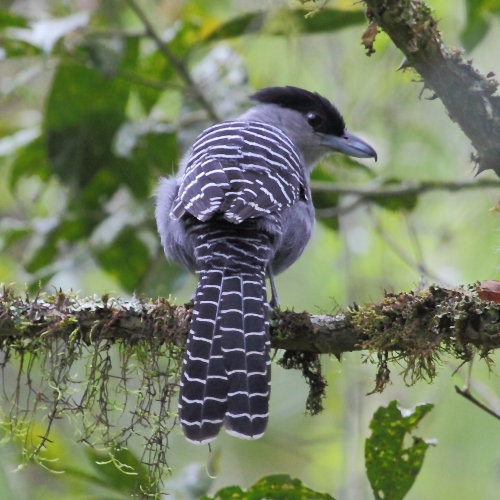
Identifying the Black-throated Antshrike in the field is facilitated by several distinctive features. Adult males showcase a striking black throat and face, which starkly contrasts with their olive-brown upperparts and paler underparts. The wings and tail are similarly draped in dark hues, providing effective camouflage within the forest. Females, while less flamboyant, possess unique identifying characteristics; they exhibit a more subdued plumage with an olive-brown throat instead of black. This sexual dimorphism aids observers in distinguishing genders within the field. Juveniles resemble the females but with even duller tones, lacking the sharply defined patterns of the adults. Confusion may arise with other antbirds such as the Barred Antshrike, but the latter exhibits more pronounced barring and lacks the solid black throat. The Black-throated Antshrike's flight silhouette is compact, with rounded wings and a short tail, suited for maneuvering through dense foliage rather than long-distance flight. When perched, they often sit quietly, scanning their surroundings for prey, with a preference for mid-level perches in the forest. Unlike more conspicuous species, the Black-throated Antshrike relies on subtle movements and its cryptic coloration to remain undetected.
Having trouble telling birds apart? Upload a photo to our bird identification tool for an instant species match.
Black-throated Antshrike Habitat and Range
Preferred Habitat
The Black-throated Antshrike inhabits the dense tropical lowland forests of the Amazon Basin. These forests, characterized by high humidity and dense undergrowth, provide the perfect habitat for the antshrike's foraging and nesting requirements. Within these forests, the bird shows a preference for areas with a thick understory, often near streams or swampy areas. This preference is likely due to the abundance of prey and the availability of nesting sites. The elevation range for the Black-throated Antshrike typically extends from sea level to about 900 meters, avoiding higher elevations where the forest canopy becomes sparser. Unlike some other forest species, the Black-throated Antshrike does not adapt well to urban environments, remaining firmly within its forested habitat. Seasonal habitat shifts are minimal, as these birds are non-migratory and rely heavily on the stability of their environment. Deforestation and habitat fragmentation pose significant threats to their habitat, highlighting the need for conservation efforts within their range.
Geographic Range
The Black-throated Antshrike's range is confined to the northern and central areas of South America, specifically within the Amazon Basin. Its presence spans countries such as Brazil, Peru, Colombia, and northern Bolivia. In Brazil, it is found in the states of Amazonas and Acre, among others. The bird's range does not extend into the more temperate regions of South America, as it is closely tied to the tropical rainforest ecosystem. It is a resident species, meaning it does not undertake long migrations, instead remaining within its established territories throughout the year. Within its range, population densities can vary, with higher concentrations often found in well-preserved forest areas. Regions such as the Tambopata Reserve in Peru and the Amazon National Park in Brazil are known hotspots where the Black-throated Antshrike is more commonly observed. The stability of its range is primarily threatened by human activities, including logging and land conversion for agriculture.
Want to know which birds visit your area? Browse our backyard birds by location guides for region-specific species lists.
What Does the Black-throated Antshrike Eat?
The diet of the Black-throated Antshrike primarily consists of insects and other small arthropods. Its foraging technique involves gleaning prey from leaves and branches, a method well-suited to its forested habitat. The antshrike exhibits remarkable patience, often spending extended periods scanning foliage for movement. Prey items include beetles, spiders, and caterpillars, which provide the necessary nutrients for energy and reproduction. During the rainy season, when insect abundance increases, the Black-throated Antshrike capitalizes on the surplus food supply to support its breeding efforts. In contrast, the dry season might see a shift towards more readily available prey, such as ants and termites. The bird’s feeding schedule is largely diurnal, with peak activity occurring in the early morning and late afternoon when insect activity is highest. The antshrike's role in controlling insect populations is crucial, as it helps maintain the balance within its ecosystem.
Black-throated Antshrike Behavior and Social Structure
The Black-throated Antshrike exhibits a complex social structure, often observed alone or in pairs, particularly during the breeding season. Pairs are strongly territorial, with both males and females actively defending their area from intruders. Courtship displays involve males showcasing their striking black throat and engaging in vocalizations to attract females. These displays are subtle yet deliberate, emphasizing the male's fitness and territory quality. Outside the breeding season, the antshrike is less territorial and may join mixed-species flocks, participating in cooperative foraging activities. This behavior provides increased protection from predators and enhances foraging efficiency. The Black-throated Antshrike's response to predators involves a combination of vocal alarms and evasive maneuvers, retreating into dense foliage to avoid detection. Daily activity patterns are predominantly diurnal, with peak foraging occurring during the cooler hours of the day. The bird remains relatively inconspicuous, relying on its cryptic plumage and stealthy movements to avoid attracting unwanted attention.
Black-throated Antshrike Nesting and Reproduction
The Black-throated Antshrike constructs its nest in the dense understory of tropical forests, choosing locations that offer ample concealment from predators. The nest, a cup-shaped structure, is crafted from twigs, leaves, and fibers, often lined with softer materials for insulation. Nest placement varies, with heights ranging from one to three meters above the ground, usually nestled within thick vegetation. The typical clutch size is two eggs, which are incubated by both parents for approximately 15 to 17 days. During incubation, the parents take turns sitting on the eggs, ensuring consistent warmth and protection. Once hatched, the chicks remain in the nest for about 14 to 16 days before fledging. Both parents are actively involved in feeding and caring for the young, providing a steady supply of insects to support their rapid growth. The Black-throated Antshrike typically raises one brood per year, although this can vary depending on environmental conditions and food availability.
Black-throated Antshrike Sounds and Vocalizations
The primary song of the Black-throated Antshrike is a series of clear, melodious whistles, often described as 'wheee-cheee' phrases repeated with regularity. These vocalizations play a crucial role during the breeding season, serving both to attract mates and deter rivals. The bird's call notes, often heard during foraging, consist of sharp 'chit' sounds that facilitate communication between mates or group members. Alarm calls are harsher and more abrupt, alerting other forest dwellers to potential threats. The Black-throated Antshrike participates in the dawn chorus, when its song can be heard echoing through the forest, competing with the myriad of other avian voices. The clarity and pattern of its song make it easily distinguishable from other forest birds, serving as an auditory hallmark of its presence.
Interesting Facts About the Black-throated Antshrike
- 1The Black-throated Antshrike can often be heard before it is seen, thanks to its distinctive song.
- 2Despite its striking appearance, the Black-throated Antshrike is notoriously elusive and hard to spot.
- 3It plays a vital role in controlling insect populations in its forest habitat, acting as a natural pest control.
- 4The species' preference for dense undergrowth makes it a reliable indicator of forest health.
- 5Unlike many birds, the Black-throated Antshrike does not migrate and stays within its territory year-round.
- 6The bird's name derives from its characteristic black throat, a prominent feature of the male's plumage.
- 7Black-throated Antshrikes exhibit a relatively high degree of sexual dimorphism compared to other antbirds.
Black-throated Antshrike Conservation Status
As of the latest assessments, the Black-throated Antshrike does not face immediate extinction threats and is classified as Least Concern by the IUCN. However, its population trend is considered stable, with local declines in some areas due to habitat loss. The primary threats to its conservation are deforestation and habitat fragmentation, driven by logging and agricultural expansion in the Amazon Basin. Conservation efforts focus on protecting large tracts of undisturbed forest, crucial for the survival of this and many other forest-dependent species. Historical population changes are difficult to quantify due to the bird's elusive nature and the remote locations it inhabits. Nonetheless, ongoing research and habitat preservation initiatives remain essential to ensure the long-term viability of the Black-throated Antshrike and its habitat.