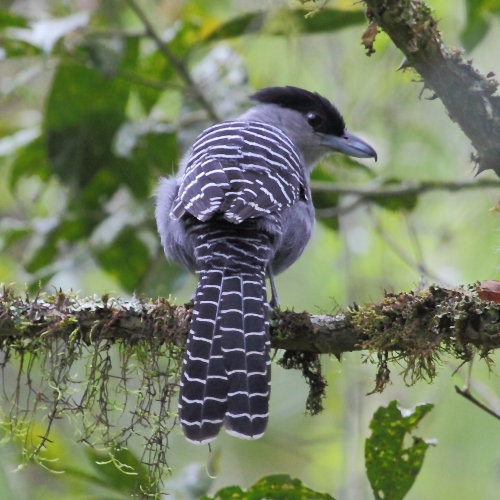
Blackish Antbird
Cercomacra nigrescens
Order: Passeriformes / Family: Thamnophilidae

Wikimedia Commons
About the Blackish Antbird
The Blackish Antbird (Cercomacra nigrescens) is a notable member of the Thamnophilidae family, residing primarily in the dense undergrowth of tropical rainforests in South America. This species exhibits a striking blackish plumage that allows it to blend seamlessly into its shadowy environment, a crucial adaptation for its survival. Found predominantly in countries like Brazil, Colombia, and Peru, the Blackish Antbird prefers humid lowland forests and riverine woodlands. Its presence is an indicator of healthy forest ecosystems, as it often relies on the presence of army ants to flush out insects for food. Unlike many other bird species, the Blackish Antbird does not migrate, maintaining year-round residency within its established territories. During the breeding season, which typically coincides with the onset of the rainy season, males and females engage in cooperative nest-building and rearing of young. The ecological role of the Blackish Antbird is significant as it contributes to the control of insect populations within its habitat. By following swarms of army ants, it not only feeds on the insects disturbed by the ants but also inadvertently supports the ants' predatory activities by clearing paths and exposing prey. This symbiotic relationship exemplifies the interconnectedness of rainforest species. The Blackish Antbird is an asset to biodiversity, highlighting the intricate web of life within tropical ecosystems. Its behaviors and interactions offer insights into the complexities of forest ecology and the importance of preserving these habitats.
The Blackish Antbird belongs to the family Thamnophilidae, within the order Passeriformes. These birds typically live average 4 years with a max recorded of 7 years.
How to Identify a Blackish Antbird
Adult Blackish Antbirds are characterized by their uniformly dark plumage, typically appearing as a deep slate or blackish color. This coloration covers both the males and females, though males generally present a slightly glossier sheen. Juveniles can be distinguished by their more muted and brownish tones, which gradually darken with age. Observers may note the subtle white markings on the edges of the wing feathers, a feature that can assist in identification. The Blackish Antbird's eyes are dark, and it possesses a short, robust bill suitable for its insectivorous diet. Confusion with other antbird species is possible, particularly with the Dusky Antbird, but the latter tends to have more pronounced pale wing bars. When perched, the Blackish Antbird maintains an upright posture, often remaining motionless for extended periods, which can make spotting them a challenge in dense foliage. In flight, its silhouette is compact with rapid, short wingbeats, typical of understory-dwelling birds that rarely venture into open spaces.
Having trouble telling birds apart? Upload a photo to our bird identification tool for an instant species match.
Blackish Antbird Habitat and Range
Preferred Habitat
The Blackish Antbird inhabits the lowland tropical rainforests and riverine woodlands of South America. It thrives in thick understory vegetation, where it can be found from sea level up to approximately 1,200 meters in elevation. The bird shows a preference for areas with dense leaf litter and tangled vines, often near streams or forest edges. Despite its affinity for undisturbed forests, it can occasionally be observed in secondary growth areas, provided they offer sufficient cover and food resources. Seasonal habitat shifts are minimal, as this species remains relatively stationary throughout the year. While urban presence is rare, the Blackish Antbird can persist in rural landscapes that maintain pockets of natural habitat, illustrating its adaptability to changing environments.
Geographic Range
The range of the Blackish Antbird extends across the northern and central regions of South America, with established populations in Brazil, Colombia, Peru, Venezuela, and Ecuador. This bird is predominantly non-migratory, residing year-round within its chosen territories. The Amazon Basin serves as a population density hotspot, offering vast tracts of suitable habitat. While it does not undertake long-distance migrations, local movements may occur in response to shifts in food availability or environmental conditions. The Blackish Antbird's range is generally confined to areas with high forest cover, making it less common in regions experiencing significant deforestation or habitat fragmentation.
Want to know which birds visit your area? Browse our backyard birds by location guides for region-specific species lists.
What Does the Blackish Antbird Eat?
The diet of the Blackish Antbird primarily consists of insects and other small arthropods, which it gleans from the forest floor or captures in mid-air. This species exhibits a strong association with army ant swarms, which it follows to exploit the insects and other prey items flushed by the ants' activities. During the wet season, when insect abundance peaks, the Blackish Antbird may focus on larger prey items such as beetles and spiders. In contrast, during drier periods, it may consume smaller insects like ants and termites more frequently. Foraging typically occurs during daylight hours, with peak activity in the early morning and late afternoon. The bird employs a methodical approach, moving slowly through the underbrush and pausing frequently to inspect potential feeding sites.
Blackish Antbird Behavior and Social Structure
The Blackish Antbird exhibits a solitary or paired social structure, often forming monogamous pairs that defend year-round territories. Territorial disputes can involve vocalizations and displays of aggression, particularly during the breeding season. Courtship involves mutual preening and the presentation of food items, strengthening the pair bond. Unlike some other avian species, the Blackish Antbird does not form flocks, preferring to maintain a degree of isolation within its territory. Its response to predators includes remaining motionless to avoid detection or retreating into dense cover. Daily activity patterns are largely diurnal, with periods of rest during the hottest parts of the day. The bird's reliance on army ant swarms for feeding creates a dynamic interaction with the ecosystem, as it must constantly adapt its foraging strategies to the movements of these ants.
Blackish Antbird Nesting and Reproduction
The nesting habits of the Blackish Antbird involve constructing nests hidden within dense vegetation, often at low heights just above the ground. Both males and females participate in building the cup-shaped nests, using materials such as twigs, leaves, and plant fibers. Clutch sizes typically range from two to three eggs, with both parents sharing incubation duties over a period of 14 to 16 days. After hatching, the young remain in the nest for approximately 10 to 12 days before fledging. Parental care continues post-fledging, with both adults involved in feeding and protecting the young until they gain independence. The Blackish Antbird usually raises one brood per year, although favorable conditions may allow for a second attempt.
Blackish Antbird Sounds and Vocalizations
The primary song of the Blackish Antbird is a series of sharp, repetitive notes delivered in rapid succession, often described as 'chip-chip-chip.' This song is typically used for communication between mates and territorial defense. Call notes are softer and more subdued, often serving as contact calls between paired birds. Alarm calls are more abrupt and intense, intended to warn of imminent threats. During the dawn chorus, the Blackish Antbird's vocalizations may blend with those of other forest inhabitants, creating a rich tapestry of sound that marks the beginning of the day in the rainforest.
Interesting Facts About the Blackish Antbird
- 1The Blackish Antbird's association with army ants makes it a key participant in the phenomenon known as 'ant-following,' where birds benefit from prey flushed by ant swarms.
- 2Despite its secretive nature, the Blackish Antbird's distinctive song helps researchers and birders detect its presence within dense forests.
- 3This antbird species has adapted to life in the understory, rarely venturing into the forest canopy or open areas, highlighting its specialized niche.
- 4Studies show that the Blackish Antbird's foraging success is closely tied to the availability of army ant swarms, emphasizing its reliance on these insects.
- 5The Blackish Antbird is part of a diverse family of birds known for their varied adaptations to forest life, with over 230 species identified worldwide.
- 6Unlike many passerines, the Blackish Antbird exhibits limited seasonal movement, reflecting its adaptation to stable tropical environments.
- 7The bird's scientific name, Cercomacra nigrescens, reflects its dark plumage, with 'nigrescens' derived from Latin for 'becoming black.'
Blackish Antbird Conservation Status
Currently, the Blackish Antbird is classified as Least Concern by the IUCN, with stable population trends. However, habitat loss due to deforestation poses a significant threat to its long-term survival. Conservation efforts focus on preserving large tracts of intact rainforest and promoting sustainable land-use practices. Historical data suggests that while the Blackish Antbird has maintained a stable presence across its range, localized declines correspond with areas of intense agricultural expansion or logging. Continued monitoring and habitat protection are crucial to ensure the persistence of this species and the ecological balance it helps maintain.