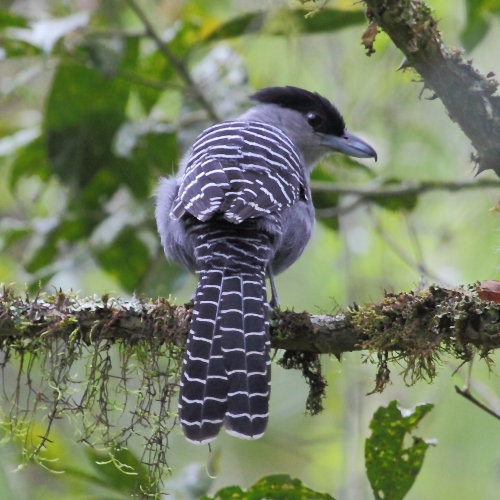
Blackish-gray Antshrike
Thamnophilus nigrocinereus
Order: Passeriformes / Family: Thamnophilidae

Wikimedia Commons
About the Blackish-gray Antshrike
The Blackish-gray Antshrike (Thamnophilus nigrocinereus) is a bird of the Thamnophilidae family, known for its subtle yet striking appearance. This bird primarily inhabits the dense, humid rainforests of northern South America, making its presence felt in countries like Brazil, Colombia, Venezuela, and Peru. Its preference for the undergrowth and forest edge habitats marks it as a quintessential denizen of tropical lowland forests.
The Blackish-gray Antshrike plays a pivotal role in the ecosystem as an insectivore. By controlling insect populations, it helps maintain a balanced food web. This bird often associates with mixed-species flocks, enhancing its foraging efficiency and reducing predation risk. Although relatively inconspicuous due to its plumage, its presence is often revealed by its distinctive vocalizations.
During the breeding season, the Blackish-gray Antshrike becomes more territorial, with males often singing to establish and defend territories. Outside of breeding, these birds may become more nomadic, following rains and food availability. This adaptability to seasonal changes in food supply highlights their ecological resilience.
The Blackish-gray Antshrike's adaptation to the undergrowth ensures that it rarely ventures into human-altered landscapes, thus making its conservation largely reliant on the preservation of its natural habitat. Its survival hinges on the health of tropical forests, as these ecosystems face ongoing threats from deforestation and habitat fragmentation.
The Blackish-gray Antshrike belongs to the family Thamnophilidae, within the order Passeriformes. These birds typically live 4-6 years with a maximum recorded of 8 years.
How to Identify a Blackish-gray Antshrike
The Blackish-gray Antshrike is a medium-sized bird characterized by its predominantly dark plumage. Adult males exhibit a uniform slate-gray coloration, which provides excellent camouflage in the dimly lit undergrowth. The females, on the other hand, have a slightly browner tint to their plumage, setting them apart from the more monochrome males.
Juveniles resemble the females but often display more mottled patterns on their feathers, assisting in differentiating them from adults. Observers should note the bird’s robust build, with a stout bill adapted for its insectivorous diet. The bird's eye-ring may appear slightly lighter, adding a subtle contrast to its otherwise dark appearance.
When perched, the Blackish-gray Antshrike maintains a typical antbird posture, often cocking its tail slightly upwards. Its flight, though infrequent due to its preference for low perches, is direct and purposeful, lacking the undulating pattern seen in other passerines. Confusion may arise with other sympatric antbirds, but the combination of its size, dark color, and habitat choice are key distinguishing features.
Having trouble telling birds apart? Upload a photo to our bird identification tool for an instant species match.
Blackish-gray Antshrike Habitat and Range
Preferred Habitat
The Blackish-gray Antshrike thrives in tropical lowland forests, particularly favoring dense undergrowth and forest edges. These birds are commonly found at elevations ranging from sea level to about 600 meters, though they rarely venture into higher altitudes. They prefer areas with ample leaf litter and tangled vegetation, which provide both food and protection from predators.
Seasonal variations do not significantly alter their habitat preferences, as they remain tied to forested environments year-round. Unlike some other tropical birds, the Blackish-gray Antshrike avoids urban and heavily disturbed areas, maintaining a strong association with natural forest habitats. This preference underscores the importance of pristine rainforests for their continued survival.
Geographic Range
The Blackish-gray Antshrike is primarily found in the northern part of South America. Its range extends across the Amazon Basin, covering significant territories in Colombia, Venezuela, Brazil, and Peru. Within these countries, the bird occupies regions rich in lowland rainforests, often staying within the vast expanses of the Amazon rainforest.
Although largely sedentary, the Blackish-gray Antshrike may exhibit minor local movements in response to changing food availability, but it lacks the long-distance migratory patterns seen in some other bird species. Population densities tend to be higher in areas where forest cover remains intact and continuous, highlighting the species' reliance on untouched habitats.
Want to know which birds visit your area? Browse our backyard birds by location guides for region-specific species lists.
What Does the Blackish-gray Antshrike Eat?
The primary diet of the Blackish-gray Antshrike consists of insects and other small arthropods. These birds employ a methodical foraging technique, often observed gleaning prey from leaves and branches within the forest undergrowth. Their stout bills are well-suited to snapping up beetles, spiders, and caterpillars, which form the bulk of their diet.
Seasonal changes in the rainforest influence the availability of prey, and the Blackish-gray Antshrike may adjust its foraging behavior accordingly, often following mixed-species flocks to capitalize on stirred-up insects. Although primarily diurnal, these birds may exhibit increased foraging activity during dawn and dusk, coinciding with peak insect activity.
Blackish-gray Antshrike Behavior and Social Structure
The Blackish-gray Antshrike exhibits a territorial and somewhat solitary nature, especially during breeding seasons. Males frequently sing to assert dominance and ownership over their chosen territories. Unlike some other antbirds, they rarely form large, cohesive flocks, although they do participate in mixed-species foraging groups.
Courtship involves the male displaying his plumage and engaging in duet singing with the female. Once paired, the birds become highly secretive, focusing on rearing their young. Predation threats prompt a series of alarm calls, causing the birds to retreat into thicker cover. Daily activities revolve around foraging, with peak activity noted in the cooler morning and late afternoon hours.
Blackish-gray Antshrike Nesting and Reproduction
The Blackish-gray Antshrike constructs a cup-shaped nest, typically situated low in dense vegetation or shrubs. These nests are crafted from twigs, leaves, and fibers, providing a camouflaged refuge for the eggs. A typical clutch consists of two to three eggs, which are incubated by both parents.
Incubation lasts roughly 14 days, with the young fledging about two weeks after hatching. Parental care is shared, with both the male and female involved in feeding and protecting the chicks. The species generally raises one brood per year, aligning their breeding cycle with the rainy season to ensure ample food supply for the growing chicks.
Blackish-gray Antshrike Sounds and Vocalizations
The primary song of the Blackish-gray Antshrike is a series of clear, whistled notes, often described as repetitive and melodious. Each note is typically of similar pitch and quality, creating a consistent pattern that can carry through the dense forest undergrowth.
In addition to their song, these birds produce a variety of call notes, including sharp, scolding sounds used as alarm calls. These calls serve as alerts to potential threats, prompting a quick retreat into cover. The dawn chorus is a particularly active time for vocalizations, with males often engaging in duet singing with their mates.
Interesting Facts About the Blackish-gray Antshrike
- 1The Blackish-gray Antshrike's song can be heard up to 100 meters away, making it a key territorial signal.
- 2They often join mixed-species flocks, gaining protection and improved foraging success.
- 3Despite their name, Blackish-gray Antshrikes are primarily gray, with subtle brown hues in females.
- 4These birds are known for their secretive nature, often heard before seen in dense undergrowth.
- 5Their stout bills allow them to efficiently snap up a variety of insects, including beetles and caterpillars.
- 6The Blackish-gray Antshrike is one of over 230 species in the Thamnophilidae family.
- 7Their reliance on pristine rainforests makes them indicators of ecosystem health.
Blackish-gray Antshrike Conservation Status
The Blackish-gray Antshrike currently holds a conservation status of Least Concern according to the IUCN. Despite this, their populations face pressure from ongoing habitat destruction and fragmentation within the Amazon Basin. Deforestation for agriculture and logging are primary threats to their natural habitat. Conservation efforts focus on preserving large tracts of continuous rainforest, which are crucial for the species' survival. Historical population data suggest stability in regions where forest cover remains intact, but declines are evident in heavily logged areas. Efforts to curb deforestation will be vital in maintaining healthy populations of this species.