
Bluish-slate Antshrike
Thamnomanes schistogynus
Order: Passeriformes / Family: Thamnophilidae

Wikimedia Commons
About the Bluish-slate Antshrike
The Bluish-slate Antshrike, scientifically known as Thamnomanes schistogynus, is an integral component of the understory bird community in the Amazon Basin. This bird, belonging to the family Thamnophilidae, thrives primarily within the dense, humid forests of South America, where it plays a key role in the intricate ecological web. Found predominantly in Peru, Bolivia, and parts of Brazil, the Bluish-slate Antshrike is most commonly spotted in lowland rainforests and occasionally extends its range into foothill regions. As a sentinel species, it often forms part of mixed-species foraging flocks, serving as an early warning system against predators, a behavior that underscores its ecological importance.
The antshrike's presence is a reliable indicator of forest health, owing to its dependence on well-preserved habitats. It has adapted to a life in the dense canopy and understory, where light barely penetrates the thick foliage. This bird's niche involves feeding primarily on insects and arthropods, which it gleans from leaves and branches. During the dry season, its role becomes even more pronounced as it helps regulate insect populations, contributing to the overall balance of the ecosystem.
Throughout the year, the Bluish-slate Antshrike engages in seasonal behaviors that reflect the changing dynamics of its environment. During the breeding season, it exhibits heightened territoriality, with males performing understated yet crucial courtship displays. Its role extends beyond mere insect control, as it also participates in seed dispersal and the maintenance of forest diversity. Conservationists regard this species as a focal point for understanding the impacts of habitat loss and climate change on Amazonian avifauna, highlighting its significance in biodiversity conservation.
The Bluish-slate Antshrike belongs to the family Thamnophilidae, within the order Passeriformes. These birds typically live typically 5-8 years, with some individuals reaching up to 10 years..
How to Identify a Bluish-slate Antshrike
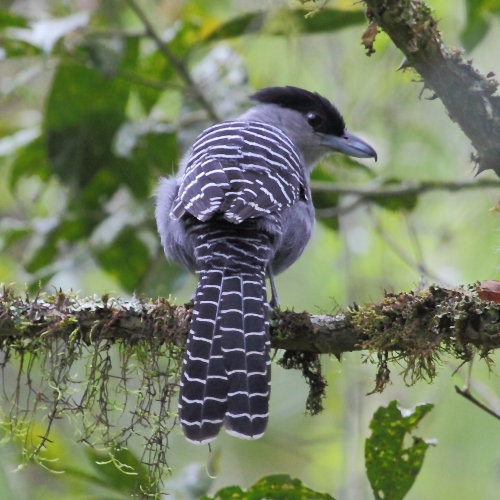
Identifying the Bluish-slate Antshrike requires attention to its unique field marks. Adult males exhibit a striking slate-blue coloration that gives the species its name. This bluish hue covers most of the body, with subtle differences in the intensity of color on the wings and tail. Females, while similarly colored, tend to have a slightly duller tone, making sex differentiation possible upon close examination. Juveniles display a more muted plumage that gradually develops the characteristic adult coloration as they mature.
The species could potentially be confused with the similar-looking Plain-winged Antshrike, but careful observation reveals distinctions. The Bluish-slate Antshrike lacks the prominent wing bars seen in its relative. In flight, these birds exhibit a quick, fluttering motion typical of many understory-dwelling species. Their perching posture is somewhat upright, often seen perched on vertical branches where they remain still for extended periods. This posture aids in their camouflage within the dense forest setting.
Another distinguishing feature is the bird's vocalization, which assists in identification when visual sightings are challenging. Their calls, along with their coloration and behavior, are essential tools for birders and researchers aiming to differentiate between closely related species in the field.
Having trouble telling birds apart? Upload a photo to our bird identification tool for an instant species match.
Bluish-slate Antshrike Habitat and Range
Preferred Habitat
The Bluish-slate Antshrike primarily inhabits the lowland forests of the Amazon Basin, thriving in the moist, humid conditions prevalent in these regions. It is typically found from sea level up to elevations of around 1,000 meters, although it is most common in the lower elevations where dense canopy cover prevails. These birds prefer areas with thick understory vegetation, which provides both cover and a rich supply of insects.
Seasonal habitat shifts are minimal, as the antshrike remains a resident species year-round in its chosen territories. Although primarily associated with tropical forest interiors, it occasionally ventures into more disturbed areas, albeit less frequently. Urban presence is virtually non-existent due to its reliance on large, uninterrupted stretches of forest, underscoring the species' sensitivity to habitat fragmentation.
In terms of forest type, the Bluish-slate Antshrike favors terra firme forests but can also be found in várzea and igapó forests, which experience seasonal flooding. Its adaptability to various forest types ensures its survival in a range of microhabitats within its geographic range.
Geographic Range
The Bluish-slate Antshrike has a distribution largely confined to the Amazon Basin across several South American countries. Its breeding and year-round range encompass territories in Brazil, Peru, Bolivia, and parts of Colombia. Within these countries, the bird is most densely populated in undisturbed lowland forests, particularly those that are part of protected areas or less accessible regions.
The species does not exhibit migratory behavior, thus its range remains fairly consistent throughout the year. However, local movements within the forest may occur in response to resource availability or territorial disputes. Population density hotspots include regions like the Tambopata National Reserve in Peru and the Madidi National Park in Bolivia, where pristine habitats support thriving populations.
While largely absent from higher elevations and urbanized areas, the Bluish-slate Antshrike's consistent presence in its core range makes it a species of interest for conservationists monitoring the impacts of deforestation and habitat alteration in the Amazon Basin.
Want to know which birds visit your area? Browse our backyard birds by location guides for region-specific species lists.
What Does the Bluish-slate Antshrike Eat?
The diet of the Bluish-slate Antshrike consists primarily of insects and other small arthropods. Its foraging behavior is characterized by methodical gleaning from foliage and branches, often within the confines of dense understory vegetation. This bird exhibits a preference for ants, beetles, spiders, and caterpillars, which it captures with precision using its sharp bill.
Seasonal variations in diet are subtle, although the wet season may see an increase in prey diversity as insect populations burgeon. Conversely, during drier periods, the antshrike may expand its diet to include other arthropods to compensate for reduced insect abundance.
A noteworthy aspect of the antshrike's foraging technique is its participation in mixed-species flocks, where it often takes on the role of a sentinel. By alerting other flock members to potential threats, this bird not only enhances its own foraging success but also contributes to the collective feeding efficiency of the group. Feeding generally occurs during daylight hours, with peak activity in the early morning and late afternoon.
Bluish-slate Antshrike Behavior and Social Structure
The social structure of the Bluish-slate Antshrike revolves around its participation in mixed-species flocks, a behavior that enhances its survival in the dense forests it inhabits. Within these flocks, antshrikes often take on the role of sentinels, using their keen observation skills to alert other birds to the presence of predators. This communal approach to foraging provides mutual benefits, increasing efficiency and reducing individual predation risk.
Territorial behavior is prominent during the breeding season when males establish and defend territories with vocalizations and occasional displays. Courtship displays are subtle but include vocal duets and mutual preening, which strengthen pair bonds. The species is generally monogamous, with pairs remaining together throughout the year.
In response to predators, the Bluish-slate Antshrike employs a combination of stealth and vocal alarms. It relies on its camouflaging plumage to remain hidden, only taking flight when necessary. Daily activity patterns are diurnal, with peak periods of activity in the cooler hours of the morning and late afternoon, coinciding with optimal foraging conditions.
Bluish-slate Antshrike Nesting and Reproduction
Nesting habits of the Bluish-slate Antshrike reflect its adaptation to the dense forest environment. Nests are typically cup-shaped and constructed with a variety of materials, including twigs, leaves, and rootlets. These nests are often positioned low in shrubs or small trees, providing concealment from predators.
The breeding season coincides with the onset of the wet season, which ensures an abundant food supply for the growing young. Clutch sizes are usually small, consisting of two to three eggs. Both parents participate in incubation, which lasts approximately two weeks.
Once hatched, the chicks are altricial and require considerable parental care. Fledging occurs about two weeks after hatching, but young birds often remain dependent on their parents for a short period thereafter. The species typically raises one brood per year, although favorable conditions may allow for a second.
Bluish-slate Antshrike Sounds and Vocalizations
The primary song of the Bluish-slate Antshrike is characterized by a series of sharp, clear notes delivered in rapid succession. These notes are often described as having a slightly metallic quality, making the song easily distinguishable from other forest sounds. The rhythm is steady, with each note spaced evenly, creating a consistent pattern.
In addition to its song, the Bluish-slate Antshrike produces a variety of call notes used for communication within mixed-species flocks. Alarm calls are sharp and abrupt, serving to alert flock members of potential threats. During the dawn chorus, its song contributes to the cacophony of bird voices, adding to the lively ambiance of the forest.
Comparatively, the song of the Bluish-slate Antshrike may remind listeners of the calls of other Thamnomanes species, though its specific tonal quality sets it apart.
Interesting Facts About the Bluish-slate Antshrike
- 1The Bluish-slate Antshrike often joins mixed-species flocks, acting as a sentinel to alert other birds of predators.
- 2Males and females of the Bluish-slate Antshrike can be distinguished by the intensity of their slate-blue plumage.
- 3Despite its secretive nature, the Bluish-slate Antshrike contributes to the dawn chorus with its unique metallic song.
- 4This antshrike is a year-round resident of the Amazon Basin, showcasing remarkable adaptability to its forest habitat.
- 5The Bluish-slate Antshrike plays a crucial role in maintaining insect populations, particularly during the dry season.
- 6Nesting low in shrubs, the Bluish-slate Antshrike's cup-shaped nests are well-camouflaged against predators.
- 7While not migratory, the Bluish-slate Antshrike may exhibit local movements within its dense forest environment.
Bluish-slate Antshrike Conservation Status
The IUCN lists the Bluish-slate Antshrike as a species of Least Concern, reflecting its currently stable population trend across most of its range. However, the primary threat to this species remains habitat loss due to deforestation and land conversion in the Amazon Basin. Conservation efforts focus on preserving large tracts of forest and establishing protected areas that safeguard critical habitats. Historical data suggest that while local populations have fluctuated, the overall distribution of the Bluish-slate Antshrike has remained largely unchanged. Continued habitat monitoring and conservation measures are essential to ensure that this stability is maintained, particularly in light of increasing pressures from agricultural expansion and climate change. Collaborations between governments, NGOs, and indigenous communities play a vital role in the conservation strategy for this species, promoting sustainable land-use practices and biodiversity conservation.
Other Thamnophilidae Species



Birds Similar to the Bluish-slate Antshrike
These species are often confused with the Bluish-slate Antshrike due to similar appearance or overlapping range.

