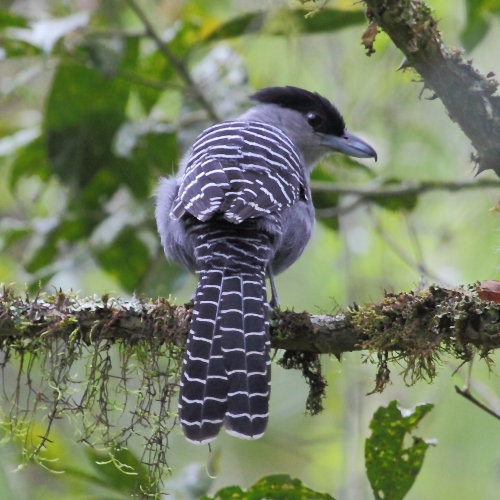
Brown-backed Antwren
Epinecrophylla fjeldsaai
Order: Passeriformes / Family: Thamnophilidae

Wikimedia Commons
About the Brown-backed Antwren
The Brown-backed Antwren (Epinecrophylla fjeldsaai) is a small but captivating bird found predominantly in the dense, humid lowland forests of South America. This species occupies a crucial ecological niche as both a predator and prey within its habitat. Its presence is most notably recorded in the Amazon Basin, particularly in regions such as southeastern Peru, western Brazil, and northern Bolivia. These areas offer the rich, tangled undergrowth and plentiful insect populations that the antwren requires for survival. The bird's significance extends beyond its role as an insectivore; it serves as an essential indicator of forest health due to its sensitivity to environmental changes. During the wet season, when insect populations burgeon, the Brown-backed Antwren becomes more active, engaging in elaborate foraging techniques to capitalize on the abundance of food. It also prefers the understory level of the forest, which provides cover and a rich hunting ground. In contrast, the dry season sees a slight shift in its behavior as it moves closer to water sources where insects congregate. The Brown-backed Antwren contributes to the forest's ecological balance by participating in the control of insect populations. It also aids in seed dispersal indirectly through its interactions with other species, which rely on the same food resources. The bird's presence in the forest undergrowth helps maintain the structure of the ecosystem by preventing any one species of insect from becoming overly dominant. As a result, the Brown-backed Antwren serves as both a keystone species and a bioindicator, alerting scientists to changes in forest health and biodiversity.
The Brown-backed Antwren belongs to the family Thamnophilidae, within the order Passeriformes. These birds typically live average 5-7 years, with some living up to 9 years..
How to Identify a Brown-backed Antwren
Identifying the Brown-backed Antwren requires careful observation of its subtle yet distinct features. Adult Brown-backed Antwrens showcase a predominantly brown plumage, which blends seamlessly with the forest understory. The back is a rich, warm brown, while the wings and tail exhibit slightly darker, more rufous tones. The underparts are a contrasting pale gray, adding to its camouflage capabilities. Males and females appear similar, although females may exhibit a slightly lighter, more uniform belly. Juveniles resemble adults but are often duller, with less contrast between the upper and lower body. In the field, the Brown-backed Antwren can be confused with similar species such as the Pygmy Antwren, but it can be distinguished by its size and the absence of white wing bars. Additionally, the Brown-backed Antwren's perching posture is often horizontal, with its tail slightly cocked, which differs from the more upright posture of the Pygmy Antwren. In flight, the Brown-backed Antwren displays rapid, flicking movements as it navigates through the dense foliage, making use of its short wings and agile body to maneuver through the forest understory.
Having trouble telling birds apart? Upload a photo to our bird identification tool for an instant species match.
Brown-backed Antwren Habitat and Range
Preferred Habitat
The Brown-backed Antwren thrives in the humid, dense understory of lowland tropical forests. It shows a preference for primary forests, where the structure and complexity provide ample cover and foraging opportunities. This bird is typically found at elevations ranging from sea level up to 1,000 meters. Seasonal shifts in habitat use are minor, though during the dry season, it may be observed closer to water bodies where insect prey is more abundant. Though primarily a forest dweller, the Brown-backed Antwren occasionally ventures into secondary growth and edge habitats, especially in undisturbed regions where such habitats border primary forest. Urban presence is minimal, as it requires the dense vegetation of rural and wilderness areas for its survival.
Geographic Range
The Brown-backed Antwren's range is confined to the western Amazon Basin, covering parts of Peru, Brazil, and Bolivia. This bird does not engage in long-distance migrations, remaining within its range year-round, though local movements occur in response to seasonal food availability. Its breeding range coincides with its general distribution, focusing on areas with high insect density and ample cover. Population density hotspots are found primarily in regions where primary forests remain intact, as these areas provide the optimal conditions for foraging and nesting. The bird's limited range and dependence on specific forest types make it vulnerable to habitat destruction, although it remains relatively widespread within suitable habitats.
Want to know which birds visit your area? Browse our backyard birds by location guides for region-specific species lists.
What Does the Brown-backed Antwren Eat?
The Brown-backed Antwren's diet primarily consists of insects and other arthropods, making it an insectivore. It feeds on a variety of prey, including ants, beetles, and spiders, which it gleans from leaves and branches within the forest understory. During the wet season, when insect populations are at their peak, the antwren becomes particularly active, engaging in acrobatic foraging maneuvers to capture prey. Seasonal changes in diet are minimal, though the species may consume more spiders and other arthropods during the dry season when insects are less abundant. The Brown-backed Antwren employs a methodical foraging technique, often seen hopping along branches and flitting between leaves with quick, precise movements. It typically feeds during daylight hours, with peak activity occurring in the morning and late afternoon when insects are most active.
Brown-backed Antwren Behavior and Social Structure
The Brown-backed Antwren exhibits a solitary or paired lifestyle, usually found alone or with a mate rather than in large flocks. It maintains a small territory, vigorously defending it from intruders, especially during the breeding season. Territorial songs and displays play a crucial role during this period. Courtship involves mutual feeding and soft vocalizations. While generally quiet, the Brown-backed Antwren becomes more vocal when establishing territory or during encounters with predators, displaying a repertoire of sharp calls. This bird's daily activities include foraging primarily in the morning and late afternoon, with midday spent resting in dense vegetation. Its response to predators involves remaining motionless and using its cryptic plumage for concealment.
Brown-backed Antwren Nesting and Reproduction
The Brown-backed Antwren constructs a small, cup-shaped nest using fine plant materials such as leaves, grass, and spider webs. Nests are often positioned in the forks of small trees or shrubs, typically at a height of 1 to 3 meters above the ground. The clutch usually consists of two eggs, which are incubated by both parents for approximately 14 days. Both parents actively participate in feeding the hatchlings, which fledge around 10 to 12 days after hatching. The species typically raises one brood per year, though in favorable conditions, a second brood may occur. Parental care continues for several weeks post-fledging, ensuring the young learn essential foraging and survival skills.
Brown-backed Antwren Sounds and Vocalizations
The Brown-backed Antwren's primary song is a series of rapid, high-pitched notes, often described as a 'trill,' delivered at a consistent rhythm. These vocalizations serve both territorial and mating purposes. Call notes are softer and more subdued, consisting of short 'chip' sounds used for communication between mates or within family groups. During moments of alarm, the bird produces sharp, intense calls to alert others of potential threats. In the early morning, the Brown-backed Antwren participates in the dawn chorus, contributing its characteristic trills to the symphony of the forest.
Interesting Facts About the Brown-backed Antwren
- 1The Brown-backed Antwren was only described in scientific literature in 2001, making it a relatively recent discovery.
- 2Despite its small size, the Brown-backed Antwren plays a significant role in controlling insect populations within its habitat.
- 3The species' cryptic plumage provides excellent camouflage, making it difficult for predators and birdwatchers alike to spot.
- 4Brown-backed Antwrens engage in mutual preening as a part of their courtship behavior, strengthening pair bonds.
- 5The distinctive trills of the Brown-backed Antwren can be heard up to 50 meters away, helping it establish territory boundaries.
- 6This species often joins mixed-species flocks, benefiting from the increased vigilance against predators provided by flock members.
- 7The Brown-backed Antwren's preference for lowland rainforest habitats makes it a key indicator species for the health of these ecosystems.
Brown-backed Antwren Conservation Status
The Brown-backed Antwren is currently classified as Least Concern by the IUCN, yet its population trend is declining due to ongoing habitat loss. Primary threats include deforestation for agriculture and logging, which reduce the availability of suitable forest habitat. Conservation efforts focus on preserving and restoring forest ecosystems, with particular emphasis on protected areas within its range. While the species is not immediately at risk of extinction, continued monitoring and habitat protection are essential to ensure its long-term survival.