
Brown-chested Barbet
Capito brunneipectus
Order: Piciformes / Family: Capitonidae

Wikimedia Commons
About the Brown-chested Barbet
The Brown-chested Barbet (Capito brunneipectus) is a striking bird endemic to the lush tropical forests of South America. Part of the Capitonidae family, this species plays a crucial role as both a predator and a seed disperser, impacting forest dynamics significantly. Its range includes Colombia, Venezuela, and parts of Brazil, where it occupies dense, humid forest canopies. The Brown-chested Barbet typically favors elevations ranging from lowland areas up to 1,500 meters, though it can occasionally be found at higher altitudes.
This barbet is especially significant for the ecological balance of its habitat. By consuming a variety of fruits, it aids in seed dispersal, thus contributing to forest regeneration. It also preys on insects, helping to control pest populations. The Brown-chested Barbet is known for its adaptability within its preferred range, but it remains highly sensitive to large-scale habitat alterations such as deforestation.
Seasonally, the Brown-chested Barbet displays intriguing behavioral adaptations. During the wet season, when fruit is abundant, its diet primarily consists of various fruits and berries. In contrast, during drier months, it supplements its diet with insects and small vertebrates. Observers note that the Brown-chested Barbet is particularly vocal during the breeding season, utilizing its calls to establish territories and attract mates. Its presence in the canopy is often revealed by its loud, distinctive calls and vibrant plumage.
The Brown-chested Barbet belongs to the family Capitonidae, within the order Piciformes. These birds typically live average 4-6 years, with a maximum recorded lifespan of 8 years..
How to Identify a Brown-chested Barbet
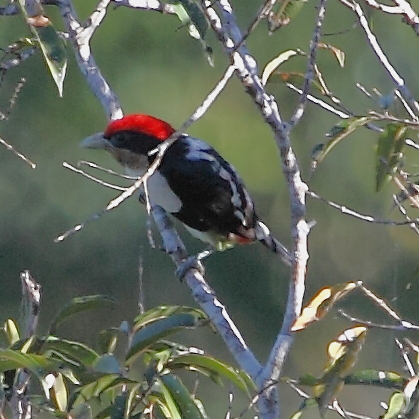
The Brown-chested Barbet is easily recognizable by its bold brown chest contrasting with its vivid green back and wings. Adults have a predominantly white plumage on their underparts, which sharply contrasts with the brown chest band. The head is adorned with a striking mix of red and yellow, making it unmistakable when viewed up close. Males and females appear similar, though males may exhibit slightly more vibrant coloration. Juveniles, however, tend to present muted tones of the adult plumage, lacking the full intensity of color until they mature.
One might confuse the Brown-chested Barbet with other barbets in its range, such as the Gilded Barbet, but the distinct brown chest band serves as a reliable field mark. Its flight is characterized by rapid wing beats and short glides, a typical barbet trait, which, coupled with its bright plumage, makes it an eye-catching presence in the forest canopy. When perched, the Brown-chested Barbet maintains an upright posture, often staying still for long periods as it surveys its surroundings.
Having trouble telling birds apart? Upload a photo to our bird identification tool for an instant species match.
Brown-chested Barbet Habitat and Range
Preferred Habitat
Primarily inhabiting tropical lowland and montane forests, the Brown-chested Barbet thrives in dense canopy environments. It is most frequently found in mature forests where large fruiting trees provide both food and nesting sites. While it prefers primary forests, this barbet can also adapt to secondary growth areas, provided there is sufficient canopy cover and food availability.
The elevation range for this species extends from sea level up to 1,500 meters, with occasional sightings at higher altitudes depending on local habitat conditions. Although primarily a forest dweller, the Brown-chested Barbet occasionally ventures into forest edges and clearings, particularly when food sources are scarce. It is rarely seen in urban environments, underscoring its reliance on forested areas for survival.
Geographic Range
The Brown-chested Barbet's range spans several countries in northern South America. It is predominantly found in Colombia, Venezuela, and parts of Brazil. In Colombia, it inhabits the Andean foothills and adjacent lowland forests, extending into Venezuela's Orinoco and Amazon basins. Within Brazil, its range is more restricted to the western and northern parts, particularly in the Amazonian region.
This species does not engage in long-distance migrations, but it may exhibit local movements in response to seasonal food availability. During the breeding season, which coincides with the wettest months, the Brown-chested Barbet tends to concentrate in areas with abundant fruiting trees. Population densities are highest in undisturbed forest areas, where they enjoy a stable supply of food and nesting sites. Fragmented forests and heavily altered landscapes see fewer barbets, indicating their sensitivity to habitat disturbance.
Want to know which birds visit your area? Browse our backyard birds by location guides for region-specific species lists.
What Does the Brown-chested Barbet Eat?
The diet of the Brown-chested Barbet is primarily frugivorous, consisting mainly of berries and fruits from a variety of forest trees. Ficus and Cecropia species are particularly favored, as their fruiting coincides with the barbet's peak feeding periods. During the wet season, when fruit is plentiful, barbets consume large quantities of these fruits, which directly aids in seed dispersal throughout the forest.
In the drier months, the Brown-chested Barbet diversifies its diet by including insects and small vertebrates. It employs a foraging technique that involves hopping through the canopy and picking off fruits and insects from branches and leaves. The barbet's strong beak is adept at breaking through tough fruit skins and capturing elusive prey. Its feeding schedule coincides with the cooler early morning and late afternoon hours when it is most active.
Want to attract Brown-chested Barbets to your yard? See our recommended feeders and seed types for the best results.
Brown-chested Barbet Behavior and Social Structure
The Brown-chested Barbet exhibits a complex social structure, often forming monogamous pairs during the breeding season. These pairs establish and defend their territories vigorously, using vocalizations to ward off intruders and assert dominance. Courtship displays involve mutual preening and the exchange of food items, strengthening pair bonds.
Outside the breeding season, barbets may form small flocks, particularly when foraging in areas with abundant fruit supplies. They are generally solitary or found in pairs, reflecting their territorial nature. In response to predators, the Brown-chested Barbet employs a series of alarm calls and may resort to mobbing behavior, particularly against aerial threats.
Daily activity patterns show peak activity during the early morning and late afternoon. During the hottest parts of the day, barbets often retreat to the forest canopy's shade, reducing their visibility and activity levels.
Brown-chested Barbet Nesting and Reproduction
Brown-chested Barbets are cavity nesters, often utilizing old woodpecker holes or natural cavities in trees. They may also excavate their own nest sites in decaying wood, using their strong bills to chip away at the soft substrate. Nesting sites are typically located several meters above ground to reduce predation risk.
The typical clutch size ranges from 2 to 4 eggs, with both parents sharing incubation duties over a period of approximately 14 to 18 days. After hatching, the chicks remain in the nest for about 30 days, during which both parents are actively involved in feeding and caring for the young. The species usually raises one brood per year, although under favorable conditions, a second brood may be attempted.
Brown-chested Barbet Sounds and Vocalizations
The primary song of the Brown-chested Barbet is a series of deep, resonant notes delivered in a steady rhythm. The song can be described as a 'took-took' sequence, similar to the sound of a distant woodblock. These calls are most frequently heard during the breeding season when males use them to establish territory and attract mates.
In addition to their primary song, barbets emit harsh, chattering notes when alarmed or agitated, serving as an effective means of communication among pairs and family groups. The dawn chorus of the Brown-chested Barbet is a prominent feature of the forest soundscape, with calls echoing through the canopy at first light.
Interesting Facts About the Brown-chested Barbet
- 1The Brown-chested Barbet is known for its powerful beak, capable of excavating nest cavities in decaying wood.
- 2This species contributes significantly to forest regeneration by dispersing seeds over large areas.
- 3Brown-chested Barbets often use old woodpecker holes as nesting sites, highlighting their adaptability.
- 4During the non-breeding season, they may form small flocks to forage more efficiently.
- 5These barbets have a preference for dense canopies, where they remain hidden from predators.
Brown-chested Barbet Conservation Status
The Brown-chested Barbet is currently classified as Least Concern by the IUCN. Despite its stable population trend, the species faces threats from habitat destruction and fragmentation due to logging and agricultural expansion. Conservation efforts focus on preserving large tracts of contiguous forest and creating protected areas to ensure suitable habitats remain intact. Historically, the barbet's population has remained relatively stable, though localized declines have been noted in heavily deforested areas. Continued monitoring and habitat protection are essential to safeguard the future of this vibrant species.
Attracting Brown-chested Barbets to Your Feeder
The Brown-chested Barbet is a regular visitor to backyard bird feeders across its range. At the Eye On The Fly feeding station, we observe Brown-chested Barbets regularly and capture footage with our feeder cameras.
Other Capitonidae Species



Birds Similar to the Brown-chested Barbet
These species are often confused with the Brown-chested Barbet due to similar appearance or overlapping range.