
Scarlet-crowned Barbet
Capito aurovirens
Order: Piciformes / Family: Capitonidae

Wikimedia Commons
About the Scarlet-crowned Barbet
The Scarlet-crowned Barbet (Capito aurovirens) is a visually striking bird found in the diverse tropical lowland forests of northern South America. This species is significant not only for its vibrant plumage but also for its ecological role as a seed disperser, aiding in the propagation of numerous plant species. The Scarlet-crowned Barbet thrives in the Amazon Basin, which includes countries such as Colombia, Venezuela, Ecuador, Peru, and Brazil. This barbet prefers dense forests and is particularly common in regions with abundant fruit-bearing trees, as it primarily feeds on fruits. Its presence in these forests is essential for maintaining the health and diversity of these ecosystems. During the breeding season, the Scarlet-crowned Barbet becomes more vocal and active, often seen in pairs as they engage in courtship displays. The bird's call can be heard resonating through the forest, adding to the soundscape of its habitat. Despite being non-migratory, some local movements occur in response to fruit availability. This behavior helps ensure that the barbet remains in areas where its preferred food sources are plentiful. The Scarlet-crowned Barbet's ecological role extends beyond seed dispersal. As a consumer of a variety of fruits and insects, it helps control insect populations, contributing to the balance of its ecosystem. Its interactions with other species, such as sharing resources with frugivorous birds, highlight its integral role in the forest community. Preservation of its habitat is crucial for maintaining not just the Scarlet-crowned Barbet population but also the overall biodiversity of the region.
The Scarlet-crowned Barbet belongs to the family Capitonidae, within the order Piciformes. These birds typically live average 5-7 years, with the longest recorded lifespan being 9 years..
How to Identify a Scarlet-crowned Barbet
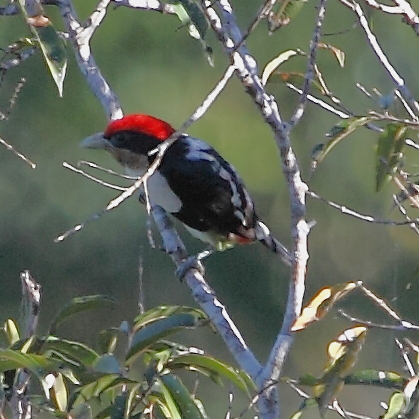
Identifying the Scarlet-crowned Barbet is straightforward due to its distinctive red crown, which stands out against the predominantly green and yellow body. The adult plumage features a striking contrast between its black back and wings and the bright yellow chest and belly. A white throat patch further accentuates its vivid coloration. Juveniles are duller in color, with a less pronounced red crown and more muted yellows and greens. There are subtle differences between males and females; males generally possess brighter red crowns and more vibrant overall plumage. In terms of confusion with similar species, the Scarlet-crowned Barbet can be distinguished from other barbets by its unique color combination. In flight, the bird displays a relatively short, rounded silhouette with rapid wing beats. When perched, it often adopts an upright posture, showcasing its colorful head and chest prominently. Its stout bill, adapted for consuming fruit, is another key feature that aids in its identification.
Having trouble telling birds apart? Upload a photo to our bird identification tool for an instant species match.
Scarlet-crowned Barbet Habitat and Range
Preferred Habitat
The Scarlet-crowned Barbet primarily inhabits tropical lowland forests, thriving in humid environments rich in fruiting trees. It is typically found at elevations ranging from sea level to about 900 meters. The bird shows a preference for dense, primary forests but can also occupy secondary growth and forest edges, especially where fruit is abundant. Unlike some other species, the Scarlet-crowned Barbet does not commonly venture into urban areas, although it may be seen in rural settings where forested areas remain intact. Seasonal habitat shifts are minimal, as this species does not migrate. Instead, it adjusts its range locally according to fruit availability. Thus, while primarily a forest-dwelling bird, it may occasionally be found in adjacent habitats that provide adequate food resources.
Geographic Range
The Scarlet-crowned Barbet's range is confined to the northern regions of South America, primarily within the Amazon Basin. Its distribution spans Colombia, Venezuela, Ecuador, Peru, and Brazil, with some occurrences in northern Bolivia. The breeding range of the Scarlet-crowned Barbet aligns closely with its overall range, as the species is non-migratory. Consequently, there are no significant migration corridors for this bird. Population density hotspots include areas with extensive undisturbed forest coverage, particularly regions with high fruit availability. These areas typically support thriving barbet populations. However, its presence becomes sparser in regions where deforestation has reduced suitable habitats. Conservation efforts in these regions focus on preserving remaining forest tracts to maintain viable populations of the Scarlet-crowned Barbet.
Want to know which birds visit your area? Browse our backyard birds by location guides for region-specific species lists.
What Does the Scarlet-crowned Barbet Eat?
The primary diet of the Scarlet-crowned Barbet consists of a variety of fruits, which it forages in the forest canopy. Its strong, stout bill allows it to consume fruits of different sizes, from small berries to larger drupes. Seasonally, its diet shifts slightly as certain fruits become more or less abundant. In addition to fruit, the barbet occasionally consumes insects and other small invertebrates, supplementing its diet with protein. Foraging techniques include perching quietly in fruiting trees and making short flights to pluck fruit from branches. It often feeds during the cooler morning hours, taking advantage of the availability of ripe fruits. As a frugivore, the Scarlet-crowned Barbet plays a critical role in seed dispersal, helping to maintain plant diversity in its habitat. By moving between feeding sites, it spreads seeds across the forest, facilitating the growth of new plants.
Scarlet-crowned Barbet Behavior and Social Structure
The Scarlet-crowned Barbet exhibits a range of behaviors that highlight its adaptability and social nature. It is often seen in pairs or small family groups, particularly during the breeding season when pairs engage in cooperative nesting and feeding activities. Territorial behavior is evident as vocalizations and displays are used to defend feeding areas and nesting sites from intruders. Courtship displays involve a combination of vocalizations, displays of plumage, and mutual preening, strengthening the bond between mating pairs. Flocking behavior is occasionally observed, especially when food resources are plentiful, allowing multiple birds to feed together without significant competition. The Scarlet-crowned Barbet remains active throughout the day, with peak activity occurring in the early morning and late afternoon when temperatures are cooler. In response to predators, it employs a mix of vocal alarms and evasive flight, often retreating to dense foliage for cover.
Scarlet-crowned Barbet Nesting and Reproduction
The nesting habits of the Scarlet-crowned Barbet are fascinating, reflecting its adaptation to forest environments. It typically nests in tree cavities, either natural or those excavated by other birds, such as woodpeckers. The bird may also use artificial nest boxes if available. Nesting sites are usually located several meters above ground, providing protection from ground-based predators. The clutch size ranges from two to four eggs, which are incubated by both parents for approximately 14-16 days. After hatching, the chicks remain in the nest for about 30 days, during which both parents participate in feeding and caring for the young. The Scarlet-crowned Barbet generally raises one brood per year, although in regions with abundant food, a second brood may occur. Parental roles are well-defined, with both sexes sharing responsibilities in incubating eggs and feeding chicks.
Scarlet-crowned Barbet Sounds and Vocalizations
The Scarlet-crowned Barbet's primary song is a repetitive series of short, sharp notes that carry well through the dense forest canopy. This song, often described as a series of 'tuk' or 'tok' sounds, serves as both a territorial and mate-attracting call. In addition to its primary song, the barbet uses a variety of call notes to communicate with mates and signal alarms in response to potential threats. These calls are generally short, sharp, and vary slightly in pitch. Dawn chorus participation is a notable behavior, with the barbet's vocalizations contributing to the early morning soundscape. Compared to other birds, its calls are less melodious but more rhythmic and consistent, aiding in its identification even when not in direct view.
Interesting Facts About the Scarlet-crowned Barbet
- 1The Scarlet-crowned Barbet is not only a visual delight but is also a crucial seed disperser in its habitat, aiding plant reproduction.
- 2Despite its striking appearance, the Scarlet-crowned Barbet can be surprisingly difficult to spot in the dense forest canopy.
- 3The species' range is entirely within the Amazon Basin, highlighting its reliance on tropical forest ecosystems.
- 4Scarlet-crowned Barbets have a broad diet that includes over 30 different species of fruit-bearing plants.
- 5While primarily frugivorous, the barbet also plays a role in controlling insect populations by consuming them opportunistically.
- 6The Scarlet-crowned Barbet's song is a defining feature of the Amazon forest's dawn chorus, a testament to its presence.
- 7Barbets have zygodactyl feet, with two toes facing forward and two backward, aiding in their arboreal lifestyle.
Scarlet-crowned Barbet Conservation Status
The IUCN currently lists the Scarlet-crowned Barbet as a species of Least Concern, with population trends considered stable. However, the primary threat to this species is habitat loss due to deforestation and land conversion for agriculture. Conservation efforts focus on protecting large areas of tropical forest to ensure the long-term survival of the Scarlet-crowned Barbet and other forest-dependent species. Historically, population changes have mirrored the rate of deforestation in its range, with declines noted in heavily affected areas. Continued efforts to manage and preserve habitat, alongside education and awareness programs, are crucial in mitigating threats to this vibrant bird.
Other Capitonidae Species



Birds Similar to the Scarlet-crowned Barbet
These species are often confused with the Scarlet-crowned Barbet due to similar appearance or overlapping range.