
Gilded Barbet
Capito auratus
Order: Piciformes / Family: Capitonidae

Wikimedia Commons
About the Gilded Barbet
The Gilded Barbet (Capito auratus) occupies a notable position in the avian world, characterized by its vibrant plumage and intriguing behavior. This medium-sized bird, part of the Capitonidae family, is primarily found in the lowland rainforests of South America. Its range extends across several countries, including Colombia, Ecuador, Peru, Bolivia, and Brazil. The lush, humid forests provide an ideal habitat for the Gilded Barbet, with dense canopy and abundant food sources. These birds thrive in tropical climates, making the Amazon Basin a critical part of their distribution. The ecological role of the Gilded Barbet is significant. As a frugivore, it contributes to seed dispersal, aiding in forest regeneration and diversity. The bird's diet primarily consists of fruits, which it deftly extracts using its stout bill. This feeding behavior not only aids in plant propagation but also supports a variety of other species that rely on the same fruit trees. Seasonal behaviors of the Gilded Barbet include shifts in feeding patterns and territory defense, particularly during the breeding season. During this time, both males and females become more vocal and active, establishing and defending territories to ensure successful mating and rearing of young. The Gilded Barbet's presence is a vital indicator of forest health. Its reliance on intact, undisturbed habitats makes it sensitive to environmental changes. Deforestation and habitat fragmentation pose significant threats, potentially impacting its population. Conservation efforts are crucial to maintaining the ecological balance in regions where the Gilded Barbet resides. Understanding the bird's behavior, habitat preferences, and ecological significance can provide valuable insights into the health of tropical ecosystems.
The Gilded Barbet belongs to the family Capitonidae, within the order Piciformes. These birds typically live average 5-7 years, with a max recorded of 10 years..
How to Identify a Gilded Barbet
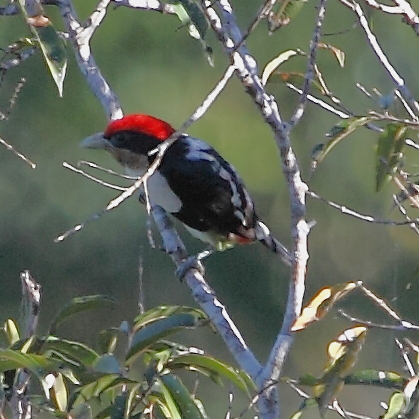
Identifying the Gilded Barbet involves noting its distinctive coloration and features. The adult plumage is particularly striking, with a bright yellow body contrasted by a glossy black cap and neck, setting it apart from other species. The face and throat also exhibit patches of black, while the wings and tail are brown with hints of green. Males and females are similar in appearance, making gender differentiation challenging in the field. Juveniles, however, can be distinguished by their duller, more muted colors and lack of the pronounced black cap seen in adults. Birders should note the bird's robust bill, which is a key adaptation for its frugivorous diet. In flight, the Gilded Barbet presents a compact silhouette with rapid wingbeats and a short tail, which aids in agile navigation through dense forest canopies. When perched, it maintains an upright posture, often remaining motionless for extended periods, a behavior that aids in camouflage. Confusion with similar species, such as the Scarlet-hooded Barbet, can occur, but the Gilded Barbet's unique color pattern and distinct vocalizations help in accurate identification.
Having trouble telling birds apart? Upload a photo to our bird identification tool for an instant species match.
Gilded Barbet Habitat and Range
Preferred Habitat
The Gilded Barbet inhabits tropical lowland forests, thriving in environments with dense canopy cover and abundant fruit-bearing trees. These habitats are primarily found in the Amazon Basin, stretching across countries like Peru, Ecuador, and Brazil. The elevation range for this species typically lies between sea level and 1,200 meters, favoring the humid climate of primary and secondary forests. The bird shows a marked preference for areas with minimal human disturbance, although it can occasionally be found in secondary growth forests that provide sufficient resources. Unlike some birds that adapt well to urban settings, the Gilded Barbet remains predominantly in rural, forested areas. Seasonal habitat shifts are minimal, as the species tends to be sedentary, remaining within its established range year-round.
Geographic Range
The Gilded Barbet's range encompasses several key regions in South America, highlighting its preference for tropical, lowland environments. It can be found in Colombia, Ecuador, Peru, Bolivia, and the extensive rainforests of Brazil. Unlike migratory species, the Gilded Barbet does not undertake significant seasonal movements, maintaining a year-round presence within its established range. Population density hotspots occur in areas where fruiting trees are abundant, providing necessary food resources. While the bird's distribution is relatively widespread within its preferred habitat, localized threats such as deforestation can impact populations. Conservation efforts focus on preserving large tracts of intact forest to support this and other dependent species.
Want to know which birds visit your area? Browse our backyard birds by location guides for region-specific species lists.
What Does the Gilded Barbet Eat?
The diet of the Gilded Barbet centers primarily around fruit, which makes up the bulk of its nutritional intake. It favors a variety of fruits, including figs and berries, which it consumes by using its strong, stout bill to pluck from trees. This frugivorous diet plays a crucial role in seed dispersal, facilitating forest regeneration. During certain seasons, when fruit availability may fluctuate, the barbet may supplement its diet with insects and small invertebrates, which provide additional protein. Foraging typically occurs in the early morning and late afternoon, when the bird can take advantage of cooler temperatures and reduced competition from other frugivores. It employs a methodical approach to foraging, moving systematically through the mid to upper canopy levels of the forest to locate ripe fruits.
Gilded Barbet Behavior and Social Structure
The Gilded Barbet exhibits intriguing social and territorial behaviors. It is generally seen alone or in pairs, rather than large flocks, reflecting its territorial nature. During the breeding season, males become particularly vocal and aggressive in defending their chosen territory from rivals. Courtship displays include a series of calls and postures designed to attract a mate and establish pair bonds. Once paired, both male and female participate in territory defense and nesting duties. The barbet's daily activity patterns include periods of foraging interspersed with rest and vocal communication. Its response to predators involves remaining motionless to avoid detection, leveraging its camouflage in the dense foliage. The bird's vocalizations play a role in maintaining social bonds and signaling presence to conspecifics.
Gilded Barbet Nesting and Reproduction
Nesting for the Gilded Barbet involves selecting a suitable cavity in a tree, often one that has been naturally formed or previously used by other species. The bird does not typically excavate its own nests but will modify an existing cavity as needed. Preferred nesting sites are located high in the canopy, providing protection from ground-based predators. The female lays a clutch of 2-3 eggs, which both parents incubate over a period of approximately 14 days. After hatching, the chicks remain in the nest for about 30 days before fledging. Both male and female share feeding and brooding responsibilities, ensuring the young receive adequate nutrition and care. The Gilded Barbet typically raises one or two broods per year, depending on food availability and environmental conditions.
Gilded Barbet Sounds and Vocalizations
The primary song of the Gilded Barbet is a repetitive, melodious series of notes, often described as a resonant 'wook-wook-wook,' delivered in a steady rhythm. This song serves as a territorial call and a means of communication between mates. In addition to its song, the bird produces a variety of call notes, including short, sharp 'chip' sounds used in social interactions and as alarm calls. During the dawn chorus, the Gilded Barbet actively participates, its voice contributing to the rich tapestry of sounds in the forest. These vocalizations are crucial for establishing presence and maintaining social bonds within its territory.
Interesting Facts About the Gilded Barbet
- 1The Gilded Barbet's diet makes it an important seed disperser, aiding forest regeneration.
- 2Both male and female Gilded Barbets participate equally in nesting duties, sharing incubation and feeding.
- 3The Gilded Barbet's song can often be heard before the bird is seen, as it remains well-camouflaged in the canopy.
- 4The species is non-migratory, residing year-round in its tropical forest habitat.
- 5Juvenile Gilded Barbets lack the distinctive black cap of adults, aiding in age identification.
- 6Despite its preference for dense forests, the Gilded Barbet can adapt to secondary growth areas when necessary.
- 7The Gilded Barbet's strong bill is adapted for its frugivorous diet, allowing it to pluck and consume a variety of fruits.
Gilded Barbet Conservation Status
Listed as Least Concern by the IUCN, the Gilded Barbet maintains a stable population trend, although local populations face pressure from habitat destruction. Primary threats include deforestation for agriculture and logging, which result in habitat fragmentation. Despite these challenges, the bird's range within protected areas and its adaptability to secondary forests help mitigate some risks. Conservation efforts focus on preserving large tracts of forest and promoting sustainable land use practices. Historical population changes have seen declines in heavily deforested regions, underscoring the importance of ongoing conservation measures.
Other Capitonidae Species



Birds Similar to the Gilded Barbet
These species are often confused with the Gilded Barbet due to similar appearance or overlapping range.