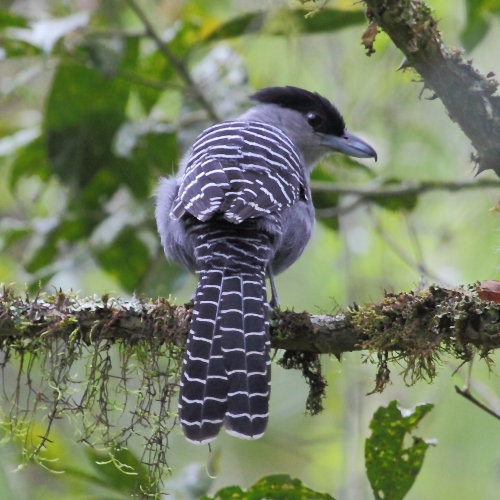
Brownish-headed Antbird
Schistocichla brunneiceps
Order: Passeriformes / Family: Thamnophilidae

Wikimedia Commons
About the Brownish-headed Antbird
The Brownish-headed Antbird, scientifically known as Schistocichla brunneiceps, inhabits the dense undergrowth of tropical forests across northern South America. This bird, part of the Thamnophilidae family, is predominantly found in regions such as the Amazon Basin, spanning countries like Brazil, Colombia, Venezuela, and Peru. Its habitat preference includes lowland evergreen forests, where it thrives in the shaded understory. The bird plays a significant ecological role as both a predator and a prey species within this complex ecosystem. By feeding on insects and small invertebrates, the Brownish-headed Antbird helps control pest populations, contributing to the ecological balance of its habitat. The species demonstrates a degree of territorial behavior, particularly during the breeding season, when it becomes more vocal. Seasonally, this bird does not undertake long migrations but may shift locally within its range to exploit varying food resources. The Brownish-headed Antbird's presence is a valuable indicator of healthy forest ecosystems, as it relies on dense foliage for foraging and nesting. The bird's cryptic plumage aids in camouflage, minimizing predation risks and allowing it to navigate the forest floor stealthily. Its ecological significance extends beyond its feeding habits; it also acts as a seed disperser when consuming fruit, inadvertently aiding in forest regeneration. Observing the Brownish-headed Antbird requires patience and a keen eye, as its elusive behavior and preference for thick vegetation make it a challenging yet rewarding subject for birdwatchers and researchers alike.
The Brownish-headed Antbird belongs to the family Thamnophilidae, within the order Passeriformes. These birds typically live typically 3-5 years, with some individuals reaching up to 6 years..
How to Identify a Brownish-headed Antbird
The Brownish-headed Antbird can be identified by its distinctive brown crown, which contrasts with its otherwise grayish-brown plumage. Adult antbirds exhibit a uniform coloration across their bodies, with subtle variations in shading that provide effective camouflage within the forest understory. The species does not exhibit significant sexual dimorphism, making males and females difficult to distinguish in the field. However, close observation may reveal slight differences in the intensity of the brown head coloration. Juveniles resemble adults but typically display a duller, more mottled plumage that gradually transitions to the adult pattern as they mature. In flight, the Brownish-headed Antbird shows a compact silhouette with short, rounded wings and a relatively long tail, adaptations that facilitate agile maneuvering through dense vegetation. Perched individuals often adopt a horizontal posture, blending seamlessly with their surroundings. The bird's short, strong legs and curved bill are adapted for foraging in the leaf litter and probing into crevices for prey. Compared to similar species, such as the Spot-backed Antbird, the Brownish-headed Antbird lacks distinct markings on its back, aiding in its identification. Birdwatchers should note the subtle differences in plumage and behavior to accurately identify this species in its natural habitat.
Having trouble telling birds apart? Upload a photo to our bird identification tool for an instant species match.
Brownish-headed Antbird Habitat and Range
Preferred Habitat
The Brownish-headed Antbird primarily inhabits lowland tropical forests, favoring areas with dense understory vegetation. It thrives in regions with thick foliage, where it can forage and nest with minimal disturbance. This species is predominantly found at elevations ranging from sea level to approximately 600 meters, although it may occasionally venture higher in search of food or during the breeding season. The bird's preference for undisturbed forest habitats makes it more common in remote areas than in regions subject to deforestation or urbanization. Seasonal changes may prompt local movements within its range, particularly during periods of food scarcity when it seeks out alternative feeding grounds. Unlike some antbird species, the Brownish-headed Antbird does not typically inhabit secondary or fragmented forests, relying instead on the structural complexity of mature forests for survival. Its presence is a strong indicator of habitat integrity, as the bird's survival depends on the availability of dense cover and abundant invertebrate prey.
Geographic Range
The Brownish-headed Antbird's range extends across a significant portion of northern South America, with its core distribution centered in the Amazon Basin. Countries where it is commonly found include Brazil, Colombia, Venezuela, and Peru. Within these regions, the bird occupies a range of forested habitats, particularly lowland evergreen forests where dense understory growth provides ideal conditions for foraging and nesting. While the species does not undertake long-distance migrations, it may exhibit local movements in response to seasonal changes in food availability. Population density is highest in areas with extensive, undisturbed forest cover, particularly in remote regions of the Amazon where human impact is minimal. Despite its broad range, the bird's presence can be patchy, reflecting the distribution of suitable habitat. Conservation efforts in these regions focus on maintaining habitat integrity and preventing further deforestation, which poses a significant threat to the Brownish-headed Antbird's continued survival.
Want to know which birds visit your area? Browse our backyard birds by location guides for region-specific species lists.
What Does the Brownish-headed Antbird Eat?
The Brownish-headed Antbird primarily feeds on a diet of insects and small invertebrates, which it skillfully extracts from leaf litter and decaying wood on the forest floor. Common prey items include ants, beetles, spiders, and caterpillars. During the wet season, the bird may expand its diet to include fruit and seeds, taking advantage of seasonal abundance. Foraging behavior is characterized by deliberate movements through dense underbrush, where the bird uses its curved bill to probe crevices and overturn leaves. This technique allows it to exploit a variety of microhabitats within its territory. The antbird typically feeds alone or in pairs, although it may join mixed-species foraging flocks, benefiting from the collective vigilance against predators. Feeding occurs primarily during the early morning and late afternoon when insect activity is highest, though the bird remains alert for opportunities throughout the day. The ability to adapt its foraging strategy to seasonal variations in prey availability highlights the Brownish-headed Antbird's ecological flexibility.
Brownish-headed Antbird Behavior and Social Structure
The Brownish-headed Antbird exhibits a range of behaviors that reflect its adaptation to life in dense tropical forests. Socially, it tends to be solitary or found in pairs, with both males and females actively defending their territory from intruders. Territorial disputes involve vocal displays and occasional physical confrontations, although these are generally brief. During the breeding season, courtship displays include vocalizations and mutual preening, strengthening pair bonds. The species does not typically form large flocks, but it may join mixed-species groups for foraging, benefiting from shared vigilance against predators. In response to perceived threats, the Brownish-headed Antbird employs a range of alarm calls and evasive maneuvers, retreating swiftly into dense cover. Its daily activity patterns are primarily diurnal, with peak activity occurring in the early morning and late afternoon. The bird's behavior reflects a balance between foraging efficiency and predator avoidance, underscoring its role as a cautious yet effective predator within the forest ecosystem.
Brownish-headed Antbird Nesting and Reproduction
The Brownish-headed Antbird constructs its nest low to the ground, often within dense underbrush or concealed within clumps of vegetation. The nest itself is a compact, cup-shaped structure made from twigs, leaves, and other plant materials, lined with softer fibers for insulation. Clutch size typically ranges from two to three eggs, which both parents incubate for a period of approximately 14 to 16 days. The eggs are pale with subtle speckling, providing camouflage against the forest floor. Once hatched, the chicks remain in the nest for about 10 to 12 days, during which both parents participate in feeding and protection. Post-fledging, the young continue to receive parental care until they are fully independent, usually within a few weeks. The species generally raises one brood per year, although favorable conditions may occasionally permit a second attempt. Nesting success is closely tied to habitat quality, as disturbance and predation can significantly impact reproductive outcomes.
Brownish-headed Antbird Sounds and Vocalizations
The primary song of the Brownish-headed Antbird is a series of sharp, rhythmic notes delivered in a deliberate sequence. Each note is clear and piercing, with a moderate pitch that carries well through the dense forest canopy. In addition to its song, the bird produces a variety of call notes used for communication between mates and as alarms. These calls are shorter and more abrupt, often delivered in rapid succession when alerting others to potential danger. During the dawn chorus, the Brownish-headed Antbird's vocalizations contribute to the symphony of the forest, signaling its presence and reinforcing territorial boundaries. The bird's song is distinctive, allowing experienced listeners to distinguish it from other antbird species with similar habitats. Its vocal repertoire plays a crucial role in maintaining social bonds and coordinating activities within the pair.
Interesting Facts About the Brownish-headed Antbird
- 1The Brownish-headed Antbird's name reflects its distinctive crown coloration, unique among antbirds.
- 2Despite its secretive nature, the Brownish-headed Antbird's song is a key tool for territory defense.
- 3This species is an indicator of healthy forest ecosystems, depending on dense understory for survival.
- 4The Brownish-headed Antbird rarely ventures into open areas, preferring the cover of thick foliage.
- 5Both male and female Brownish-headed Antbirds share responsibilities in nest building and chick rearing.
- 6The bird's diet includes ants and termites, making it an effective pest controller in its habitat.
- 7Brownish-headed Antbirds are known to join mixed-species flocks, benefiting from collective predator vigilance.
Brownish-headed Antbird Conservation Status
The Brownish-headed Antbird is currently listed as Least Concern by the IUCN, with population trends considered stable. However, ongoing threats such as habitat loss due to deforestation and land conversion pose significant risks to its long-term survival. Conservation efforts focus on preserving large tracts of undisturbed forest and implementing sustainable land-use practices. Protected areas and reserves in the Amazon Basin are crucial for the species' conservation, offering safe havens from habitat destruction. Historical population data suggest that while the species has maintained stable numbers, localized declines have occurred in regions experiencing intense logging and agricultural expansion. Continued monitoring and habitat protection efforts are essential to ensure the Brownish-headed Antbird remains a thriving component of its ecosystem.