Capped Wheatear
Oenanthe pileata
Order: Passeriformes / Family: Muscicapidae
Wikimedia Commons
About the Capped Wheatear
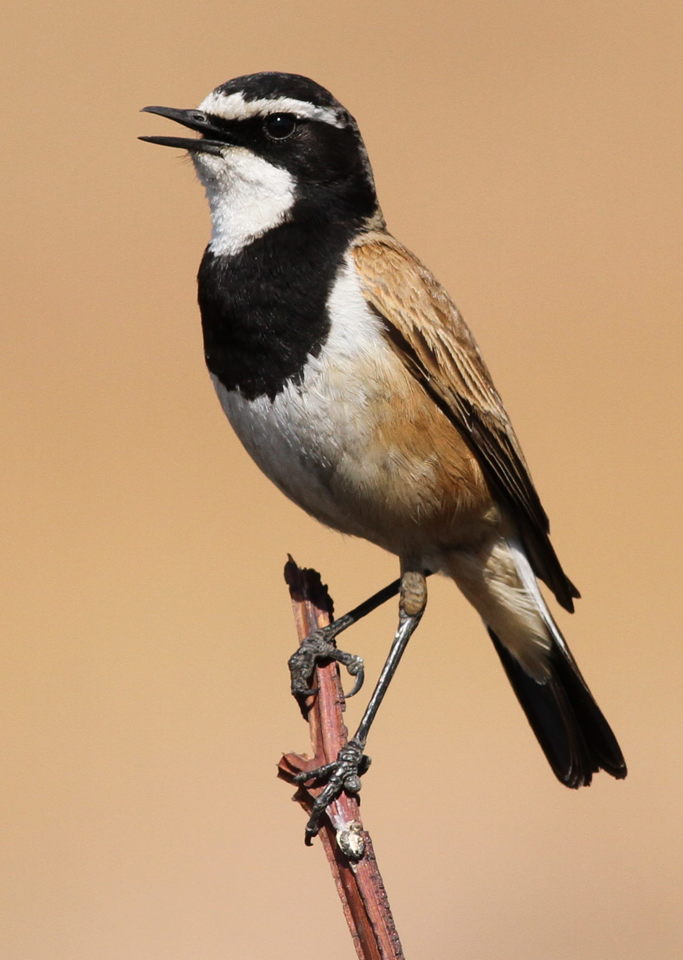
The Capped Wheatear (Oenanthe pileata) is a striking songbird native to the open landscapes of southern Africa, showcasing a distinctive black cap and white underparts. This species belongs to the family Muscicapidae and is a prominent inhabitant of grasslands, savannas, and semi-arid regions. It plays a significant ecological role by controlling insect populations and dispersing seeds. Found primarily in South Africa, Botswana, Namibia, and Zimbabwe, the Capped Wheatear adapts well to its environment, frequently seen foraging on the ground. They are mostly sedentary, with some seasonal movement in response to food availability and rainfall patterns. Behaviorally, the Capped Wheatear exhibits a unique combination of ground-feeding techniques and aerial pursuits, allowing it to exploit a variety of prey including insects and small invertebrates. During wetter months, they may shift territories slightly to exploit new food sources, while remaining within their established range. The Capped Wheatear's song, a series of melodious notes and trills, is a defining characteristic that can often be heard across its range, particularly during the breeding season. Their vocalizations are not only a means of communication but also serve to establish and defend territories. The presence of this bird is crucial for maintaining the ecological balance in its habitat, as it helps regulate insect populations that could otherwise reach pest levels. In addition to their ecological contributions, Capped Wheatears are indicators of healthy grassland ecosystems. Observing these birds can provide insights into the overall health of their habitats, as changes in their populations may reflect broader environmental shifts.
The Capped Wheatear belongs to the family Muscicapidae, within the order Passeriformes. These birds typically live average 5-8 years with limited data on maximum lifespan..
How to Identify a Capped Wheatear
The Capped Wheatear is easily recognized by its contrasting plumage. Adults display a bold black cap extending from the beak to the nape, which sharply contrasts with their white throat and belly. The back and wings are a warm brown, offering a distinctive contrast to the black and white coloration. Juveniles tend to have a duller appearance, with a more mottled brown plumage and less defined cap, which becomes more distinct as they mature. Male and female Capped Wheatears show minimal differences in plumage, although males might exhibit slightly more vibrant colors during the breeding season. In flight, the Capped Wheatear's silhouette is characterized by its straight, pointed wings and slightly rounded tail, often with noticeable white edges. This silhouette, combined with its agile flight pattern, can help distinguish it from similar species like the Familiar Chat, which lacks the distinct black cap. When perched, the Capped Wheatear often sits upright, displaying its characteristic plumage to full effect, which can aid in identification even from a distance. The bird's posture, along with its active foraging behavior on the ground, provides reliable identification clues.
Having trouble telling birds apart? Upload a photo to our bird identification tool for an instant species match.
Capped Wheatear Habitat and Range
Preferred Habitat
The Capped Wheatear thrives in open habitats such as grasslands, savannas, and semi-arid regions. It is particularly fond of areas with sparse vegetation that provide ample ground for foraging. In these environments, they can be found at elevations ranging from sea level to approximately 2,000 meters. While they prefer rural landscapes, they can sometimes be found in urban fringes where suitable open spaces exist. Seasonal habitat shifts are minimal, as they are largely non-migratory, but they may adjust their range slightly in response to rainfall and food abundance. The bird's preference for open, undeveloped landscapes makes it less common in densely forested or heavily urbanized areas.
Geographic Range
The Capped Wheatear's range primarily covers southern Africa, where it is resident throughout countries such as South Africa, Namibia, Botswana, and Zimbabwe. Breeding occurs across this range, with a particular concentration in the more open and arid regions. While they are largely sedentary, some local movements occur in response to environmental conditions, particularly during dry seasons when they might venture into new areas in search of food. The absence of long-distance migration means they do not have defined migration corridors, but they are spread widely across suitable habitats within their range. Population density tends to be higher in areas where grasslands and savannas are undisturbed by human activities.
Want to know which birds visit your area? Browse our backyard birds by location guides for region-specific species lists.
What Does the Capped Wheatear Eat?
The diet of the Capped Wheatear primarily consists of insects and other small invertebrates. Beetles, ants, and caterpillars form a significant part of their diet, alongside small spiders and other arthropods. During the drier months, they may also consume seeds and small berries, adapting their diet to the available resources. Foraging primarily takes place on the ground, where they employ a run-and-pause technique to capture prey. They exhibit remarkable agility in chasing insects flushed from grass or soil. While they feed throughout the day, peak foraging activity often occurs during the cooler morning and late afternoon hours. The Capped Wheatear's diet plays a crucial role in controlling insect populations, thus benefiting agricultural landscapes.
Capped Wheatear Behavior and Social Structure
Capped Wheatears exhibit a solitary or paired social structure, often seen alone or in pairs rather than large groups. Territorial behavior is pronounced, especially during the breeding season when males actively defend their territory through song and physical displays. Courtship involves aerial displays and vocalizations, with the male showcasing his plumage and agility. The species does not typically form flocks but may gather in loose groups if food is abundant. When faced with predators, Capped Wheatears rely on their agility and alertness, often taking to flight swiftly to evade capture. Their daily activity pattern includes periods of active foraging interspersed with rest and preening, typically seeking shelter during the hottest parts of the day.
Capped Wheatear Nesting and Reproduction
Capped Wheatears build their nests on the ground, often utilizing natural depressions or abandoned burrows. Nests are constructed using grasses, twigs, and feathers, providing a well-insulated environment for the eggs. Preferred nest locations include sheltered areas such as under bushes or rocks. Clutch size typically ranges from 2 to 4 eggs, with an incubation period of about 14 days. Both parents participate in feeding and caring for the young, which fledge approximately 15 days after hatching. The species usually raises one to two broods per year, depending on environmental conditions and food availability. Parental roles are shared, with both adults contributing to nest defense and chick rearing.
Capped Wheatear Sounds and Vocalizations
The primary song of the Capped Wheatear consists of a series of melodious whistles and trills, often delivered from a prominent perch. The rhythm is varied but typically includes repeated phrases that can carry over long distances. Call notes are short and sharp, often used to communicate between pairs or signal alarm. Alarm calls are more abrupt and can be harsh, serving to alert others of potential threats. During the dawn chorus, Capped Wheatears contribute a lively and melodic element to the soundscape, their songs blending with those of other grassland species.
Interesting Facts About the Capped Wheatear
- 1The Capped Wheatear is known for its ground-nesting habits, often reusing old burrows or depressions.
- 2Despite its sedentary nature, the Capped Wheatear exhibits local movements in response to seasonal rainfall.
- 3The bird's distinctive black cap serves as a key visual cue during territorial disputes and courtship.
- 4Capped Wheatears often use vantage points like termite mounds or rocks to scout for prey.
- 5The species' song is not only melodious but also serves as a key tool in territory establishment.
- 6Juvenile Capped Wheatears lack the striking black cap, making them harder to identify at a distance.
- 7Their widespread presence in southern Africa makes them a reliable indicator of grassland ecosystem health.
Capped Wheatear Conservation Status
The Capped Wheatear is currently listed as Least Concern by the IUCN, with a stable population trend. Primary threats include habitat degradation due to agricultural expansion and urban development, which can reduce available foraging and nesting areas. Conservation efforts focus on habitat preservation and sustainable land management practices that support biodiversity. Historically, the population has remained relatively stable, benefiting from the bird's adaptability to various open habitats. Continued monitoring and habitat protection are essential to ensure the long-term survival of this and other grassland species.