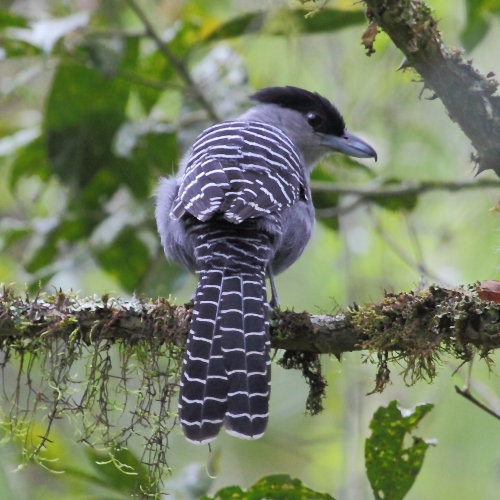
Castelnau's Antshrike
Thamnophilus cryptoleucus
Order: Passeriformes / Family: Thamnophilidae

Wikimedia Commons
About the Castelnau's Antshrike
Castelnau's Antshrike (Thamnophilus cryptoleucus) is a fascinating bird species found primarily in the Amazon basin, known for its secretive behavior and preference for dense thickets. This bird plays a significant role in its ecosystem by controlling insect populations, thus maintaining ecological balance. It is predominantly found in parts of Brazil, Peru, and Bolivia, thriving in the humid, lowland forests where it forages among the undergrowth. The species displays some seasonal behaviors, particularly in response to flooding patterns of the Amazon River, which can alter its habitat availability and food sources. During the wet season, these antshrikes may move to slightly elevated areas to avoid inundated grounds, though they generally stick to areas with ample cover. Their presence in the Amazon rainforest adds to the rich biodiversity of this vital global ecosystem. As insectivores, Castelnau's Antshrikes help keep insect populations in check, thereby protecting the plants and trees that form the rainforest's backbone. By controlling insect numbers, they also facilitate the survival of other avian species that rely on similar food sources but may not penetrate the dense undergrowth as efficiently. The bird's ecological role extends beyond its immediate environment, illustrating the interconnectedness of life in tropical forests. Its habits and lifestyle offer insight into the challenges and adaptations faced by Amazonian wildlife, contributing to our understanding of tropical ecosystems.
The Castelnau's Antshrike belongs to the family Thamnophilidae, within the order Passeriformes. These birds typically live average 4-5 years, maximum recorded 6 years..
How to Identify a Castelnau's Antshrike
The adult Castelnau's Antshrike exhibits a cryptic plumage that blends seamlessly with its forested surroundings. Males typically have dark gray to black upperparts with a lighter gray underside, while females sport a more subdued brownish hue. Juveniles resemble females in coloration, providing them with effective camouflage. Subtle differences in plumage can be observed between males and females, with males exhibiting more pronounced black markings. The bird's stout bill and rounded wings are characteristic features. Its flight silhouette is somewhat rounded, with a tail that is often cocked at an angle when perched. This antshrike's perching posture is generally upright, allowing it to scan the underbrush for prey effectively. Similar species confusion might arise with other antshrikes in the region, such as the Black-capped Antshrike, but careful observation of the plumage and behavior can aid in accurate identification.
Having trouble telling birds apart? Upload a photo to our bird identification tool for an instant species match.
Castelnau's Antshrike Habitat and Range
Preferred Habitat
Castelnau's Antshrike inhabits the dense, humid forests of the Amazon basin, favoring areas with thick undergrowth and abundant foliage. Its presence is most common at low elevations, typically below 500 meters. These birds tend to avoid open areas, preferring the shelter and protection of forested environments where they can remain concealed. They exhibit little seasonal habitat shift but may relocate locally in response to flooding during the wet season. Unlike some other bird species, Castelnau's Antshrike is not commonly found in urban or suburban environments, remaining closely tied to its forest habitat.
Geographic Range
The range of Castelnau's Antshrike extends across the Amazon basin, predominantly within Brazil, Peru, and Bolivia. It is a resident species, meaning it does not undertake significant migrations. However, local movements may occur as the bird seeks suitable foraging areas or responds to seasonal changes in its environment. Population density hotspots are found in the dense forests along riverbanks, where the combination of abundant food and cover provides optimal living conditions. While the species is fairly widespread within its range, it remains largely restricted to undisturbed forest habitats.
Want to know which birds visit your area? Browse our backyard birds by location guides for region-specific species lists.
What Does the Castelnau's Antshrike Eat?
Castelnau's Antshrike primarily feeds on a diet of insects and other small arthropods. Its foraging technique involves gleaning prey from leaves and branches, often working methodically through tangled underbrush. The bird's diet consists mainly of ants, beetles, and spiders, which it captures using its sharp bill. During the wet season, when insect activity increases, the antshrike's diet may expand to include a wider variety of insects. Prey size is generally small, but the bird's precise hunting skills allow it to capture elusive prey. Feeding occurs throughout the day, with peaks in activity during the cooler morning and evening hours.
Castelnau's Antshrike Behavior and Social Structure
Castelnau's Antshrike exhibits a solitary or paired lifestyle, often seen with a mate rather than in large flocks. Territorial by nature, these birds will vigorously defend their chosen patch of forest, using vocalizations and displays to ward off intruders. Courtship displays involve vocal duets and mutual preening, strengthening the pair bond. While generally quiet, the antshrike can become more vocal when alarmed by predators. Daily activity patterns include periods of active foraging interspersed with rest in dense foliage, where the bird remains well-hidden. Its response to predators involves retreating deeper into cover, utilizing its cryptic plumage to stay undetected.
Castelnau's Antshrike Nesting and Reproduction
Nesting for Castelnau's Antshrike involves constructing a cup-shaped nest from twigs, leaves, and other plant materials, typically placed low in dense vegetation. Preferred nest locations include forks of small trees or shrubs, where the nest can remain concealed. The clutch size generally consists of 2-3 eggs, which both parents incubate over a period of approximately 14 days. After hatching, chicks fledge within 12-14 days, though they remain dependent on parental care for some time thereafter. Both parents share feeding and protection duties, ensuring the survival of their young. The species may produce multiple broods per year, depending on environmental conditions.
Castelnau's Antshrike Sounds and Vocalizations
The song of Castelnau's Antshrike is a series of soft, whistled notes that rise and fall in pitch, resembling a gentle conversation between mates. Call notes are short and sharp, often used to maintain contact within dense foliage. Alarm calls are more urgent, consisting of rapid chattering sounds that alert others to potential danger. During the dawn chorus, the antshrike's voice blends into the symphony of the forest, adding to the vibrant acoustic environment.
Interesting Facts About the Castelnau's Antshrike
- 1Castelnau's Antshrike is named after Francis de Laporte de Castelnau, a French naturalist and explorer.
- 2Unlike many birds, Castelnau's Antshrike thrives in the dense, impenetrable underbrush of the Amazon rainforest.
- 3The species relies heavily on its cryptic plumage to avoid predators, blending seamlessly into the forest environment.
- 4Its diet primarily consists of insects such as ants, beetles, and spiders, making it an integral part of the ecosystem.
- 5Castelnau's Antshrike exhibits territorial behavior, with pairs defending their territory through vocalizations.
- 6This bird is non-migratory, residing year-round in the Amazon basin, although it may make local movements.
- 7The species' preference for undisturbed habitats highlights the importance of conservation in the Amazon region.
Castelnau's Antshrike Conservation Status
Currently, Castelnau's Antshrike holds a status of Least Concern according to the IUCN. However, its population trend is potentially decreasing due to ongoing habitat destruction and fragmentation. Primary threats include deforestation for agriculture and logging, which reduce available habitat. Conservation efforts focus on preserving large tracts of Amazonian forest and enforcing sustainable land-use practices. Historically, the bird's population has remained relatively stable, but continued vigilance is necessary to ensure its long-term survival.