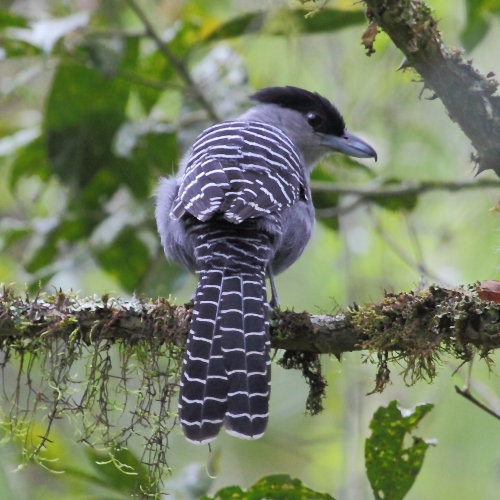
Checker-throated Antwren
Epinecrophylla fulviventris
Order: Passeriformes / Family: Thamnophilidae

Wikimedia Commons
About the Checker-throated Antwren
The Checker-throated Antwren (Epinecrophylla fulviventris) is a small passerine bird belonging to the family Thamnophilidae. This species is predominantly found in the humid lowland forests of Central and South America, stretching from Nicaragua through Costa Rica and Panama, and reaching into the northern regions of Colombia. The bird is a quintessential understory dweller, often seen in pairs or small family groups as it navigates dense vegetation. Its ecological significance is underscored by its role in insect population control, as it feeds primarily on small arthropods, thereby maintaining the ecological balance within its habitat. The Checker-throated Antwren contributes to seed dispersal indirectly by consuming insects that interact with various plant species, thus supporting plant growth and forest regeneration. Ecologically, it thrives in primary and secondary forests, where it benefits from the dense canopy cover and rich biodiversity.
This antwren is an active participant in mixed-species flocks, particularly during the non-breeding season. These flocks enhance foraging efficiency and offer protection from predators. During the breeding season, which typically spans from March to July, the Checker-throated Antwren demonstrates territorial behavior, with pairs defending their chosen nesting sites vigorously. Seasonal behaviors include vocal displays and increased foraging activity to support the energy demands of raising their young.
In terms of conservation, while not currently listed as threatened, the Checker-throated Antwren faces pressures from habitat loss due to deforestation and land conversion for agriculture. Conservation efforts focus on preserving its natural habitat through the establishment of protected areas and sustainable land management practices. Due to its preference for dense forest environments, the preservation of these ecosystems is critical to the species' continued survival.
The Checker-throated Antwren belongs to the family Thamnophilidae, within the order Passeriformes. These birds typically live average 4-5 years, with a maximum recorded of 7 years..
How to Identify a Checker-throated Antwren
The Checker-throated Antwren is a small bird, measuring approximately 10 to 12 centimeters in length. Adult males exhibit a distinctive black and white checkered throat pattern, which is a key identifying feature. Their plumage is primarily grayish-brown, with subtle olive tones on the back and wings. In contrast, females lack the checkered throat and instead have a more uniform buffy throat and chest, which can aid in distinguishing the sexes in the field.
Juveniles resemble females but can be identified by their slightly duller coloration and less distinct markings. Observers should note the bird’s relatively short wings and tail, which give it a compact appearance. The flight silhouette of the Checker-throated Antwren is generally weak and fluttery, consistent with its primary lifestyle as an understory dweller, where it prefers short flights between branches.
This species may be confused with other antwrens, such as the Streak-crowned Antvireo, but the latter has a more pronounced streaking on the head and a different vocalization pattern. The Checker-throated Antwren’s perching posture is typically horizontal, often accompanied by flicking tail movements, which are useful behavioral cues for identification.
Having trouble telling birds apart? Upload a photo to our bird identification tool for an instant species match.
Checker-throated Antwren Habitat and Range
Preferred Habitat
The Checker-throated Antwren inhabits dense, humid lowland forests, with a particular affinity for areas with thick understory vegetation. It is most commonly found at elevations ranging from sea level up to 1200 meters but tends to be more abundant at lower elevations. Primary and secondary forests serve as its primary habitats, with the antwren showing a preference for undisturbed environments.
Seasonal habitat shifts are minimal, as the species is largely sedentary. However, it may exhibit some local movement in response to changes in food availability or post-breeding dispersal. Although primarily a forest bird, it occasionally ventures into shrublands adjacent to forested areas, particularly where these border on rivers or streams.
The Checker-throated Antwren is rarely found in urban settings, as it relies heavily on the complex structure of natural forest environments for foraging and nesting. Its presence in rural areas is largely confined to those regions where significant forest patches remain intact.
Geographic Range
The Checker-throated Antwren's range extends from the lowland forests of Nicaragua, through Costa Rica and Panama, to the northernmost parts of Colombia. This distribution makes it a bird of the Neotropics, with a strong preference for areas within the Central American isthmus. Its range does not exhibit significant seasonal shifts, as it is a resident species, not known for long-distance migrations.
Within its range, the species can be found in both Pacific and Caribbean lowlands, though it may show local preferences depending on habitat quality and food availability. Population density hotspots tend to occur in regions where forest cover is extensive and well-preserved, such as national parks and protected reserves in Costa Rica.
Though it occupies a relatively small geographic range compared to some other avian species, the Checker-throated Antwren maintains stable populations where suitable habitat conditions persist. Its non-migratory nature means that conservation efforts can focus on localized habitat protection and restoration.
Want to know which birds visit your area? Browse our backyard birds by location guides for region-specific species lists.
What Does the Checker-throated Antwren Eat?
The diet of the Checker-throated Antwren consists primarily of small insects and spiders, which it gleans from leaves and branches in the forest understory. This insectivorous diet plays a critical role in controlling the populations of forest arthropods. During the wet season, when insect abundance peaks, the antwren's diet is enriched with caterpillars and other larvae, which provide a high protein content essential for breeding activities.
Foraging technique is characterized by active gleaning, where the bird hops from branch to branch, carefully inspecting foliage. It may occasionally join mixed-species foraging flocks, which enhances its ability to locate prey items and reduces the risk of predation. The Checker-throated Antwren is known for its agility and precision in capturing insects, often making quick, darting movements to snatch prey.
Feeding occurs primarily during the early morning and late afternoon, aligning with periods of peak insect activity. During the drier months, the antwren may rely more heavily on foraging in damp microhabitats, such as near streams or in shaded gullies, where insects remain more abundant.
Checker-throated Antwren Behavior and Social Structure
The Checker-throated Antwren is primarily monogamous, with pairs maintaining territories that they defend vigorously during the breeding season. Territorial behavior includes vocal displays and physical chases to deter intruders. Socially, the species often participates in mixed-species flocks, which provides safety in numbers and improves foraging success.
Courtship displays involve the male performing a series of rapid, side-to-side movements while singing, aimed at attracting the female's attention. Flocking patterns outside of the breeding season allow the Checker-throated Antwren to exploit food resources more efficiently and provide a level of protection against predators.
Daily activity patterns are diurnal, with peak activities occurring shortly after dawn and before dusk. In response to predators, such as raptors or larger mammals, the Checker-throated Antwren employs a combination of alarm calls and evasive flight into denser foliage. The bird's small size and agility afford it some protection, allowing it to quickly disappear into the underbrush when threatened.
Checker-throated Antwren Nesting and Reproduction
Checker-throated Antwrens construct small, cup-shaped nests, typically positioned low in the understory vegetation, often less than two meters above the ground. These nests are crafted from fine plant fibers, leaves, and spider silk, providing both strength and camouflage among the foliage.
The typical clutch consists of two eggs, which are incubated primarily by the female, though the male may assist during the day. The incubation period lasts approximately 14 days, after which the chicks hatch and are cared for by both parents. Fledging occurs within 10 to 12 days, with the young remaining dependent on parental care for a short time thereafter.
The Checker-throated Antwren may raise two broods per year, particularly in regions where food resources are abundant and climatic conditions remain favorable. Parental roles are well-defined, with both adults contributing to feeding and protecting the offspring until they are independent.
Checker-throated Antwren Sounds and Vocalizations
The primary song of the Checker-throated Antwren is a series of high-pitched notes delivered in rapid succession, with a clear, tinkling quality. This song serves both to defend territory and to attract mates. Call notes are typically short and sharp, used to maintain contact between pairs or family groups as they forage through dense vegetation.
Alarm calls are more urgent, with a harsher tonal quality designed to alert conspecifics to the presence of potential predators. During the dawn chorus, the Checker-throated Antwren's song can often be heard intermingling with those of other understory birds, contributing to the rich tapestry of sounds characteristic of tropical forests.
Compared to other antwrens, its vocalizations are relatively simple, but their distinct rhythm and pitch make them recognizable to experienced birders familiar with the acoustic landscape of its habitat.
Interesting Facts About the Checker-throated Antwren
- 1The Checker-throated Antwren was first described by the ornithologist John Gould in 1859, highlighting its long-standing recognition in bird taxonomy.
- 2Unlike many other passerines, the Checker-throated Antwren does not migrate, remaining in its tropical forest home year-round.
- 3The species' distinct checkered throat pattern of males serves as both a mating signal and a territorial marker.
- 4In mixed-species flocks, the Checker-throated Antwren often associates with woodcreepers, which occupy slightly higher strata in the forest.
- 5The agility of the Checker-throated Antwren allows it to capture prey from the undersides of leaves, a niche feeding strategy within the forest understory.
- 6The Checker-throated Antwren's call notes are a crucial aspect of its communication, allowing it to maintain contact with mates in the dense forest habitat.
- 7Research on the Checker-throated Antwren has contributed to broader studies on the ecological dynamics of mixed-species flocks in tropical forests.
Checker-throated Antwren Conservation Status
The IUCN currently lists the Checker-throated Antwren as of Least Concern, with populations considered stable. However, primary threats include habitat destruction due to deforestation and agricultural expansion, which can fragment populations and reduce available habitats. Historical population changes have not been well-documented, but current conservation efforts focus on habitat protection and the establishment of reserves in key areas of its range, such as Costa Rica's national parks. Sustainable forestry practices and reforestation projects contribute to mitigating habitat loss. Monitoring programs are essential for detecting early signs of population decline, while community-based conservation initiatives encourage local participation in preserving the regions the antwren inhabits. Continued habitat preservation is crucial for ensuring the long-term survival of this species.