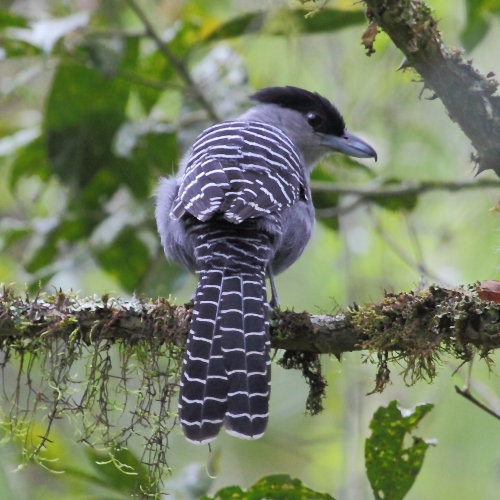
Cherrie's Antwren
Myrmotherula cherriei
Order: Passeriformes / Family: Thamnophilidae

Wikimedia Commons
About the Cherrie's Antwren
The Cherrie's Antwren (Myrmotherula cherriei) is a notable member of the Thamnophilidae family, commonly observed in the tropical lowland forests of Central America. This species plays a vital role in maintaining the ecological balance of its habitat through its insectivorous diet, which helps control insect populations. The bird's presence is most strongly felt in the dense undergrowth of humid forests where it thrives, particularly in areas of Costa Rica and Panama.
The Cherrie's Antwren is an essential component of the forest ecosystem, often participating in mixed-species foraging flocks. These flocks, comprising various bird species, enhance the foraging efficiency and survival of the antwren by reducing predation risks and allowing access to a broader range of food sources. The bird's population is currently stable, contributing to the overall health of its native habitats.
Ecologically, the Cherrie's Antwren adapts to its environment with minimal seasonal migratory behavior. This species typically remains within its established territories year-round, which aids in the stability of local ecosystems. The bird's preference for lowland, humid environments makes it a critical species for studies on climate change impacts on tropical forests.
During the breeding season, Cherrie's Antwren exhibits distinct territorial behaviors, which are vital for understanding its role in forest community dynamics. Observations of its social interactions and nesting habits provide insights into the reproductive strategies of small passerine birds in tropical ecosystems. The bird's unique calls and songs add to the symphony of sounds that characterize its lush forest habitat.
The Cherrie's Antwren belongs to the family Thamnophilidae, within the order Passeriformes. These birds typically live average 5 years with a maximum recorded of 8 years..
How to Identify a Cherrie's Antwren
The Cherrie's Antwren can be identified by its contrasting black and white coloration, with males sporting more pronounced black markings on their heads and wings. Females, in contrast, display a slightly browner tinge, particularly on their wings and tails, allowing for sexual dimorphism identification in the field. Juveniles resemble adult females but can be distinguished by their subtler tones and less defined markings.
This small bird, measuring approximately 10-11 cm in length, exhibits a short tail and a compact body, typical for antwrens. Its flight is quick and direct, often close to the undergrowth, making it a challenge to spot when in motion. When perched, the Cherrie's Antwren often holds its body horizontally, making short, hopping movements as it forages.
In terms of similar species, the Cherrie's Antwren may be confused with other antwrens in its range, such as the Pacific Antwren. However, the distinct black and white patterning of the Cherrie's Antwren is a key differentiator, as is its preference for lower, denser vegetation compared to its relatives.
Having trouble telling birds apart? Upload a photo to our bird identification tool for an instant species match.
Cherrie's Antwren Habitat and Range
Preferred Habitat
Cherrie's Antwren inhabits the humid lowland forests of Central America, particularly favoring areas with dense undergrowth and tangled vegetation. These forests provide ample cover and food resources, which are critical for the bird's survival. It is typically found at elevations ranging from sea level to about 1,000 meters, although it prefers lower altitudes where humidity and temperature are optimal year-round.
The species shows a strong preference for primary and secondary forests, where it can exploit both natural and human-altered environments. While it does not typically venture into urban areas, the Cherrie's Antwren may occasionally be found in semi-open rural landscapes if sufficient vegetation cover is available. Seasonal changes do not significantly affect its habitat preferences, as it remains predominantly in the same regions throughout the year.
Geographic Range
The Cherrie's Antwren is primarily found in the lowland forests of Costa Rica and Panama. Its range extends from the Caribbean slope of eastern Costa Rica through central Panama, including the Pacific slope. The bird is non-migratory, maintaining a consistent presence in these regions throughout the year.
Population density is higher in protected areas and national parks, where the habitat remains largely undisturbed by human activity. Locations such as La Selva Biological Station in Costa Rica and the forests surrounding the Panama Canal are notable hotspots for observing this species. The bird's range does not extend far beyond these areas, making it a species of particular interest to local conservation efforts.
Want to know which birds visit your area? Browse our backyard birds by location guides for region-specific species lists.
What Does the Cherrie's Antwren Eat?
The diet of the Cherrie's Antwren primarily consists of small insects and arthropods, which it deftly captures using its agile foraging skills. This bird employs a technique known as 'gleaning,' where it picks prey items from the undersides of leaves and branches while navigating the dense forest undergrowth.
During the wetter months, when insect activity is higher, the Cherrie's Antwren's diet remains largely consistent, focusing on ants, beetles, and caterpillars. In drier seasons, it may broaden its diet to include smaller spiders and other invertebrates to meet its nutritional needs. The bird typically forages in pairs or small family groups, often joining mixed-species flocks to increase foraging success and reduce individual risk of predation.
Cherrie's Antwren Behavior and Social Structure
Cherrie's Antwren exhibits intriguing social behavior, often forming small family groups or joining mixed-species flocks. These flocks enhance foraging opportunities and provide safety in numbers from potential predators. The bird is territorial, especially during the breeding season, actively defending its space with vocalizations and physical displays.
Courtship involves a combination of song and display flights, with the male performing short, energetic flights around the female to demonstrate vigor and readiness to mate. The species is diurnal, most active during the early morning and late afternoon when it is cooler and insect activity peaks.
In response to predators, Cherrie's Antwren employs a variety of alarm calls to warn fellow flock members of danger. It is a highly vocal bird, using a repertoire of sounds to communicate everything from alarm to territory establishment.
Cherrie's Antwren Nesting and Reproduction
The Cherrie's Antwren constructs a cup-shaped nest using fine plant fibers, leaves, and spider silk, carefully camouflaging it within the dense forest undergrowth to avoid detection by predators. Nest sites are typically low to the ground, often less than two meters high, nestled among thick foliage.
A typical clutch consists of two eggs, with both parents sharing incubation duties over a period of approximately 14 days. After hatching, the chicks remain in the nest for another 10-12 days before fledging. Both parents continue to feed and protect the young birds for several weeks post-fledging, ensuring their survival and successful integration into the surrounding habitat. Cherrie's Antwren usually raises one brood per year, though favorable conditions may allow for a second.
Cherrie's Antwren Sounds and Vocalizations
The primary song of the Cherrie's Antwren is a series of high-pitched, rapid notes that accelerate into a trill, reminiscent of a distant typewriter. This song serves multiple roles, from attracting mates to marking territory boundaries. Its call notes are sharp and distinctive, often described as a 'chik' sound, used to maintain contact between individuals, especially while foraging.
Alarm calls are more abrupt and louder, serving to alert other birds to potential threats. During the dawn chorus, the Cherrie's Antwren's song can be heard mingling with those of other species, creating a vibrant tapestry of sound that defines the forest environment.
Interesting Facts About the Cherrie's Antwren
- 1Cherrie's Antwren is named after the American ornithologist who first described it, George Kruck Cherrie.
- 2This species often engages in cooperative breeding, with older siblings helping to raise the young.
- 3Cherrie's Antwren prefers dense undergrowth for foraging, making it a challenge to observe in the wild.
- 4The bird's rapid, high-pitched trill is unique and helps differentiate it from similar species.
- 5Cherrie's Antwren is part of a larger group known as 'antbirds,' which are adept at following swarms of army ants.
- 6While primarily insectivorous, the bird has been observed occasionally eating small fruits.
- 7Mixed-species flocks with Cherrie's Antwren can include up to 30 different bird species, showcasing its social adaptability.
Cherrie's Antwren Conservation Status
The Cherrie's Antwren is currently listed as Least Concern by the IUCN, with a stable population trend. However, ongoing deforestation and habitat fragmentation pose significant threats to its long-term survival. Conservation efforts focus on habitat preservation, particularly in protected areas and national parks where the species is most abundant. Historically, the population has experienced fluctuations due to habitat loss, but recent conservation measures have helped stabilize numbers. Continued protection of lowland forest habitats is essential to ensure the species' continued survival and ecological function.