Chestnut-backed Antbird
Myrmeciza exsul
Order: Passeriformes / Family: Thamnophilidae

Wikimedia Commons
About the Chestnut-backed Antbird
The Chestnut-backed Antbird (Myrmeciza exsul) is a captivating species native to the neotropical regions of Central America. Characterized by its striking chestnut and black plumage, this bird is a quintessential member of the Thamnophilidae family. Its ecological role is significant in the dynamic ecosystems of humid lowland forests, where it primarily thrives. The species is particularly abundant in countries such as Costa Rica, Panama, and parts of northwestern Colombia. Throughout these regions, it occupies lowland rainforests, often found in moist environments below 1,200 meters in elevation.
The Chestnut-backed Antbird plays a crucial role in the forest ecosystem as an insectivorous bird, assisting in the regulation of arthropod populations. By consuming a variety of insects, it helps maintain the ecological balance within its forest habitat. Its presence is indicative of healthy, undisturbed forests, making it an important indicator species for conservationists studying habitat integrity.
Seasonally, the Chestnut-backed Antbird exhibits subtle changes in behavior. During the breeding season, which typically occurs from March to August, males become highly territorial, engaging in vocal displays to ward off rivals and attract mates. Outside of this period, these birds are somewhat more tolerant of intruders, yet they still maintain defined territories. Their sedentary nature means they do not undergo significant migrations, although they may undertake minor local movements in response to food availability and environmental conditions.
This bird's dependency on undisturbed forests highlights the importance of rainforest conservation efforts. As deforestation continues to threaten its habitat, understanding the ecological significance of the Chestnut-backed Antbird becomes increasingly vital. Conservation strategies that protect large tracts of contiguous forest are essential to ensure the survival of this and many other forest-dependent species. The antbird's ability to thrive in secondary growth forests offers a glimmer of hope, suggesting that with effective habitat management, its populations can remain stable.
The Chestnut-backed Antbird belongs to the family Thamnophilidae, within the order Passeriformes. These birds typically live average 5-7 years, with a maximum recorded of 9 years..
How to Identify a Chestnut-backed Antbird
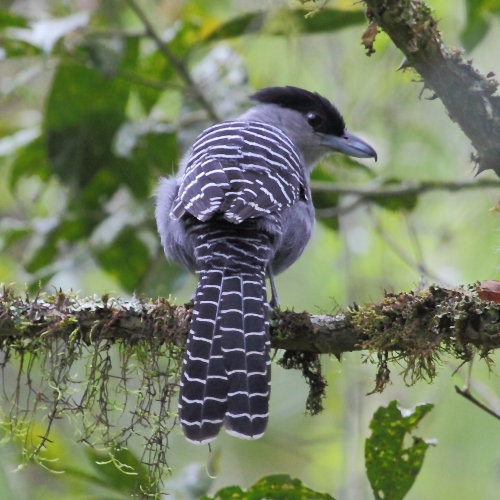
The adult Chestnut-backed Antbird is unmistakable due to its rich chestnut back and flanks, contrasting with its black head, throat, and breast. Its eyes are a strikingly pale blue, offering a unique field mark that aids in identification. Males and females appear similar, though subtle differences can be detected upon closer inspection, with females sometimes exhibiting a slightly duller hue.
Juvenile Chestnut-backed Antbirds lack the distinctive blue eyes of adults and possess a more subdued chestnut coloration. This can make them challenging to identify, particularly when seen fleetingly in dense undergrowth. The bird's dark wings and tail further complement its unique coloration, ensuring it stands out among the foliage.
In terms of confusion with similar species, the Chestnut-backed Antbird can occasionally be mistaken for the Bicolored Antbird in areas where their ranges overlap. However, the Bicolored Antbird lacks the vibrant chestnut coloring and is more uniformly black and white. Furthermore, the Chestnut-backed Antbird's perching posture is often upright and alert, reflecting its constant awareness of its surroundings. Its flight is typically short and direct, with rapid wingbeats, as it rarely ventures far from its territory within the forest.
Having trouble telling birds apart? Upload a photo to our bird identification tool for an instant species match.
Chestnut-backed Antbird Habitat and Range
Preferred Habitat
The Chestnut-backed Antbird predominantly inhabits lowland humid forests, thriving in areas with dense understory growth. These environments, often characterized by high humidity and substantial leaf litter, provide ample foraging opportunities and cover from predators. It is commonly found in primary rainforests and, to a lesser extent, in well-developed secondary forests, allowing it some resilience against habitat disturbance.
This species is particularly associated with the dense thickets and tangled vegetation near forest edges and along streams. In Costa Rica and Panama, it is frequently observed in the lowlands, generally below 1,200 meters in elevation. The bird's preference for thick, shaded understory makes it less likely to be seen in open or fragmented landscapes, underscoring the importance of intact forest canopies for its survival.
While the Chestnut-backed Antbird is not typically found in urban environments, it may occasionally venture into gardens or plantations adjacent to forested areas, especially if these areas provide sufficient cover and food resources. Seasonal shifts in habitat are minimal, as this species is largely sedentary, relying on its established territory throughout the year.
Geographic Range
The Chestnut-backed Antbird's range is confined to the humid lowland forests of Central America, extending from Honduras through Nicaragua, Costa Rica, and Panama, reaching into the Chocó region of northwestern Colombia. This distribution reflects its preference for neotropical rainforests, where it exhibits relatively stable population densities.
Unlike many migratory birds, the Chestnut-backed Antbird does not undertake long-distance migrations. Its sedentary nature means that it remains within its established range year-round, with only minor local movements in response to environmental conditions or resource availability. This limited range highlights the species' dependence on specific forest habitats and underscores the importance of localized conservation efforts.
Population density hotspots are most notable in the coastal lowland forests of Costa Rica and Panama. These areas, characterized by extensive forest cover and high biodiversity, provide ideal conditions for the Chestnut-backed Antbird. In areas where suitable habitat remains intact, populations are relatively stable, although they face ongoing threats from habitat destruction.
Want to know which birds visit your area? Browse our backyard birds by location guides for region-specific species lists.
What Does the Chestnut-backed Antbird Eat?
The Chestnut-backed Antbird's diet primarily consists of insects and other small arthropods, which it forages from the forest floor and low vegetation. It employs a methodical foraging technique, using its keen senses to detect prey within leaf litter and dense undergrowth. Its diet includes ants, beetles, spiders, and occasionally small lizards or frogs.
Seasonal variations in diet are subtle, reflecting the relatively constant availability of arthropod prey in tropical forests. However, during the breeding season, the Chestnut-backed Antbird may increase its food intake to meet the nutritional demands of rearing young. This period often coincides with peaks in insect abundance, providing ample food resources for the birds.
The antbird forages primarily during daylight hours, with peak activity occurring in the early morning and late afternoon. It employs a passive hunting strategy, waiting patiently for prey to come within striking distance before swiftly capturing it. Its ability to exploit a variety of prey types contributes to its success in diverse forest habitats.
Chestnut-backed Antbird Behavior and Social Structure
The Chestnut-backed Antbird displays a fascinating array of behaviors, reflective of its adaptation to dense forest environments. Socially, it is primarily monogamous, with pairs maintaining territories throughout the year. Territorial behavior is pronounced, particularly during the breeding season, when males engage in vocal displays to assert dominance and attract mates.
Courtship involves a series of displays and vocalizations, with males performing fluttering flights and presenting food offerings to females as part of the bonding process. Once paired, the birds exhibit strong site fidelity, often returning to the same nesting locations annually.
Flocking behavior is not typical for the Chestnut-backed Antbird, as it tends to forage alone or in pairs. However, it may occasionally associate with mixed-species flocks, particularly in areas where food resources are abundant. When confronted by predators, these birds rely on their cryptic plumage and quick movements to evade detection, often retreating to dense cover.
Daily activity patterns are largely diurnal, with peak foraging occurring during the cooler hours of early morning and late afternoon. The birds spend much of their time within their territory, engaging in foraging, preening, and territorial defense. Their vocalizations, a key component of their behavior, are used to communicate with mates and ward off intruders.
Chestnut-backed Antbird Nesting and Reproduction
The nesting habits of the Chestnut-backed Antbird reflect its adaptation to dense forest environments. These birds typically construct low, cup-shaped nests, skillfully woven from twigs, leaves, and other plant materials. Nests are strategically placed within dense vegetation, often less than two meters above the ground, providing concealment from predators.
Clutch size generally comprises two eggs, though occasionally three, with both parents sharing incubation responsibilities. The incubation period lasts approximately 16 to 18 days, after which the altricial chicks hatch. Both parents participate actively in feeding the chicks, delivering a steady supply of insects and other small prey to the nest.
Fledging occurs about 12 to 14 days post-hatching, with young birds remaining reliant on parental care for several weeks as they learn to forage and navigate their forest environment. Typically, the Chestnut-backed Antbird raises one to two broods per year, depending on environmental conditions and resource availability.
Parental roles are well-defined, with both sexes participating in nest construction, incubation, and chick rearing. This cooperative breeding strategy enhances the survival prospects of the young, ensuring that the next generation of Chestnut-backed Antbirds is well-equipped to thrive in their forest habitat.
Chestnut-backed Antbird Sounds and Vocalizations
The vocalizations of the Chestnut-backed Antbird are a distinctive feature of its behavior, characterized by a series of sharp, high-pitched notes. Its primary song consists of a rapid sequence of whistles, often described as "peet-peet-peet," delivered at a steady tempo. This song serves both to establish territory and attract mates during the breeding season.
In addition to its primary song, the Chestnut-backed Antbird produces a variety of call notes, including soft chirps and more urgent alarm calls. These alarm calls, sharp and insistent, signal the presence of potential threats and prompt nearby conspecifics to seek cover.
Dawn chorus behavior is particularly prominent, with males engaging in extended singing sessions at first light. This early morning vocal activity serves to reinforce territorial boundaries and strengthen pair bonds.
The Chestnut-backed Antbird's vocal repertoire plays a crucial role in its social interactions, providing a means of communication that helps maintain the intricate social structure of its forest habitat.
Interesting Facts About the Chestnut-backed Antbird
- 1The Chestnut-backed Antbird's eye coloration is a striking pale blue, adding to its distinctive appearance.
- 2Despite its name, the Chestnut-backed Antbird is not an obligate ant-follower, though it may opportunistically join ant swarms.
- 3The species exhibits strong site fidelity, often returning to the same nesting location year after year.
- 4The Chestnut-backed Antbird's song can be heard over considerable distances, serving as an effective territorial marker.
- 5Its ability to thrive in secondary growth forests offers hope for conservation efforts in disturbed habitats.
- 6This bird's diet includes small lizards and frogs, showcasing its adaptability as an insectivorous predator.
- 7The Chestnut-backed Antbird's nesting sites are typically well-concealed, aiding in protection from predators.
Chestnut-backed Antbird Conservation Status
The Chestnut-backed Antbird is currently listed as a species of Least Concern by the IUCN, reflecting its relatively stable population across much of its range. However, ongoing habitat destruction poses a significant threat to its long-term survival. The primary threat facing this species is deforestation, driven by agricultural expansion, logging, and urban development. Conservation efforts focusing on habitat preservation are essential to secure the future of the Chestnut-backed Antbird. Protected areas, such as national parks and reserves in Costa Rica and Panama, play a crucial role in maintaining viable populations. Additionally, community-based conservation initiatives that promote sustainable land-use practices offer promise for mitigating habitat loss. Historically, the species has demonstrated some resilience to habitat changes, particularly in areas where secondary growth forests provide suitable conditions. However, continued habitat fragmentation could lead to population declines if not addressed. Monitoring population trends and implementing targeted conservation strategies will be vital to ensuring that the Chestnut-backed Antbird continues to thrive in its native forests.