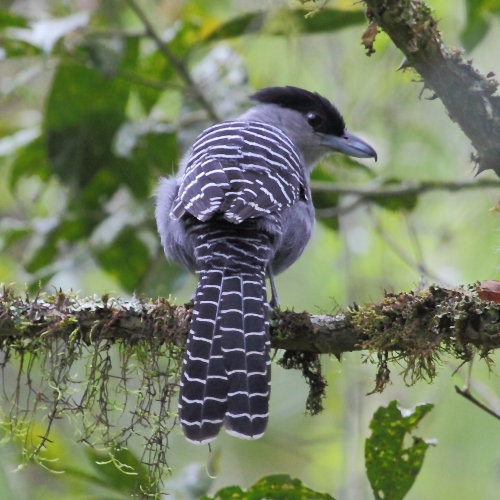
Chestnut-backed Antshrike
Thamnophilus palliatus
Order: Passeriformes / Family: Thamnophilidae

Wikimedia Commons
About the Chestnut-backed Antshrike
The Chestnut-backed Antshrike (Thamnophilus palliatus) is a captivating bird species found primarily in the tropical rainforests of South America. Its presence is marked by its striking chestnut-colored plumage on the back, contrasting with a more subdued grayish underside. This species plays a significant ecological role as part of the Thamnophilidae family, which consists of insectivorous birds that help control insect populations in their environment. Commonly found in countries like Ecuador, Colombia, and Peru, the Chestnut-backed Antshrike thrives in lowland and foothill forests, typically below 1,200 meters in elevation. Its ecological significance extends beyond mere insect control, as it often participates in mixed-species foraging flocks, providing a dynamic interaction with other bird species as they collaboratively search for food. The Chestnut-backed Antshrike's habitat preference leans towards dense shrubbery and understory vegetation where it can forage efficiently. Seasonal behaviors of these birds include a notable shift in activity patterns during the breeding season, when males become more vocal to establish territories and attract mates. During this period, observers often note an increase in territorial displays and calls, which serve as a key identifier in the dense forest environment. In terms of conservation, the Chestnut-backed Antshrike is currently not considered threatened, largely due to its relatively widespread presence across suitable habitats. However, deforestation remains a looming threat that could impact its population in the future, particularly in regions where habitat destruction is prevalent. Despite these challenges, the resilience of this species is evident in its ability to adapt to secondary growth forests, although primary forests remain its preferred habitat.
The Chestnut-backed Antshrike belongs to the family Thamnophilidae, within the order Passeriformes. These birds typically live 5-8 years with a maximum recorded of 10 years.
How to Identify a Chestnut-backed Antshrike
The Chestnut-backed Antshrike is easily recognizable by its vibrant chestnut-colored back, which contrasts sharply with its grayish underparts. Adult males and females exhibit similar plumage, making sexual dimorphism less pronounced compared to other bird species. However, subtle differences can be observed; males tend to have a slightly darker chestnut hue, while females might exhibit a paler tone. Juveniles resemble adults but often appear duller overall, especially in the chestnut regions. When identifying the Chestnut-backed Antshrike in the field, birders should pay attention to its stout, hooked bill, a common trait among antshrikes. Its flight silhouette is compact, with rounded wings and a short tail, enabling it to maneuver adeptly through dense vegetation. Perching posture is generally upright, allowing for quick takeoffs during foraging. While confusion with other antshrike species might occur, the distinct chestnut back serves as a reliable field mark. The Barred Antshrike, for example, presents a similar size and shape but lacks the chestnut coloring, instead displaying a barred pattern on its body. Observers should also listen for the Chestnut-backed Antshrike's vocalizations, as its calls and songs are unique identifiers among mixed-species flocks.
Having trouble telling birds apart? Upload a photo to our bird identification tool for an instant species match.
Chestnut-backed Antshrike Habitat and Range
Preferred Habitat
The Chestnut-backed Antshrike inhabits tropical lowland and foothill forests, favoring environments with dense understory vegetation. It is most prevalent at elevations below 1,200 meters, where it can exploit the rich insect life. This bird prefers primary forests but can also adapt to secondary growth areas, provided there is sufficient cover and food availability. Seasonal habitat shifts are minimal, as the species is generally non-migratory, maintaining territories year-round. Urban and suburban presence is rare, as the Chestnut-backed Antshrike favors secluded forested regions away from human activity.
Geographic Range
The Chestnut-backed Antshrike's range spans several countries in northwestern South America, including Ecuador, Colombia, and Peru. It occupies a relatively narrow band of humid forest along the Andean foothills and adjacent lowlands. While primarily a resident species, it may exhibit localized movements in response to food availability and habitat conditions. Population density is notably higher in areas with intact primary forests, where insect prey is abundant. In regions such as the western Amazon basin, it is a common resident, thriving in the lush, biodiverse ecosystems.
Want to know which birds visit your area? Browse our backyard birds by location guides for region-specific species lists.
What Does the Chestnut-backed Antshrike Eat?
The diet of the Chestnut-backed Antshrike consists primarily of insects and other small arthropods. It forages by gleaning prey from foliage, using its sturdy bill to extract insects from leaves and branches. During the wet season, when insect populations peak, the bird's diet is more diverse, including a broader range of prey such as spiders and caterpillars. Foraging typically occurs in the lower to mid-levels of the forest canopy, where the bird can exploit dense vegetation. Feeding schedules vary slightly with the availability of prey, but generally, this species is active throughout the day, peaking in activity during the cooler morning hours.
Chestnut-backed Antshrike Behavior and Social Structure
The Chestnut-backed Antshrike exhibits a fascinating array of behaviors, particularly during the breeding season. It is generally observed as a solitary or paired bird, although it often associates with mixed-species flocks for foraging. Territorial behavior is pronounced, with males frequently engaging in vocal displays to defend their area and attract mates. Courtship involves both auditory and visual displays, with males showcasing their plumage through subtle posturing. Though not strictly a flocking species, the Chestnut-backed Antshrike's participation in mixed-species flocks highlights its adaptive social behavior. In response to predators, these birds rely on their cryptic plumage and quick, agile movements to evade threats. Daily activity patterns include periods of intense foraging interspersed with rest and preening, particularly during midday when temperatures peak.
Chestnut-backed Antshrike Nesting and Reproduction
Nesting for the Chestnut-backed Antshrike involves constructing a small, cup-shaped structure typically located in dense shrubs or tangles of vines. The nest is crafted from twigs, leaves, and other plant materials, providing a well-camouflaged site for egg-laying. The typical clutch consists of two to three eggs, with both parents sharing incubation duties over approximately 14 days. After hatching, the young remain in the nest for about two weeks, during which both parents are actively involved in feeding and caring for them. The species generally produces one to two broods per year, depending on environmental conditions and food availability.
Chestnut-backed Antshrike Sounds and Vocalizations
The primary song of the Chestnut-backed Antshrike is a distinctive series of clear, whistled notes, descending in pitch and repeated several times. This song serves as both a territorial call and a communication tool between mates. In addition to the primary song, the bird emits sharp call notes used in social interactions and as alarm calls. During the dawn chorus, the Chestnut-backed Antshrike's song is particularly prominent, as males assert their presence across territories. This vocalization is a reliable auditory marker for identifying the species within the dense forest environment.
Interesting Facts About the Chestnut-backed Antshrike
- 1The Chestnut-backed Antshrike often joins mixed-species flocks, benefiting from cooperative foraging strategies.
- 2Despite its striking plumage, the Chestnut-backed Antshrike is adept at remaining hidden in dense underbrush.
- 3This species contributes to the ecosystem by helping control insect populations, maintaining forest health.
- 4The Chestnut-backed Antshrike's song is a key identifier in its dense forest habitat, aiding in territory defense.
- 5Males and females share incubation duties, a behavior that enhances reproductive success and chick survival.
- 6The species' ability to adapt to secondary forests highlights its resilience in the face of habitat change.
- 7The Chestnut-backed Antshrike's participation in dawn chorus showcases its vocal prowess and territorial nature.
Chestnut-backed Antshrike Conservation Status
Currently classified as Least Concern by the IUCN, the Chestnut-backed Antshrike maintains a stable population across its range. However, habitat destruction due to deforestation poses a significant threat to its future stability. Conservation efforts focus on preserving primary forests and promoting sustainable land-use practices. Historically, the species has shown resilience in adapting to secondary growth habitats, although its preference for primary forests underscores the importance of conservation initiatives. Continued monitoring of population trends and habitat integrity is crucial for ensuring the ongoing survival of the Chestnut-backed Antshrike.