Chestnut-crested Antbird
Rhegmatorhina cristata
Order: Passeriformes / Family: Thamnophilidae

Wikimedia Commons
About the Chestnut-crested Antbird
The Chestnut-crested Antbird, known scientifically as Rhegmatorhina cristata, is a fascinating avian species belonging to the Thamnophilidae family. This bird finds its home primarily in the dense, humid rainforests of the Amazon Basin. It thrives in the undergrowth of these rich ecosystems, predominantly in Brazil but also extending into parts of Peru and Bolivia. The Chestnut-crested Antbird plays a critical ecological role as an ant-follower, a niche group of birds that rely on swarms of army ants to flush out insects and other prey. This behavior is not only intriguing but crucial for the ecosystem, as it helps control insect populations and maintains the delicate balance of rainforest habitats. During the wet season, when army ants become more active, the Chestnut-crested Antbird is most visible and vocal, making it a key indicator of seasonal changes in these tropical forests. Its presence is a testament to the health of its environment. The bird's behavior and habitat preferences underscore the importance of conservation efforts in the Amazon, a region facing constant threats from deforestation and climate change. The Chestnut-crested Antbird's reliance on pristine forested areas highlights the need for sustainable practices and protective measures. Despite its specialized feeding habits, the antbird is not just a passive participant in its ecosystem. It actively contributes to seed dispersal and forest regeneration by consuming fruits and seeds, albeit in smaller quantities compared to its primary diet of insects. This role further emphasizes the complex interrelationships within the rainforest and the antbird's part in maintaining biodiversity. As with many Amazonian species, the Chestnut-crested Antbird faces challenges due to habitat fragmentation and the encroachment of human activities. Conservationists and researchers continue to study this bird to better understand its needs and devise strategies to protect its natural habitat. Efforts to preserve the Amazonian rainforests are crucial not only for the antbird but for countless species that depend on this unique environment.
The Chestnut-crested Antbird belongs to the family Thamnophilidae, within the order Passeriformes. These birds typically live 5-9 years, with a maximum recorded of 11 years..
How to Identify a Chestnut-crested Antbird
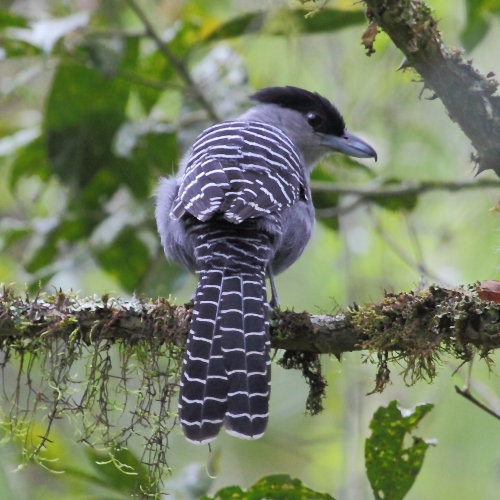
The Chestnut-crested Antbird is a medium-sized bird, measuring approximately 16 cm in length. Adult plumage is characterized by a striking chestnut crown, contrasting with a more subdued grayish-brown body. The face is marked by a subtle black mask, adding to its distinctive appearance. Males and females are similar in plumage, though females may exhibit slightly duller tones. Juveniles resemble adults but tend to have a more muted color palette, often with less pronounced chestnut on the crest. In terms of field marks, the Chestnut-crested Antbird's plumage allows it to blend seamlessly into the forest floor's leaf litter and shadows, a vital adaptation for its ant-following lifestyle. The bird's short, rounded wings and long legs are well-suited for its ground-dwelling habits, allowing for agile movement through dense underbrush. Observers may confuse the Chestnut-crested Antbird with other antbird species, such as the Hairy-crested Antbird. However, the chestnut crown of Rhegmatorhina cristata is a reliable distinguishing feature. In flight, which is rare, the bird displays a somewhat weak and fluttering silhouette. When perched, the antbird often adopts a low, horizontal stance, maintaining a vigilant watch for ant swarms.
Having trouble telling birds apart? Upload a photo to our bird identification tool for an instant species match.
Chestnut-crested Antbird Habitat and Range
Preferred Habitat
The Chestnut-crested Antbird inhabits the lowland rainforests of the Amazon Basin, thriving in humid, dense undergrowth. This species prefers areas with ample leaf litter and fallen logs where army ants are prevalent. Typically found at elevations ranging from 100 to 500 meters, the antbird is a quintessential resident of tropical forest interiors. Seasonal habitat shifts are minimal, as the bird remains within the rainforest throughout the year, relying on stable ant populations for food. While primarily a forest dweller, the Chestnut-crested Antbird's habitat is increasingly affected by human encroachment, particularly in regions facing deforestation. Unlike more adaptable species, this antbird does not frequent urban or suburban areas, underscoring the critical need to preserve its natural environment.
Geographic Range
The Chestnut-crested Antbird's range is closely tied to the Amazon Basin, with a primary distribution in the northern and central regions of Brazil. Its territory extends into parts of eastern Peru and northern Bolivia, where suitable forest conditions exist. This bird does not undertake long migrations, instead exhibiting a sedentary lifestyle within its established range. As a result, its movements are largely dictated by the availability of army ant swarms. The highest population densities occur in untouched rainforest regions, where ant swarms are frequent. While not migratory, the antbird may shift its foraging areas slightly in response to seasonal changes in ant activity. Despite its limited range, the Chestnut-crested Antbird is more widespread than its close relatives, occupying a broad swath of the Amazonian interior.
Want to know which birds visit your area? Browse our backyard birds by location guides for region-specific species lists.
What Does the Chestnut-crested Antbird Eat?
The Chestnut-crested Antbird primarily feeds on insects and other arthropods, which it captures by following swarms of army ants. These ants flush out prey from the forest floor, providing the antbird with a ready supply of food. The bird's diet includes beetles, spiders, and small invertebrates, with occasional consumption of small fruits and seeds. Seasonal diet changes are minimal, as the bird relies on the consistent presence of army ants throughout the year. The antbird employs a sit-and-wait foraging technique, using its keen eyesight and hearing to detect prey movements. It typically feeds during the day, with peak activity in the early morning and late afternoon. Prey size ranges from small insects to medium-sized arthropods, depending on availability and competition with other ant-following species.
Chestnut-crested Antbird Behavior and Social Structure
The Chestnut-crested Antbird exhibits a highly social structure, often seen in pairs or small family groups following army ant swarms. Territorial behavior is pronounced, with males and females jointly defending their feeding grounds from intruding conspecifics. During courtship, the male performs a series of displays, including wing flicking and vocalizations, to attract a mate. Flocking patterns are centered around ant swarms, where multiple antbird species may gather. The antbird's response to predators involves a mix of concealment and alarm calls, alerting nearby birds to potential threats. Daily activity patterns revolve around ant swarms, with heightened foraging in the morning and late afternoon. The bird is less active during the midday heat, retreating to shaded areas to conserve energy.
Chestnut-crested Antbird Nesting and Reproduction
Chestnut-crested Antbirds build cup-shaped nests using leaves, twigs, and grasses, typically placed low in dense vegetation. These nests are well-concealed, providing protection from predators. Preferred nesting locations include the base of small trees or within dense thickets. A typical clutch consists of two eggs, which both parents incubate for approximately 14-16 days. After hatching, the chicks remain in the nest for about 12-14 days before fledging. Both parents share feeding duties, ensuring the young receive ample nutrition. The number of broods per year is generally limited to one, reflecting the challenges of raising young in the rainforest environment. Parental roles are well-defined, with males often taking on a protective role while females focus on incubation and feeding.
Chestnut-crested Antbird Sounds and Vocalizations
The Chestnut-crested Antbird's primary song is a series of melodious whistles, often described as 'peee-wee peee-wee', with a rising and falling pitch. These calls serve both territorial and mating purposes. Call notes are typically sharp and penetrating, used to maintain contact between pairs or family groups. Alarm calls are more abrupt, alerting other birds to potential dangers. During the dawn chorus, the antbird's song is a prominent feature, adding to the rich acoustic tapestry of the rainforest. Compared to other antbirds, its vocalizations are relatively musical and less harsh, making them easier to identify.
Interesting Facts About the Chestnut-crested Antbird
- 1The Chestnut-crested Antbird relies almost entirely on army ants to flush out its prey, a behavior known as 'ant-following'.
- 2This bird's striking chestnut crest is more than decoration - it plays a role in social interactions and mate selection.
- 3Despite its reliance on ants, the Chestnut-crested Antbird does not consume the ants themselves, focusing instead on insects they disturb.
- 4Chestnut-crested Antbirds are rarely seen flying, as they prefer to move by hopping through the undergrowth.
- 5This species has a relatively small home range compared to other ant-following birds, often living entire lives within a few square kilometers.
- 6The bird's call is a distinctive part of the Amazon dawn chorus, often heard before being seen due to its reclusive nature.
- 7Chestnut-crested Antbirds contribute to forest health by inadvertently dispersing seeds from the small fruits they consume.
Chestnut-crested Antbird Conservation Status
The Chestnut-crested Antbird is currently listed as Least Concern by the IUCN, although its population is believed to be decreasing due to habitat loss. Primary threats include deforestation, habitat fragmentation, and climate change, all of which impact the availability of ant swarms and suitable forested areas. Conservation efforts focus on protecting critical habitats within the Amazon Basin, with initiatives aimed at reducing deforestation and promoting sustainable land use. Historical population changes have not been well-documented, but the ongoing loss of Amazonian rainforest poses a significant risk to this and other dependent species. Continued research and monitoring are essential to ensure the long-term survival of the Chestnut-crested Antbird.