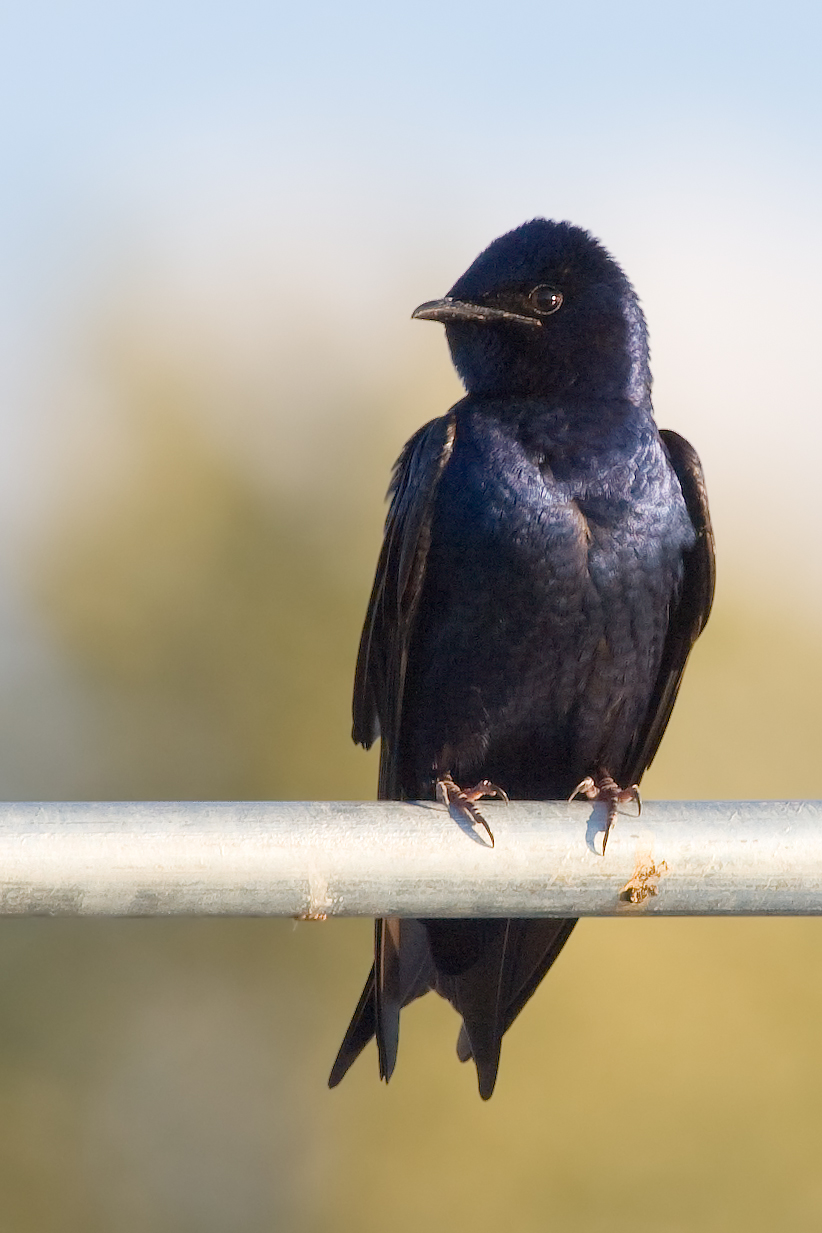
Cuban Martin
Progne cryptoleuca
Order: Passeriformes / Family: Hirundinidae

Wikimedia Commons
About the Cuban Martin
The Cuban Martin, scientifically known as Progne cryptoleuca, is an intriguing member of the swallow family, Hirundinidae. This medium-sized bird, averaging 18-20 cm in length, is a striking presence in the skies with its glossy, dark blue-black plumage. Native to Cuba, this bird holds cultural significance as an emblem of seasonal change, often signaling the onset of spring with its arrival. The Cuban Martin plays a vital role in its ecosystem as an insectivore, preying on various flying insects, which helps control pest populations. Throughout Cuba, this bird frequents open areas, including savannas, agricultural fields, and urban regions, often seen darting through the air in search of food. Seasonal changes influence the movements of the Cuban Martin, with some populations migrating to the island's coastal areas during the winter months, while others might shift to higher elevations to exploit the abundant insect life. The bird typically nests in cavities, often utilizing abandoned woodpecker holes or artificial structures like buildings. This adaptability to human-altered landscapes highlights its resilience and ability to thrive across different environments. Beyond Cuba, the Cuban Martin occasionally appears in other Caribbean islands, although it is primarily a resident species. Its presence across the island and sporadically in surrounding regions underscores its ecological importance, contributing to the biodiversity and health of the ecosystems it inhabits. Observers can often witness the Cuban Martin's skillful aerial maneuvers, especially during dawn and dusk when insects are most active. As day turns to night, this energetic bird retires to its roosting sites, often in large colonies, showcasing its social nature. Understanding the Cuban Martin's habits and habitats is crucial for conservation efforts, ensuring this vibrant species remains a part of Cuba's natural heritage for generations.
The Cuban Martin belongs to the family Hirundinidae, within the order Passeriformes. These birds typically live average 5-7 years, with some individuals living up to 9 years..
How to Identify a Cuban Martin
Identifying the Cuban Martin involves noting its distinctive features and behaviors. Adults are characterized by their glossy, iridescent blue-black upperparts and a contrasting white belly, a striking combination that aids in recognition. The species exhibits little sexual dimorphism, though males may appear slightly more vibrant. Juveniles differ, displaying a more muted, brownish-black plumage with a lighter underside, a trait that can lead to misidentification with other swallows. The Cuban Martin can be confused with similar species like the Purple Martin, but it is generally smaller and lacks the extensive geographical range of its relative. In flight, the Cuban Martin's silhouette is notable for its streamlined body, forked tail, and pointed wings, features that enhance its agility and speed. When perched, the bird often exhibits an upright posture on wires or branches, frequently found in groups. The Cuban Martin's flight is characterized by rapid, direct movements interspersed with gliding, a behavior typical of swallows. Observing these patterns can assist birders in distinguishing it from other aerial insectivores.
Having trouble telling birds apart? Upload a photo to our bird identification tool for an instant species match.
Cuban Martin Habitat and Range
Preferred Habitat
The Cuban Martin thrives in a variety of habitats across its range. It prefers open areas with abundant flying insects, commonly found in savannas, agricultural lands, and urban settings. The species demonstrates a remarkable adaptability, often utilizing both natural and man-made structures for nesting and perching. Elevation-wise, the Cuban Martin ranges from sea level up to mountainous regions, though it is more frequently observed in lower elevations where food sources are plentiful. Seasonal shifts do occur, with some populations moving towards coastal areas during the winter months, taking advantage of milder conditions and plentiful food. In urban areas, the Cuban Martin is a familiar sight, often seen darting through cityscapes where insects congregate, showcasing its ability to coexist with human development.
Geographic Range
The Cuban Martin is primarily found in Cuba, where it is a resident species. Its presence is noted across the island, from the coastal regions to inland areas, reflecting its adaptability to various environments. While primarily sedentary, some populations may undertake short-distance migrations within the Caribbean, occasionally reaching nearby islands such as the Bahamas and Jamaica. During the breeding season, the Cuban Martin is widespread throughout Cuba, utilizing a range of habitats from urban areas to natural woodlands. In winter, while many remain in Cuba, some may move to the island's coastal regions, where food remains plentiful. The bird's range highlights its adaptability, thriving in diverse environments within its primary territory. Population density varies, with higher concentrations often observed in areas where food sources are abundant, such as agricultural fields and urban settings.
Want to know which birds visit your area? Browse our backyard birds by location guides for region-specific species lists.
What Does the Cuban Martin Eat?
The Cuban Martin primarily feeds on a diet of flying insects, exploiting its agility and speed to capture prey mid-air. Its diet includes a variety of insects such as beetles, flies, and mosquitoes, which it consumes in large quantities. During the breeding season, the Cuban Martin's dietary needs increase, prompting frequent foraging trips to provide for nestlings. Seasonal changes in insect availability can influence its feeding patterns, with the bird adjusting its hunting times to coincide with peak insect activity periods, often around dawn and dusk. The bird's foraging technique involves rapid aerial chases, employing sudden turns and dives to capture prey. The Cuban Martin's role as an insectivore contributes significantly to controlling insect populations, benefiting both natural and agricultural ecosystems.
Cuban Martin Behavior and Social Structure
The Cuban Martin is a social and active bird, often observed in flocks, especially outside the breeding season. This social structure aids in predator avoidance and enhances foraging efficiency. During the breeding season, pairs establish territories around nesting sites, displaying territorial behaviors to protect their chosen sites. Courtship displays are subtle, involving aerial chases and vocalizations to attract mates. The species is diurnal, with peak activity observed during the early morning and late afternoon, corresponding with insect activity. In response to predators, the Cuban Martin relies on its speed and agility, engaging in evasive flight patterns. Flocking patterns vary, with larger groups forming during migration or in areas with abundant food. Overall, the Cuban Martin's behavior reflects its adaptability and social nature, thriving in diverse environments.
Cuban Martin Nesting and Reproduction
The Cuban Martin constructs nests in cavities, often utilizing natural sites such as abandoned woodpecker holes or artificial structures like buildings. Nesting occurs during the spring and early summer when insect abundance supports raising young. The nest consists of grass, feathers, and other soft materials, providing insulation and comfort for the eggs. Clutch sizes typically range from 3-5 eggs, with both parents sharing incubation duties over approximately two weeks. After hatching, fledging occurs within three to four weeks, during which time both parents vigorously provide food for the growing chicks. The species typically manages one brood per year, though favorable conditions may allow for a second. Parental roles are generally balanced, with both adults participating in feeding and protection of the young.
Cuban Martin Sounds and Vocalizations
The Cuban Martin's vocalizations include a series of clear, melodic notes, often described as 'cheerful' and 'bubbly.' The primary song consists of a rhythmic sequence that carries well over distances, allowing communication across the flock. Call notes are sharp and distinct, used for maintaining contact among individuals. Alarm calls are more abrupt and rapid, signaling the presence of predators. During the dawn chorus, the Cuban Martin's song contributes to the vibrant soundscape, its notes blending with those of other bird species. The vocalizations serve multiple purposes, from attracting mates to coordinating group movements, reflecting the bird's social nature.
Interesting Facts About the Cuban Martin
- 1The Cuban Martin can consume over 300 insects per day, making it a vital player in controlling pest populations.
- 2Unlike many swallows, the Cuban Martin often nests in urban areas, utilizing buildings for nesting sites.
- 3This bird's iridescent plumage appears different colors depending on the angle of sunlight, a trait shared with other swallows.
- 4Cuban Martins are known to form large roosting colonies, sometimes numbering in the hundreds.
- 5During aerial displays, Cuban Martins can reach speeds of up to 40 km/h, showcasing their agility.
- 6The species' vocalizations play a critical role in group cohesion, helping maintain contact during flight.
Cuban Martin Conservation Status
The Cuban Martin is currently not considered threatened, with a stable population trend according to the IUCN Red List. Primary threats include habitat loss due to urbanization and agricultural expansion, which can reduce available nesting sites. Conservation efforts focus on preserving natural habitats and promoting the use of artificial nesting structures in urban areas. Historical population changes have shown resilience, with the species adapting to human-modified environments. Continued monitoring and habitat protection are crucial to ensure the Cuban Martin remains a thriving part of Cuba's avian community.
Other Hirundinidae Species


Birds Similar to the Cuban Martin
These species are often confused with the Cuban Martin due to similar appearance or overlapping range.