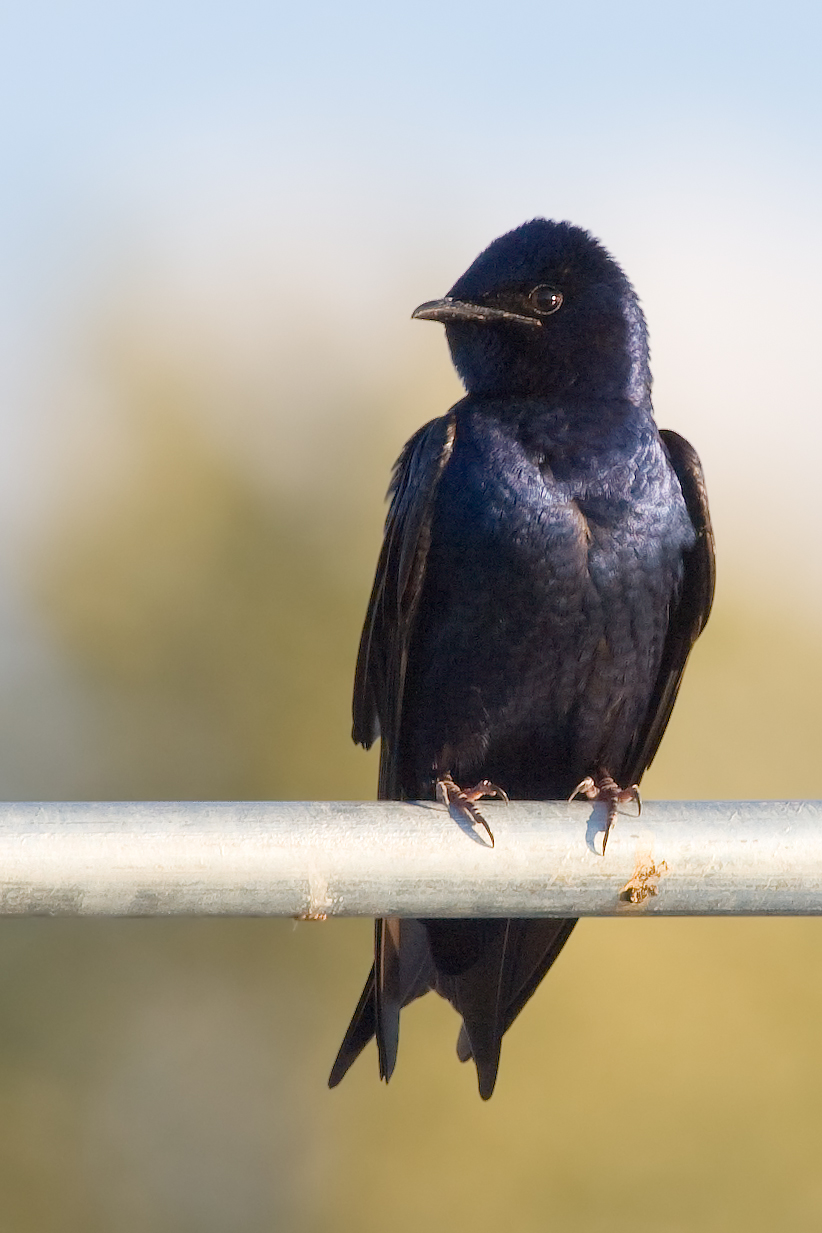
Gray-breasted Martin
Progne chalybea
Order: Passeriformes / Family: Hirundinidae

Wikimedia Commons
About the Gray-breasted Martin
The Gray-breasted Martin (Progne chalybea) is a common swallow found throughout much of Central and South America, known for its adaptability to various environments. This species plays a crucial ecological role as an insectivore, helping to control insect populations in both urban and rural settings. These martins are particularly abundant around open areas near water, often seen gliding gracefully over riverbanks, lakes, and even urban parks. They are strongly associated with savannas, grasslands, and agricultural areas, where they can find ample food sources. During the breeding season, which varies slightly depending on their location, Gray-breasted Martins become more territorial, often returning to the same nesting sites year after year. In the Amazon basin, for instance, breeding typically occurs during the dry season when insects are most plentiful. In contrast, populations in more temperate regions, such as parts of northern Argentina and central Brazil, may adjust their breeding patterns to align with local climatic conditions. Gray-breasted Martins exhibit migratory behavior in the more northern parts of their range, moving southward during the winter months. However, in much of their range across the tropical lowlands, they are present year-round. Their presence is a familiar sight over open fields and water bodies, where they often form large flocks, catching insects in mid-air with remarkable agility. This species' adaptability to human-modified landscapes and its proficiency in aerial foraging make it a resilient and successful member of its ecological community. Its widespread distribution across the Americas highlights its significance as both a common and ecologically important bird.
The Gray-breasted Martin belongs to the family Hirundinidae, within the order Passeriformes. These birds typically live average 4-6 years, with a maximum of 10 years recorded..
How to Identify a Gray-breasted Martin
The Gray-breasted Martin is a medium-sized swallow, measuring about 18 cm in length, with a wingspan of approximately 42 cm. Adult males and females are similar in appearance, both sporting a glossy blue-black upper side with a distinctive pale gray breast and underparts. The contrast between the dark upperparts and the lighter underparts is a key field mark. Juveniles resemble adults but have a browner hue with less gloss on the upperparts and a slightly mottled gray underside. In flight, the Gray-breasted Martin's long, pointed wings and forked tail are noticeable, providing a silhouette typical of swallows. When perched, these martins often sit upright on utility wires or exposed branches, showing off their sleek posture. The Gray-breasted Martin can be confused with the smaller and less robust Northern Rough-winged Swallow, which lacks the glossy upperparts and has a more uniform brown coloration. Additionally, the Southern Martin, though similar in habitat, differs in having a more pronounced forked tail and less contrasting underparts.
Having trouble telling birds apart? Upload a photo to our bird identification tool for an instant species match.
Gray-breasted Martin Habitat and Range
Preferred Habitat
Gray-breasted Martins occupy a wide range of open habitats, including savannas, wetlands, and agricultural fields. They prefer areas near water bodies like rivers, lakes, and marshes, which provide abundant insect prey. In urban settings, they are commonly found around parks and gardens, often nesting on buildings and bridges. Elevation-wise, these martins are typically found from sea level up to 2,000 meters, though they are more common in lowland regions. They exhibit some seasonal habitat shifts, particularly in the more northerly parts of their range, moving to lower elevations or more suitable climates during adverse weather conditions.
Geographic Range
The Gray-breasted Martin's range extends from southern Mexico through Central America and into much of South America, including countries like Colombia, Venezuela, and Brazil. They are widespread in the Amazon basin and can be found as far south as northern Argentina. Populations in southern Mexico and parts of Central America may migrate, moving southward during the non-breeding season. In contrast, populations in the tropical lowlands remain year-round residents. The species shows a preference for lowland regions but can also inhabit montane valleys and highlands during certain times of the year.
Want to know which birds visit your area? Browse our backyard birds by location guides for region-specific species lists.
What Does the Gray-breasted Martin Eat?
Gray-breasted Martins primarily feed on flying insects, making them excellent aerial foragers. Their diet includes a wide variety of insects such as beetles, flies, and dragonflies. During the breeding season, when energy demands are high, they may increase their intake of larger insects. Their foraging technique involves agile flight maneuvers, capturing prey mid-air using their short, broad bills. Feeding activity peaks during early morning and late afternoon when insect activity is highest. During rainy seasons, they may shift to capturing insects closer to the ground or over water surfaces.
Gray-breasted Martin Behavior and Social Structure
Gray-breasted Martins are social birds, often forming large flocks, particularly outside the breeding season. They exhibit site fidelity, returning to the same nesting areas annually. During courtship, males perform aerial displays to attract females, showcasing their agility and strength. They are not highly territorial but will defend nesting sites from intruders, especially during breeding. When threatened by predators, both adults and juveniles may join in mobbing behavior to deter the threat. Daily activity is largely diurnal, with periods of intense feeding interspersed with resting on perches.
Gray-breasted Martin Nesting and Reproduction
Gray-breasted Martins typically nest in cavities, using natural sites such as tree holes or artificial structures like eaves and bridges. They build nests composed of grass, mud, and feathers, forming a cup-like structure. The typical clutch size ranges from 3 to 5 eggs, which are white and measure about 20 mm in length. The incubation period lasts approximately 15-18 days, with both parents sharing incubation duties. Once hatched, the young fledge after about 22-25 days. In favorable conditions, the Gray-breasted Martin may raise two broods per year.
Gray-breasted Martin Sounds and Vocalizations
The primary song of the Gray-breasted Martin is a series of soft, musical warbles and chirps, often delivered from a high perch. Calls include a sharp 'chip' or 'chur' used in communication between flock members. Alarm calls are harsher and more urgent, alerting others to potential danger. During the dawn chorus, their warbling notes can be heard echoing through their habitat, creating a melodious soundscape that announces the start of a new day.
Interesting Facts About the Gray-breasted Martin
- 1Gray-breasted Martins are known to travel up to 800 km during migration, showcasing their strong flying ability.
- 2This species is one of the most adaptable swallows, often seen in areas heavily modified by human activity.
- 3Gray-breasted Martins can consume up to 2,000 insects per day, playing a vital role in controlling pest populations.
- 4They have been observed using bridges and buildings as nesting sites, demonstrating their comfort in urban areas.
- 5During the breeding season, Gray-breasted Martins may form loose colonies, with several pairs nesting in close proximity.
Gray-breasted Martin Conservation Status
The Gray-breasted Martin is currently listed as Least Concern by the IUCN, with a stable population trend. It benefits from its adaptability to urban environments and wide distribution. However, habitat loss due to deforestation and urban expansion poses potential threats in certain areas. Conservation efforts focus on preserving natural habitats and ensuring the availability of nesting sites. Overall, the species has maintained stable numbers due to its ability to thrive in diverse environments.
Other Hirundinidae Species


Birds Similar to the Gray-breasted Martin
These species are often confused with the Gray-breasted Martin due to similar appearance or overlapping range.