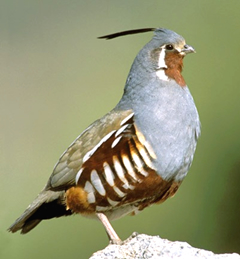
Cook's Quail
Cyrtonyx cooki
Order: Galliformes / Family: Odontophoridae

Wikimedia Commons
About the Cook's Quail
The Cook's Quail, or Cyrtonyx cooki, stands out among the quail family due to its distinctive appearance and ecological role in the grassland and desert ecosystems of North America. Found primarily in the southwestern United States and parts of northern Mexico, this bird plays a crucial role in seed dispersion and insect population control. With its compact build and short, rounded wings, the Cook's Quail is well adapted to its environment. Its presence in regions such as Arizona, New Mexico, and the Chihuahuan Desert highlights its preference for arid landscapes interspersed with grasses and shrubs. Seasonal behaviors of Cook's Quail include a distinct breeding period in the spring, where they engage in elaborate courtship displays. Outside of the breeding season, these quails form small flocks and can often be seen foraging on the ground in groups. The Cook's Quail's ecological significance extends beyond its role in local food webs. As a ground-dwelling bird, it participates actively in the aeration of soil, which contributes to the health of its habitat. Additionally, the bird's feeding habits aid in controlling insect populations, providing a natural pest management service. The Cook's Quail also serves as an indicator species for the health of grassland and desert ecosystems. Changes in its population can reflect broader environmental shifts, making it a valuable subject for conservationists. The bird’s ability to adapt to shifting conditions in its arid habitats demonstrates its resilience, yet it also underscores the importance of mindful conservation efforts to ensure the continued vitality of these ecosystems.
The Cook's Quail belongs to the family Odontophoridae, within the order Galliformes. These birds typically live average 4-5 years with a maximum recorded of 8 years.
How to Identify a Cook's Quail
The Cook's Quail exhibits a striking appearance, characterized by black and white feathers on its face and throat, contrasting with its otherwise brown and gray body. Adult males have a pronounced black and white facial pattern that sets them apart from females, who display more subdued gray and brown tones. Juveniles resemble females but with softer and less distinct markings. In flight, the Cook's Quail shows a rounded wing silhouette, a feature common among quails, which aids in quick takeoffs and agile maneuvers. When perched, it maintains an upright posture, often blending with the grassland or desert backdrop due to its earth-toned plumage. Confusion with similar species such as the Montezuma Quail is possible, but the Cook's Quail's facial markings and habitat preferences can help distinguish it. Observers should note the short tail and rounded wings, which are typical of this species.
Having trouble telling birds apart? Upload a photo to our bird identification tool for an instant species match.
Cook's Quail Habitat and Range
Preferred Habitat
Cook's Quail thrives in arid and semi-arid habitats, including grasslands and deserts. These environments provide the open spaces and sparse vegetation that the quail uses for foraging and nesting. Typically found at elevations ranging from 1,000 to 2,500 meters, Cook's Quail seeks out areas with a mix of grasses and shrubs. Seasonal shifts may lead these birds to move to more sheltered areas during periods of extreme weather, though they generally remain within their established range. While less frequently seen in urban areas, Cook's Quail may occasionally venture into agricultural lands that mimic their natural habitat.
Geographic Range
The range of Cook's Quail primarily encompasses the southwestern United States, including Arizona, New Mexico, and parts of Texas, extending into northern Mexico. This bird's breeding range aligns closely with its year-round habitat, as it tends not to migrate over long distances. Instead, it makes local movements in response to seasonal changes in food availability and weather conditions. Population density is highest in areas like the Chihuahuan Desert, where suitable habitat is abundant. These regions provide the necessary resources for breeding, foraging, and shelter throughout the year.
Want to know which birds visit your area? Browse our backyard birds by location guides for region-specific species lists.
What Does the Cook's Quail Eat?
The diet of Cook's Quail consists mainly of seeds and insects, with a preference for grass seeds and small invertebrates. During the spring and summer, when insects are more abundant, they make up a significant portion of the diet, providing essential protein for breeding and raising young. Foraging occurs primarily on the ground, where the quail uses its beak to sift through soil and leaf litter. The bird's feeding schedule is largely crepuscular, with increased activity during the early morning and late afternoon. In drier months, the Cook's Quail may consume more plant material and rely on dew for moisture.
Cook's Quail Behavior and Social Structure
Cook's Quail exhibits interesting social behaviors, forming small coveys outside of the breeding season. These groups usually consist of family units, aiding in predator detection and foraging efficiency. During the breeding season, males perform elaborate courtship displays, including vocalizations and physical displays, to attract mates. Territorial behavior becomes prominent, with males defending their chosen areas vigorously. In response to predators, Cook's Quail employs a combination of camouflage and quick, low flights to evade capture. Daily activity patterns include foraging during cooler parts of the day and resting during peak heat.
Cook's Quail Nesting and Reproduction
Nesting for Cook's Quail involves a simple scrape on the ground, often lined with grasses and leaves. The location is typically concealed among dense vegetation to protect from predators. A typical clutch consists of 8 to 12 eggs, with an incubation period of approximately 21 to 23 days. Both parents participate in rearing the young, though the female primarily incubates the eggs. Once hatched, the precocial chicks leave the nest quickly and follow the parents in search of food. Cook's Quail may raise one or two broods per year, depending on environmental conditions.
Cook's Quail Sounds and Vocalizations
The primary song of Cook's Quail is a series of clear, whistled notes, often described as a rising and falling cadence. These calls serve territorial and mating purposes. Alarm calls are sharper and more urgent, alerting the covey to potential threats. During the dawn chorus, males are particularly vocal, establishing their presence in the territory. Their calls can be reminiscent of other quail species, but the rhythm and tone are distinct to those familiar with their behavior.
Interesting Facts About the Cook's Quail
- 1Cook's Quail can fly at speeds up to 40 km/h, making quick escapes from predators possible.
- 2The facial pattern of Cook's Quail is unique among North American quails, aiding in quick identification.
- 3Cook's Quail forms coveys of up to 20 birds, a behavior that enhances survival through social vigilance.
- 4During the breeding season, a single male Cook's Quail may mate with multiple females.
- 5Cook's Quail chicks are capable of running and feeding themselves just hours after hatching.
- 6The quail’s diet shifts seasonally, with insects comprising up to 70% of its intake during the summer.
- 7Cook's Quail exhibits site fidelity, often returning to the same breeding grounds each year.
Cook's Quail Conservation Status
Currently, Cook's Quail holds a status of Least Concern according to the IUCN, though habitat loss and fragmentation pose significant threats. Urban expansion and agricultural development encroach on their natural habitats. Conservation efforts focus on habitat preservation and restoration to maintain population stability. Historically, population trends have fluctuated with climate and land use changes, emphasizing the need for ongoing monitoring and adaptive management strategies.