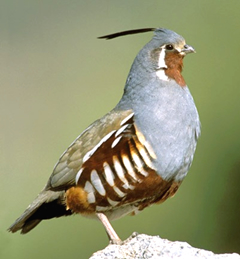
Dark-backed Wood-Quail
Odontophorus melanonotus
Order: Galliformes / Family: Odontophoridae

Wikimedia Commons
About the Dark-backed Wood-Quail
The Dark-backed Wood-Quail (Odontophorus melanonotus) is a reclusive bird endemic to the montane forests of northwestern South America. This species thrives in humid, dense forest environments, typically at elevations ranging from 1,200 to 2,500 meters. It is primarily found in Colombia and Ecuador, where it inhabits isolated patches of cloud forest and subtropical woodlands. The Dark-backed Wood-Quail plays a critical role in its ecosystem by aiding in seed dispersion and providing prey for larger predators. Throughout the year, this ground-dwelling bird is known for its secretive behavior, often heard more than seen. Its presence indicates a healthy, biodiverse forest ecosystem. The bird's preference for undisturbed habitats makes it a valuable indicator species for conservation efforts.
During the breeding season, the Dark-backed Wood-Quail becomes more vocal, with its calls resonating through the forest understory. This species exhibits a monogamous pair-bonding system, and its breeding period coincides with the rainy season when food availability peaks. As a ground-nesting bird, it plays an essential part in the forest's nutrient cycle. By foraging on the forest floor, the Dark-backed Wood-Quail helps in the breakdown of leaf litter and contributes to soil health.
Ecologically, the Dark-backed Wood-Quail is a vital component of the forest food web. Its diet consists primarily of seeds, fruits, and invertebrates, making it an effective agent of seed dispersal. The species' movements within its territory are influenced by seasonal variations in food abundance, leading to minor shifts in habitat use. The Dark-backed Wood-Quail's elusive nature and the dense habitats it occupies pose challenges for ornithologists and conservationists aiming to study its behavior and population dynamics. Understanding the ecological role of the Dark-backed Wood-Quail is crucial for developing conservation strategies that protect its habitat and ensure the species' long-term survival.
The Dark-backed Wood-Quail belongs to the family Odontophoridae, within the order Galliformes. These birds typically live average lifespan is 5-7 years, with some individuals reaching 9 years..
How to Identify a Dark-backed Wood-Quail
The Dark-backed Wood-Quail can be recognized by its distinctive dark plumage. Adults have a predominantly blackish-brown back, with a subtle iridescent sheen that reflects light in the dim forest. The underparts are a rich chestnut-brown, providing a striking contrast. The bird's head features a bold black crown and throat, with a contrasting white stripe above the eye, giving it an alert expression. Juveniles resemble adults but have duller plumage and less pronounced facial markings.
Males and females are similar in appearance, though males may exhibit slightly more vibrant plumage. The Dark-backed Wood-Quail's silhouette is compact and rounded, typical of the quail family, with a short, stout bill adapted for foraging on the ground. Its legs are strong and adapted for scratching at the forest floor in search of food.
This species is often confused with other wood-quails within its range, such as the Rufous-fronted Wood-Quail. However, the Dark-backed Wood-Quail's darker coloration and distinctive facial markings help differentiate it from similar species. When disturbed, the bird takes flight with a rapid burst of wing beats, although it prefers to escape on foot, relying on its agility and camouflage to navigate the dense underbrush.
Having trouble telling birds apart? Upload a photo to our bird identification tool for an instant species match.
Dark-backed Wood-Quail Habitat and Range
Preferred Habitat
The Dark-backed Wood-Quail inhabits tropical montane forests, thriving in humid environments with dense undergrowth. It is commonly found in cloud forests and subtropical woodlands at elevations between 1,200 to 2,500 meters. The bird favors areas with a thick layer of leaf litter and abundant canopy cover, which provide both food resources and protection from predators.
These quails are not typically found in urban or heavily disturbed areas, as they require undisturbed forest habitats to thrive. Seasonal habitat shifts occur as the bird moves in response to food availability, often staying within the same general area but utilizing different microhabitats within the forest.
Their preference for remote and inaccessible forest areas makes the Dark-backed Wood-Quail less likely to be spotted by casual observers. Conservation of these habitats is critical for the survival of this species, as deforestation and habitat fragmentation pose significant threats.
Geographic Range
The Dark-backed Wood-Quail is primarily found in the Andean regions of Colombia and Ecuador. Its range is relatively restricted, limited to suitable forest habitats within these countries. The species does not undertake long migrations, instead exhibiting localized movements based on food availability and seasonal changes in the forest environment.
In Colombia, the bird is present in the western and central Andes, while in Ecuador, it is found in the western slopes of the Andes. The population density is highest in protected areas where habitat conditions remain optimal. Despite its limited range, the Dark-backed Wood-Quail is considered a resident species, maintaining territories throughout the year.
Conservation areas and national parks within its range provide crucial refuges for this species, highlighting the importance of protected areas in preserving biodiversity. Habitat protection and restoration efforts are vital to maintaining the bird's population and preventing further range contraction.
Want to know which birds visit your area? Browse our backyard birds by location guides for region-specific species lists.
What Does the Dark-backed Wood-Quail Eat?
The Dark-backed Wood-Quail's diet consists mainly of seeds, fruits, and invertebrates. It forages on the forest floor, using its strong legs to scratch through leaf litter in search of food. This behavior not only helps the bird find sustenance but also aids in the decomposition of organic material.
During the wet season, the abundance of fruits and seeds provides a plentiful food source. The bird consumes a variety of plant materials, including berries and fallen fruits from the forest canopy. Insects and other invertebrates comprise a secondary component of the diet, especially during the breeding season when protein demands increase.
The Dark-backed Wood-Quail's foraging occurs primarily in the early morning and late afternoon, coinciding with cooler temperatures and reduced predator activity. This schedule allows the bird to maximize its feeding efficiency while minimizing exposure to potential threats.
Dark-backed Wood-Quail Behavior and Social Structure
The Dark-backed Wood-Quail is a social bird, often found in small family groups or coveys. These groups typically consist of a breeding pair and their offspring, although larger gatherings may occur when food resources are abundant. The species exhibits strong territorial behavior, with pairs defending their home range from intruding conspecifics.
Courtship displays involve vocalizations and subtle physical gestures, strengthening pair bonds and signaling readiness to breed. The birds communicate through a series of calls, with males often initiating vocal exchanges. During the breeding season, these calls become more frequent and serve to establish territory boundaries.
In response to predators, the Dark-backed Wood-Quail relies on its camouflage and agility. When threatened, it will often freeze or dash into dense cover rather than taking flight. Daily activity patterns include periods of foraging interspersed with rest and preening, maintaining the bird's plumage and overall health.
Dark-backed Wood-Quail Nesting and Reproduction
The Dark-backed Wood-Quail nests on the ground, typically choosing a concealed location beneath dense vegetation or among fallen leaves. The nest itself is a simple scrape lined with leaves and twigs, providing a minimal structure that blends into the forest floor.
Clutch size ranges from 3 to 5 eggs, with both parents sharing incubation duties. The incubation period lasts approximately 18 to 20 days, after which the chicks hatch synchronously. The altricial chicks are covered in down and remain in the nest for a few days before venturing out under the watchful eyes of their parents.
Both parents participate in feeding and protecting the chicks, guiding them to food sources and teaching them essential survival skills. The fledging period is relatively short, with young birds becoming more independent after 2 to 3 weeks. Dark-backed Wood-Quails typically raise one brood per year, although favorable conditions may lead to a second attempt.
Dark-backed Wood-Quail Sounds and Vocalizations
The Dark-backed Wood-Quail's primary song is a series of rhythmic, low-pitched whistles that carry well through the forest. These calls serve both to communicate with mates and to establish territory boundaries. The song often begins with a series of short notes, building in intensity before tapering off.
In addition to its song, the bird emits a variety of call notes, including soft clucks and purrs used in communication between family members. Alarm calls are sharp and abrupt, designed to alert nearby birds of potential threats.
During the dawn chorus, the Dark-backed Wood-Quail's calls are particularly prominent, contributing to the rich tapestry of forest sounds. The bird's vocalizations are an integral part of its social interactions and territorial behavior.
Interesting Facts About the Dark-backed Wood-Quail
- 1The Dark-backed Wood-Quail's call can be heard up to 500 meters away, making it easier to hear than see in dense forests.
- 2Despite its elusive nature, the Dark-backed Wood-Quail plays a key role in seed dispersal, aiding in forest regeneration.
- 3The species' preference for dense, undisturbed forests makes it a valuable indicator of habitat health and biodiversity.
- 4Dark-backed Wood-Quails are monogamous, often forming lifelong pair bonds that contribute to their strong territorial behavior.
- 5These quails have been observed using their strong legs to create small depressions in the ground, serving as dust baths to clean their plumage.
- 6The Dark-backed Wood-Quail's plumage provides excellent camouflage, blending seamlessly with the forest floor and undergrowth.
- 7Unlike many birds, the Dark-backed Wood-Quail rarely flies, preferring to escape predators by running through the forest undergrowth.
Dark-backed Wood-Quail Conservation Status
The Dark-backed Wood-Quail is currently listed as Near Threatened by the IUCN. Its population trend is decreasing, primarily due to habitat loss and fragmentation resulting from deforestation and agricultural expansion. The species' reliance on intact forest habitats makes it vulnerable to these anthropogenic pressures. Conservation efforts focus on protecting and restoring forest habitats, with several national parks and reserves playing a crucial role in safeguarding the bird's population. Community-based conservation programs aim to involve local communities in habitat protection and sustainable land-use practices. Historically, the Dark-backed Wood-Quail has experienced fluctuations in population size, with current trends emphasizing the urgent need for effective conservation strategies. Continued research and monitoring are necessary to understand better the species' ecology and implement targeted conservation measures.