Dot-winged Antwren
Microrhopias quixensis
Order: Passeriformes / Family: Thamnophilidae

Wikimedia Commons
About the Dot-winged Antwren
The Dot-winged Antwren, known scientifically as Microrhopias quixensis, is a small but charismatic member of the Thamnophilidae family. This bird is predominantly found in the lush, humid tropical forests stretching from southern Mexico through Central America, reaching as far south as northern South America, including Colombia, Venezuela, Ecuador, Peru, and Brazil. It plays a vital role in the forest ecosystem by controlling insect populations, thus maintaining the health of the vegetation. This insectivorous bird is often seen flitting through the understory and mid-story layers of these dense forests, where it frequently participates in mixed-species foraging flocks. The Dot-winged Antwren's presence in these regions signifies a healthy, biodiverse environment, as it requires dense foliage for foraging and nesting. This species exhibits seasonal behaviors, such as increased vocal activity during breeding and subtle shifts in foraging tactics as food availability varies throughout the year. The Dot-winged Antwren is particularly significant for birdwatchers and researchers studying the complex ecological webs of tropical forests. Its behavior and population dynamics offer insights into the impacts of habitat changes and climate variations on tropical bird species. This antwren's preference for undisturbed forest makes it a useful indicator of habitat integrity, and its sensitivity to deforestation highlights the importance of conserving tropical forest ecosystems. Understanding the ecological role of the Dot-winged Antwren aids in broader conservation efforts, emphasizing the need for sustainable practices to protect these vital habitats.
The Dot-winged Antwren belongs to the family Thamnophilidae, within the order Passeriformes. These birds typically live typically 5-7 years, with the oldest recorded at 10 years..
How to Identify a Dot-winged Antwren
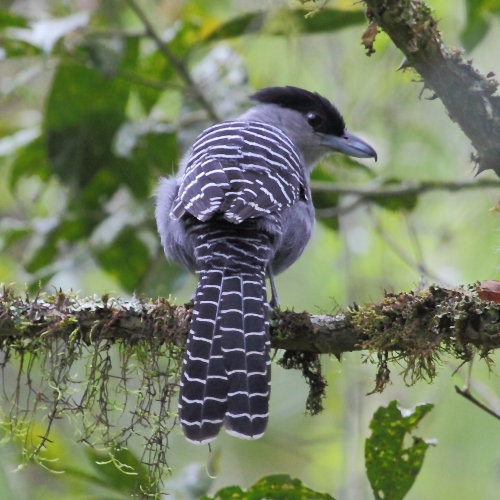
The Dot-winged Antwren is a small bird, measuring about 11-12 cm in length and weighing roughly 10-12 grams. Its most distinctive feature is the striking white dots on its wings, which contrast sharply against its predominantly black plumage. Males are generally darker, sporting an entirely black body with prominent white wing spots. In contrast, females have a more muted appearance, with brownish tones replacing the males' black, yet they retain the characteristic white wing spots. Juveniles resemble females but with even more subdued coloration. The Dot-winged Antwren can be confused with other small forest birds, such as the Checker-throated Stipplethroat, but can be distinguished by its unique wing pattern and lack of throat markings. In flight, the antwren displays a slightly rounded silhouette with rapid wing beats, a common trait among small insectivorous forest birds. When perched, it often adopts a slightly cocked tail posture, displaying its characteristic wing spots. Observing these distinctive marks is crucial for correct identification in the dense understory where this bird typically resides.
Having trouble telling birds apart? Upload a photo to our bird identification tool for an instant species match.
Dot-winged Antwren Habitat and Range
Preferred Habitat
The Dot-winged Antwren predominantly inhabits lowland tropical forests, thriving in the humid, dense undergrowth and mid-story layers. It prefers undisturbed, mature forests, where it finds ample cover and insect prey. These birds are typically found from sea level up to 1,200 meters in elevation, although they occasionally venture higher. Seasonal habitat shifts are minimal, as they are non-migratory and maintain territories year-round. While they can adapt to secondary growth and edges of forests, their presence in urbanized or highly disturbed areas is rare, highlighting their sensitivity to habitat changes. Conservation of their preferred habitats is crucial for their survival.
Geographic Range
The range of the Dot-winged Antwren extends from southern Mexico through Central America, including Guatemala, Belize, Honduras, Nicaragua, Costa Rica, and Panama. In South America, their range includes Colombia, Venezuela, Ecuador, Peru, and northern Brazil. They are non-migratory, residing in these areas year-round, with no significant long-distance movements. Their population density peaks in pristine forest regions, where they benefit from the abundance of insect prey and optimal nesting sites. While they are widespread within their range, habitat fragmentation and deforestation pose significant threats to their populations, making them less common in heavily altered landscapes.
Want to know which birds visit your area? Browse our backyard birds by location guides for region-specific species lists.
What Does the Dot-winged Antwren Eat?
The Dot-winged Antwren primarily feeds on insects, with ants, beetles, and spiders forming the bulk of its diet. It employs a methodical foraging technique, gleaning insects from leaves and twigs within the dense understory and mid-story of tropical forests. These birds often join mixed-species flocks, which allows them to exploit a wider range of food sources while benefiting from the collective vigilance against predators. Seasonal changes in prey availability may lead to slight shifts in diet composition, although insects remain their primary food source throughout the year. The antwren's small size limits it to capturing prey items that are similarly small, typically no larger than a few centimeters.
Dot-winged Antwren Behavior and Social Structure
The Dot-winged Antwren exhibits a complex social structure, often living in monogamous pairs within well-defined territories. Territorial behavior is pronounced, with both males and females engaging in vocal displays to defend their area from intruding conspecifics. During the breeding season, males perform courtship displays that include song and visual demonstrations, such as wing flicking and tail fanning, to attract mates. While generally solitary outside of mixed-species flocks, they may form small family groups post-breeding. Their response to predators includes alarm calls and evasive maneuvers, retreating deeper into dense foliage for cover. Dot-winged Antwrens are primarily diurnal, with peak activity during early morning and late afternoon when foraging tends to be most productive.
Dot-winged Antwren Nesting and Reproduction
The Dot-winged Antwren constructs a small, cup-shaped nest using fine plant materials, spider silk, and lichens, often situated in the fork of a tree branch or nestled among dense vegetation. These nests are typically placed at a height of 1-3 meters, providing concealment from predators. A typical clutch consists of 2-3 eggs, which are incubated by both parents for approximately 14-16 days. After hatching, the altricial chicks remain in the nest for another 10-12 days before fledging. Parental care extends beyond fledging, with both adults actively feeding and protecting the young until they become independent. The Dot-winged Antwren may raise multiple broods per year if conditions are favorable.
Dot-winged Antwren Sounds and Vocalizations
The primary song of the Dot-winged Antwren is a rapid series of clear, high-pitched notes delivered in a descending pattern, often described as "tsee-tsee-tsee-tsee." This song carries well through the dense forest, serving both territorial and mate attraction purposes. Call notes are sharp and metallic, used for communication between pairs or within mixed-species flocks. In response to danger, alarm calls are quick and harsh, alerting nearby birds to the presence of predators. During the dawn chorus, their song is more frequent and pronounced, contributing to the vibrant soundscape of tropical forests.
Interesting Facts About the Dot-winged Antwren
- 1The Dot-winged Antwren often joins mixed-species feeding flocks, enhancing its foraging efficiency and protection from predators.
- 2Despite its small size, the Dot-winged Antwren's vocalizations are surprisingly loud, helping it communicate effectively in dense forests.
- 3This species is a member of the antbird family, which is known for its association with army ant swarms, although the Dot-winged Antwren is not a specialist in this behavior.
- 4The Dot-winged Antwren is particularly sensitive to forest fragmentation, often serving as an indicator species for habitat health.
- 5Their nests are ingeniously camouflaged with lichens and spider silk, making them nearly invisible to predators.
- 6Dot-winged Antwrens are known to participate in cooperative defense of territories, with pairs working together to ward off intruders.
- 7They exhibit a fascinating behavior known as "anting," where they allow ants to crawl over their plumage, possibly for cleaning purposes.
Dot-winged Antwren Conservation Status
The Dot-winged Antwren is currently listed as Least Concern on the IUCN Red List, although its populations face pressures from habitat loss due to deforestation and agriculture. While its overall population is stable, localized declines occur in areas where forest habitats are severely fragmented or degraded. Conservation efforts focus on habitat preservation and sustainable land-use practices to mitigate these impacts. Protected areas in Central and South America play a crucial role in safeguarding this species' habitats, ensuring the long-term stability of its populations.