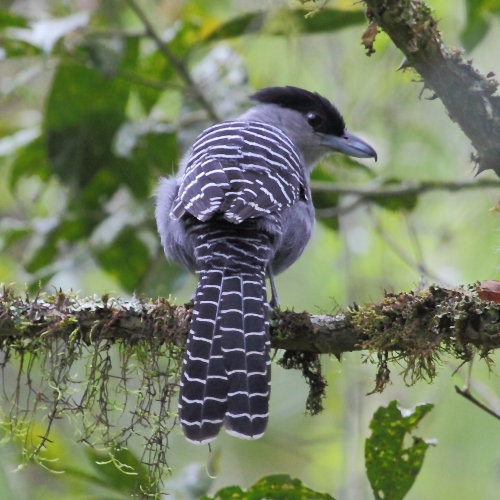
Drymophila variegata
Drymophila variegata
Order: Passeriformes / Family: Thamnophilidae
About the Drymophila variegata
Drymophila variegata, commonly known as the variegated antbird, is a striking representative of the Thamnophilidae family. This bird inhabits subtropical and tropical moist lowland forests, particularly favoring the dense undergrowth of the Andean regions in Peru and Ecuador. Its presence is vital for the ecological balance, as it controls insect populations through its feeding habits. The variegated antbird demonstrates a preference for moist, montane forests, ranging in elevation from 800 to 2,000 meters. This bird exhibits a remarkable adaptation to its dense forest habitat, moving through the underbrush with agility and precision.
The variegated antbird plays a critical role in the food web, preying on a variety of insects, thus regulating their populations. Its ecological significance extends to being a part of a diverse avian community that contributes to the richness and complexity of the Andean forest ecosystems. This bird's behavior is a classic example of the ant-following guild, where it trails army ants to catch insects flushed out by these foraging swarms.
Seasonally, the Drymophila variegata remains relatively sedentary, with little evidence of long-distance migration. It may exhibit minor altitudinal movements in response to changing food availability or climatic conditions. During the breeding season, it becomes more territorial, showcasing a shift from its usual secretive nature to a more conspicuous presence as it defends its nesting territory. This behavior underscores its adaptability and the fine balance it maintains within its ecological niche.
The Drymophila variegata belongs to the family Thamnophilidae, within the order Passeriformes. These birds typically live average 5-7 years with a max recorded of 9 years..
How to Identify a Drymophila variegata
The variegated antbird is medium-sized, measuring approximately 14-16 centimeters in length. Adults showcase a distinctive plumage pattern of black and white barring across their bodies. The upperparts are primarily black with prominent white streaks, while the underparts exhibit a more subtle barring. Males and females share similar appearances, although females may have slightly less pronounced markings. Juveniles tend to display a duller version of the adult plumage, with more brownish tones and less defined barring.
One of the most distinguishing features of Drymophila variegata is its rounded wings and long tail, which aid in maneuvering through dense vegetation. Its flight silhouette is compact, with rapid wingbeats, enabling it to navigate the forest undergrowth efficiently. When perched, the variegated antbird often holds its tail slightly cocked, a posture that is useful for identification in the field.
Though similar in habits to other antbirds, such as the checker-throated antwren, the variegated antbird's unique barred pattern and habitat preferences help distinguish it from its relatives. Observers should note its behavior of staying close to the ground, often within a meter of the forest floor, which can be a useful identification clue.
Having trouble telling birds apart? Upload a photo to our bird identification tool for an instant species match.
Drymophila variegata Habitat and Range
Preferred Habitat
The variegated antbird thrives in subtropical and tropical moist lowland forests, with a strong preference for dense underbrush and tangled vegetation. It favors elevations ranging from 800 to 2,000 meters, predominantly in the Andean regions of Peru and Ecuador. This bird is primarily found in the forest's lower strata, staying close to the ground within the dense foliage.
In terms of habitat shifts, Drymophila variegata remains relatively stable throughout the year, with no significant seasonal movements. It is not commonly found in urban areas, preferring the seclusion and cover offered by rural and wilderness regions. The dense, humid forest provides the necessary cover and abundance of prey items needed for its survival. It is less frequently observed in fragmented or heavily disturbed habitats, highlighting its reliance on intact forest ecosystems.
Geographic Range
The breeding range of Drymophila variegata is primarily confined to the Andean regions of Peru and Ecuador, where it inhabits subtropical and tropical moist lowland forests. This bird does not exhibit long-distance migration behaviors, remaining within its natal territory year-round. Within its range, the variegated antbird is more densely populated in areas with abundant undergrowth and minimal human disturbance.
Specific regions within its range, such as the cloud forests of southern Ecuador and northern Peru, serve as population density hotspots. These areas provide the ideal environmental conditions necessary for the species' survival and reproduction. While the variegated antbird does not migrate, it may undertake minor altitudinal movements in response to local weather conditions or food availability.
Despite its relatively limited range, the variegated antbird remains a reliable presence within its preferred habitats. Observers and researchers often focus on these regions for studying the species' behaviors and ecological interactions, as it offers a consistent opportunity to observe this intriguing bird.
Want to know which birds visit your area? Browse our backyard birds by location guides for region-specific species lists.
What Does the Drymophila variegata Eat?
The diet of the variegated antbird consists primarily of insects, which it gleans from the forest floor and low vegetation. This bird exhibits a specialized foraging technique, often following swarms of army ants to capture insects displaced by the ant activity. The variegated antbird's diet includes a variety of small arthropods, such as beetles, spiders, and caterpillars, as well as occasional small vertebrates.
Seasonal changes can influence the availability of specific prey items, prompting the variegated antbird to adjust its foraging strategies accordingly. During periods of high ant activity, it can rely more heavily on ant-following behavior to secure its meals. Its foraging schedule is typically diurnal, with peak activity occurring in the early morning and late afternoon when insect activity is highest.
The bird's ability to exploit ant swarms not only highlights its adaptability but also underscores its role as an integral part of the forest's ecological dynamics. This behavior is particularly important in maintaining a balanced ecosystem, as it helps control insect populations that could otherwise reach pest levels.
Drymophila variegata Behavior and Social Structure
The variegated antbird exhibits a fascinating array of behaviors, particularly in its social and territorial interactions. It typically forages alone or in pairs, displaying a territorial nature during the breeding season when it actively defends its nesting area from intruders. Courtship displays involve a combination of vocalizations and physical posturing, with both males and females participating in these rituals to establish pair bonds.
Flocking behavior is rare for Drymophila variegata, as it tends to maintain solitary or paired foraging habits, especially outside the breeding season. Its response to predators involves a mix of alarm calls and evasive maneuvers, utilizing the dense forest cover to its advantage. The variegated antbird's daily activity patterns are largely diurnal, with peak periods of activity during the early morning and late afternoon, aligning with the availability of prey.
This bird's adaptability to its environment is evident in its interactions with army ants, where it demonstrates opportunistic foraging by capitalizing on the disturbances created by the ants. The variegated antbird's behaviors not only reflect its ecological niche but also contribute to the complexity and balance of the forest ecosystems it inhabits.
Drymophila variegata Nesting and Reproduction
Drymophila variegata constructs nests that are typically cup-shaped, crafted meticulously from leaves, twigs, and other plant materials. These nests are strategically placed in dense underbrush, often low to the ground or within shrubs, providing cover and protection from predators. The variegated antbird exhibits a preference for secluded and inaccessible nesting sites, which offer additional security for the eggs and chicks.
The typical clutch size ranges from two to three eggs, with an incubation period lasting approximately 14 to 16 days. Both parents share responsibilities in incubating the eggs and feeding the altricial chicks once they hatch. The fledging timeline is relatively short, with young birds leaving the nest within 12 to 15 days after hatching, although parental care may continue for some time thereafter.
The variegated antbird usually raises one brood per year, aligning its breeding activities with periods of optimal food availability. This strategy ensures that the chicks have access to sufficient resources during their critical growth stages. The nesting habits of Drymophila variegata underscore its adaptability and the evolutionary strategies it employs to ensure reproductive success in its dense forest habitat.
Drymophila variegata Sounds and Vocalizations
The primary song of the variegated antbird is a series of sharp, distinctive notes delivered in quick succession, resembling the rhythmic tapping of a small drum. The pitch is moderately high, and the quality is often described as metallic or tinny, easily carrying through the dense forest undergrowth. Call notes are shorter and less structured, typically used for communication between mates or signaling alarm.
Alarm calls are more abrupt and harsh, designed to alert other birds to potential dangers. These vocalizations play a crucial role in maintaining social cohesion and territorial boundaries within the species. During the dawn chorus, the variegated antbird's song contributes a unique element to the symphony of forest sounds, often marking its presence among other avian species.
The vocal repertoire of Drymophila variegata, while not as varied as some other songbirds, remains an essential aspect of its behavior, facilitating interactions and enhancing its ability to thrive in the dense forest environment it calls home.
Interesting Facts About the Drymophila variegata
- 1The variegated antbird often follows swarms of army ants, a behavior known as 'ant-following', to catch insects flushed out by the ants.
- 2Despite being a tropical species, the variegated antbird has adapted to cooler montane environments, living at elevations up to 2,000 meters.
- 3This bird's distinctive black and white barred plumage helps it blend into the dappled light of the understory, providing natural camouflage.
- 4The variegated antbird's territorial song is a key element in its courtship rituals, used to attract mates and ward off rivals.
- 5Drymophila variegata is part of a diverse avian community in the Andean forests, coexisting with species like the spotted antbird and the dusky antbird.
- 6The fledging period for the variegated antbird is notably short, with chicks leaving the nest within two weeks of hatching.
- 7Though generally sedentary, the variegated antbird may shift altitudinally in search of food, demonstrating its adaptability to environmental changes.
Drymophila variegata Conservation Status
Currently, the IUCN classifies the variegated antbird as Least Concern, indicating a stable population trend. However, ongoing habitat destruction due to deforestation and land conversion poses a significant threat to its long-term survival. Conservation efforts focus on preserving its natural habitat through protected areas and sustainable land-use practices. Historically, the population has remained relatively stable, benefiting from the dense and often inaccessible nature of its preferred habitats. Nonetheless, as human encroachment continues, there is a need for increased awareness and protective measures to ensure the species does not face future declines. Conservation organizations emphasize the importance of maintaining intact forest ecosystems, which support not only Drymophila variegata but also a myriad of other species that share its habitat. Collaborative efforts between local communities and conservationists aim to balance ecological preservation with human needs, ensuring the continued survival of the variegated antbird.