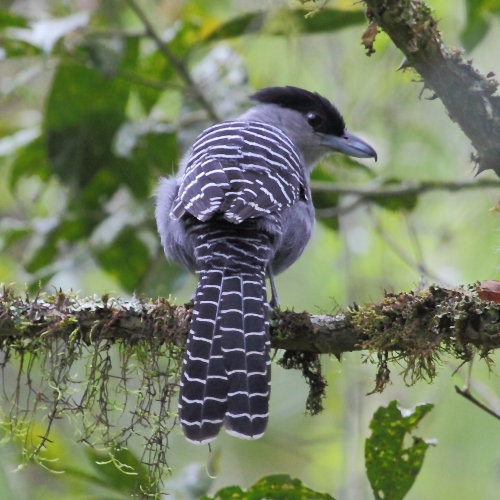
Dugand's Antwren
Herpsilochmus dugandi
Order: Passeriformes / Family: Thamnophilidae

Wikimedia Commons
About the Dugand's Antwren
The Dugand's Antwren, scientifically known as Herpsilochmus dugandi, is a member of the Thamnophilidae family, which is a group widely recognized for its diverse range of antbirds. This species is particularly celebrated for its role in the ecosystems of the Amazon Basin and parts of northern South America. It inhabits lowland tropical forests, often found in the middle to upper strata of the canopy, where it plays a vital role in controlling insect populations. The Dugand's Antwren is integral to maintaining the health of the forest ecosystem by helping to balance the insect communities, which in turn supports the diverse flora that forms the backbone of these habitats.
This antwren was first described in the mid-20th century, and it has since become a subject of interest due to its specialized habitat requirements and behaviors. The species is named in honor of the Colombian ornithologist Armando Dugand, reflecting its primary range in northern South America. The Dugand's Antwren typically resides in Colombia, Venezuela, and parts of Brazil, where it favors humid forest environments.
Ecologically, the Dugand's Antwren occupies a niche that allows it to thrive in areas where other antbirds might not. During the breeding season, which usually aligns with the rainy season, this bird becomes more vocal and conspicuous. Its presence is often indicated by its distinctive calls, which resonate through the canopy, signaling its territory to potential mates and rivals. Its adaptability to different forest types, including secondary growth, demonstrates its resilience, but habitat destruction remains a significant threat to its populations.
The Dugand's Antwren belongs to the family Thamnophilidae, within the order Passeriformes. These birds typically live average 4-6 years, with a maximum recorded of 9 years..
How to Identify a Dugand's Antwren
Identifying the Dugand's Antwren involves noting several key features. It is a small bird, measuring approximately 10-12 cm in length, with a slim build adapted for agile movement through dense foliage. The adult male typically exhibits a striking plumage with a mix of subtle grays and whites, complemented by black streaks on its head and back. The female, while similar in size, tends to have more muted tones, exhibiting a brownish hue with less pronounced streaking, which helps in camouflaging within the leafy environment.
Juvenile Dugand's Antwrens resemble females but have even less defined streaking and a paler overall appearance. This dimorphism between the sexes becomes more pronounced as the birds mature. The species' flight pattern is characterized by short, rapid bursts, allowing it to maneuver through the tightly packed branches of its forest home with ease. When perched, Dugand's Antwrens maintain an upright posture, often tilting their heads inquisitively while scanning for insects.
Confusion may arise with other small antbirds in the region, particularly those of the same genus, but the combination of its specific call and subtle plumage differences aids in accurate identification. Observers should listen for its distinctive vocalizations-a series of sharp, quick notes-when trying to locate this elusive bird.
Having trouble telling birds apart? Upload a photo to our bird identification tool for an instant species match.
Dugand's Antwren Habitat and Range
Preferred Habitat
The Dugand's Antwren predominantly inhabits tropical lowland forests, where it thrives amidst the dense canopy and sub-canopy layers. It shows a preference for humid environments, frequently found in areas with abundant leaf litter and tangled vines, which provide ample foraging opportunities. This species is typically observed at elevations ranging from sea level to about 1200 meters, although it is more commonly seen at lower elevations.
During different seasonal cycles, the bird may shift its habitat slightly, moving closer to forest edges or secondary growth during the breeding season to take advantage of increased insect activity. Unlike some other antbird species, the Dugand's Antwren is not commonly found in urban areas, as it requires the dense vegetation of forested regions to thrive.
The forest habitat is not just a shelter but a complex web of interactions where the Dugand's Antwren plays a critical role. Its presence indicates a healthy ecosystem, as it relies on intact forests that support a diverse array of insect life.
Geographic Range
The Dugand's Antwren has a distribution primarily centered in northern South America. Its breeding range extends across Colombia and Venezuela, with populations also found in the Amazonian regions of Brazil. The bird's presence in these areas is closely tied to the availability of suitable forest habitats, particularly lowland tropical forests.
Although the Dugand's Antwren does not undertake long-distance migrations, it may exhibit minor seasonal movements in response to changes in food availability or breeding conditions. These movements are generally confined within its existing range, ensuring access to the resources it needs throughout the year.
Population density can vary significantly within its range, with hotspots often occurring in regions where forest integrity is maintained. Areas such as the Colombian Amazon and Venezuelan lowlands are known for supporting substantial numbers of this species, highlighting the importance of these regions for its continued survival.
Want to know which birds visit your area? Browse our backyard birds by location guides for region-specific species lists.
What Does the Dugand's Antwren Eat?
The Dugand's Antwren primarily feeds on a diet of insects and other small arthropods, which it gleans from the foliage of the forest canopy. Its foraging technique involves agile hops and flits between branches, allowing it to probe into crevices and under leaves where prey might be hiding. The bird's diet is diverse, including beetles, ants, and spiders, with size and type shifting slightly with seasonal availability.
During the wet season, when insect numbers peak, the Dugand's Antwren may focus on larger prey items, taking advantage of the abundance to meet the increased energy demands of breeding and rearing young. Conversely, in drier periods, it may rely more heavily on smaller, more readily available insects, showcasing its adaptability.
This antwren typically forages alone or in pairs, occasionally joining mixed-species flocks that navigate the forest in search of food. Its feeding activity peaks during the early morning and late afternoon, times when insect activity is also heightened.
Dugand's Antwren Behavior and Social Structure
The behavior of the Dugand's Antwren is marked by its active and inquisitive nature. It is predominantly solitary or found in pairs, particularly during the breeding season. The bird exhibits strong territorial behavior, often defending its chosen area through vocal displays and physical posturing. Males are particularly vocal, using a series of sharp notes to demarcate territory boundaries and to attract mates.
During courtship, the Dugand's Antwren engages in a series of displays that include wing flicking and tail fanning, accompanied by soft calling to strengthen pair bonds. Flocking behavior is occasionally observed, with the species joining mixed-species groups, a strategy that offers increased protection from predators and enhances foraging efficiency.
Daily activity patterns of the Dugand's Antwren are influenced by environmental conditions, with peak activity occurring during the cooler parts of the day. In the presence of predators, such as raptors, it relies on dense foliage for cover, often freezing or dropping lower into the canopy to avoid detection.
Dugand's Antwren Nesting and Reproduction
Nesting for the Dugand's Antwren involves constructing a delicate cup-shaped nest, typically positioned in the fork of a slender tree branch, hidden among dense foliage to avoid predation. The nest is constructed from fine materials such as grass, leaves, and spider silk, providing a secure yet camouflaged structure for the eggs and chicks.
The typical clutch size ranges from two to three eggs, which are incubated primarily by the female, though the male may assist in this duty. The incubation period extends for about 12 to 14 days, after which the chicks hatch, requiring intensive parental care. Both parents partake in feeding the young, supplying a steady stream of insects to meet their nutritional needs.
Fledging occurs approximately 10 to 12 days post-hatching, with the young receiving continued care as they learn to forage independently. The Dugand's Antwren typically raises one brood per year, although favorable conditions might encourage a second attempt.
Dugand's Antwren Sounds and Vocalizations
The primary song of the Dugand's Antwren is a series of sharp, quick notes that rise and fall in a rhythmic pattern, creating a distinctive sound that is easily recognizable once learned. These vocalizations serve multiple purposes, from territory defense to mate attraction.
In addition to its song, the Dugand's Antwren produces a variety of call notes, including softer, more muted sounds used during close-range communication between pairs. Alarm calls are sharper and more urgent, designed to alert nearby conspecifics to potential threats.
The bird's vocal activity peaks during the dawn chorus, when it joins the cacophony of the forest in a concerted display of territory and identity. These sounds, combined with its visual presence, make it a notable component of its environment.
Interesting Facts About the Dugand's Antwren
- 1The Dugand's Antwren is named after Armando Dugand, a prominent Colombian ornithologist who contributed significantly to the study of South American birds.
- 2Despite its small size, the Dugand's Antwren plays a significant role in its ecosystem by helping control insect populations, which supports plant health.
- 3The Dugand's Antwren is often found in mixed-species flocks, a behavior that provides increased protection from predators and enhances foraging efficiency.
- 4While the Dugand's Antwren is not migratory, it may move locally to exploit different areas within its range as seasons change and resources fluctuate.
- 5This species is particularly vocal during the breeding season, with males often singing to establish territory boundaries and attract mates.
- 6The Dugand's Antwren's nest construction involves using spider silk, which helps bind the materials together and provides flexibility and strength.
- 7Vocalizations of the Dugand's Antwren are integral to its social interactions, helping maintain pair bonds and coordinate parental care.
Dugand's Antwren Conservation Status
The Dugand's Antwren is currently listed as Least Concern by the IUCN, reflecting a relatively stable population across its range. However, this status does not imply an absence of threats. Habitat loss due to deforestation for agriculture and logging poses significant risks, particularly in areas where forest conservation is not prioritized. Conservation efforts aimed at preserving tropical forests are crucial to maintaining the habitats that the Dugand's Antwren and countless other species depend on. Protected areas and sustainable land management practices offer hope for the continued survival of this bird. Population monitoring is essential to detect potential declines early and to implement necessary protective measures. Historically, the species has shown resilience, adapting to certain levels of habitat change, but ongoing vigilance is required to ensure that this adaptability is not stretched beyond its limits.