
Dusky-throated Antshrike
Thamnomanes ardesiacus
Order: Passeriformes / Family: Thamnophilidae

Wikimedia Commons
About the Dusky-throated Antshrike
The Dusky-throated Antshrike, scientifically known as Thamnomanes ardesiacus, is a small bird species within the family Thamnophilidae, best known for its role as a sentinel in mixed-species flocks in the neotropical forests of South America. This bird thrives in the understory of tropical lowland forests, particularly in regions of the Amazon Basin, which spans across countries like Brazil, Peru, and Bolivia. Its ecological role is significant as it acts as an early warning system for the flock, alerting other birds to the presence of predators through its distinct calls. This behavior allows other species to forage with reduced risk, enhancing their survival chances, and underscores the importance of the Dusky-throated Antshrike in maintaining the biodiversity of its habitat.
The Dusky-throated Antshrike is often found in primary forests, but it can also inhabit secondary growth areas and edges of forests where its presence indicates a healthy ecosystem. This bird's preference for dense understory and its ability to adapt to varied forest conditions contribute to its wide distribution across the Amazon Basin. During the breeding season, which generally occurs during the wet season from November to April, the antshrike's behaviors become more pronounced. Males and females engage in complex vocal interactions as part of their courtship rituals, enhancing pair bonds and ensuring successful reproduction.
Ecologically, the Dusky-throated Antshrike plays a pivotal role in insect population control. It primarily feeds on arthropods, which it gleans from foliage and branches. Its foraging behavior not only helps control insect populations but also aids in the dispersal of plant seeds, as some insects are seed predators. The presence of the Dusky-throated Antshrike in forest ecosystems thus contributes to the delicate balance of ecological interactions that sustain the rich biodiversity of the Amazon rainforest.
The Dusky-throated Antshrike belongs to the family Thamnophilidae, within the order Passeriformes. These birds typically live typically 4-7 years, with some living up to 9 years in the wild..
How to Identify a Dusky-throated Antshrike
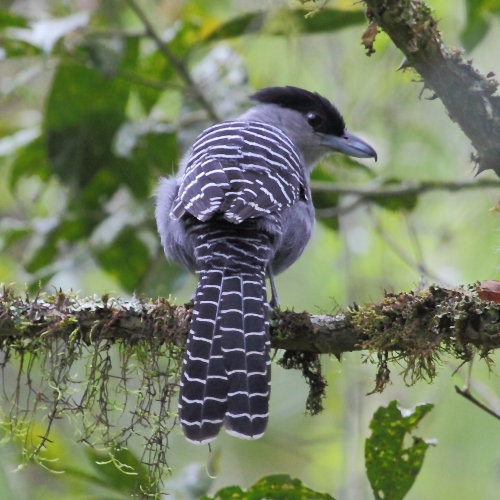
The Dusky-throated Antshrike is a small-sized bird, generally measuring around 13 to 14 cm in length. Adult males and females exhibit similar plumage, characterized by a slate-gray coloration that is more pronounced on the throat and chest, giving the bird its name. The back and wings are darker, almost blackish-gray, while the underparts are paler. The eyes are dark, and the short, stout bill is adapted for its insectivorous diet.
Juvenile birds can be distinguished from adults by their slightly duller plumage and a more brownish hue overall. Unlike many other bird species, sexual dimorphism in the Dusky-throated Antshrike is minimal, which can make field identification challenging without close observation. In flight, this species exhibits rapid, fluttering wing beats interspersed with short glides, typical of many small forest-dwelling birds.
When perched, the Dusky-throated Antshrike often holds its tail slightly cocked, a posture that, along with its vocalizations, helps differentiate it from similar species such as the Bluish-slate Antshrike, which shares its habitat but has subtle differences in shade and song. Birders often rely on vocalizations to confirm identification, as visual sightings can be brief and obscured by dense foliage.
Having trouble telling birds apart? Upload a photo to our bird identification tool for an instant species match.
Dusky-throated Antshrike Habitat and Range
Preferred Habitat
The Dusky-throated Antshrike inhabits the dense understory of tropical lowland rainforests, particularly those of the Amazon Basin. This species prefers areas with dense foliage that provide ample cover and foraging opportunities. It is typically found at elevations ranging from sea level to about 1,200 meters, though most commonly below 600 meters.
While the Dusky-throated Antshrike is primarily associated with primary forests, it can also adapt to secondary growth and forest edges. Its presence in these areas often signals a recovering ecosystem. Unlike some forest species, it does not typically venture into urban or highly disturbed areas, preferring the relative seclusion and stability of mature forest environments. Seasonal shifts are not pronounced for this species, as it remains a year-round resident of its chosen habitat, although slight movements may occur in response to local food availability.
Geographic Range
The Dusky-throated Antshrike is endemic to the neotropical regions of South America, with a range that covers a significant portion of the Amazon Basin. It is found in Brazil, Peru, Bolivia, Colombia, and Ecuador, although its presence is most densely concentrated in the western and central Amazonian lowlands.
This species is a non-migratory bird, maintaining its range throughout the year. Within its range, the Dusky-throated Antshrike is relatively widespread, though its presence is closely tied to the availability of suitable forest habitats. Population densities are highest in areas with extensive, undisturbed primary forest, but it can also be found in selectively logged or regenerating forests, provided the understory remains intact.
Despite its broad range, the Dusky-throated Antshrike is considered uncommon in localized areas, and its distribution can be patchy, dependent on the quality of the habitat. Conservation of large tracts of continuous forest is essential for maintaining healthy populations of this and many other forest-dependent species.
Want to know which birds visit your area? Browse our backyard birds by location guides for region-specific species lists.
What Does the Dusky-throated Antshrike Eat?
The primary diet of the Dusky-throated Antshrike consists of arthropods, particularly insects such as ants, beetles, and caterpillars. It forages by gleaning from foliage and branches, often picking prey from the undersides of leaves or within crevices of bark. This bird employs a methodical foraging technique, moving deliberately through the understory to locate hidden prey.
Seasonal variations in diet are minimal, as the warm, humid climate of the Amazon provides a relatively stable supply of insects year-round. However, during the wet season, when insect populations peak, the Dusky-throated Antshrike may expand its diet to include other small invertebrates, occasionally capturing spiders or small centipedes.
Prey size is generally small to medium, allowing the antshrike to consume prey whole. This bird's feeding schedule is diurnal, with peak foraging activity occurring during the cooler morning and late afternoon hours, when insects are more active and easier to find.
Dusky-throated Antshrike Behavior and Social Structure
The Dusky-throated Antshrike exhibits a highly social structure, often forming part of mixed-species foraging flocks. Within these flocks, the antshrike plays the role of sentinel, using its keen sense of sight and sound to detect predators. It communicates potential threats with a series of sharp calls, allowing other birds to take cover or escape as needed.
These antshrikes are territorial, defending their feeding and nesting areas against intruders, particularly during the breeding season. Males and females engage in vocal duets that serve to maintain pair bonds and establish territory boundaries. Courtship displays are subtle, involving mutual preening and synchronized movements rather than elaborate dances.
In response to predators, the Dusky-throated Antshrike relies on camouflage and evasive flight, diving into dense cover to avoid capture. Daily activity patterns are centered around foraging and territory defense, with periods of rest during the hottest part of the day.
Dusky-throated Antshrike Nesting and Reproduction
The nesting habits of the Dusky-throated Antshrike involve the construction of a small, cup-shaped nest, typically built low in the understory, about 1 to 3 meters above the ground. Nest materials include dead leaves, plant fibers, and spider silk, which are woven together to create a secure structure.
Clutch size generally consists of two to three eggs, which are incubated by both parents for about 14 to 16 days. The eggs are white with reddish-brown speckles, providing some degree of camouflage within the nest.
Once hatched, the chicks remain in the nest for approximately 10 to 12 days before fledging. Both parents participate in feeding and protecting the young, ensuring a high level of parental care. The Dusky-throated Antshrike typically raises one brood per year, although in optimal conditions, a second brood may be attempted.
Dusky-throated Antshrike Sounds and Vocalizations
The primary song of the Dusky-throated Antshrike is a series of sharp, staccato notes that rise and fall in pitch, producing a rhythm reminiscent of a tapping sound. These vocalizations serve as both a territorial call and a means of communication within mixed-species flocks.
Call notes are shorter and more abrupt, often used as alarm signals to alert other birds to potential dangers. Alarm calls are typically emitted in rapid succession, creating an urgent tone that prompts immediate attention.
During the dawn chorus, the Dusky-throated Antshrike's song can be heard clearly, as it joins the symphony of sounds produced by other forest inhabitants. Its vocalizations are distinctive, helping birders and researchers identify its presence despite the dense canopy that often obscures visual sightings.
Interesting Facts About the Dusky-throated Antshrike
- 1The Dusky-throated Antshrike serves as a natural sentinel, alerting mixed-species flocks to predators, which enhances survival rates.
- 2Unlike many bird species, the Dusky-throated Antshrike exhibits little sexual dimorphism, making male and female identification challenging.
- 3Dusky-throated Antshrikes play an ecological role by controlling insect populations, contributing to forest health and biodiversity.
- 4This species demonstrates a unique foraging technique, gleaning insects from foliage in the dense understory of the Amazon rainforest.
- 5The Dusky-throated Antshrike's distinctive vocalizations help it communicate within mixed-species flocks, maintaining group cohesion.
- 6During the breeding season, the Dusky-throated Antshrike engages in vocal duets, strengthening pair bonds and establishing territories.
- 7The antshrike's habitat preferences make it an indicator species for the health of lowland rainforest ecosystems in the Amazon Basin.
Dusky-throated Antshrike Conservation Status
The Dusky-throated Antshrike is currently classified as a species of Least Concern by the IUCN, owing to its wide range and stable population numbers. However, its reliance on intact forest habitats makes it vulnerable to deforestation and habitat fragmentation, which are ongoing threats throughout the Amazon Basin. Conservation efforts focus on preserving large expanses of primary and secondary forests, which are crucial for maintaining its habitat. Initiatives that promote sustainable forestry practices and protected area designations are essential for the long-term survival of this species. Historically, the population of the Dusky-throated Antshrike has remained relatively stable, though local declines have occurred in heavily deforested areas. Continued monitoring and habitat preservation are vital to ensure that this sentinel of the forest continues to thrive in its natural environment.
Other Thamnophilidae Species



Birds Similar to the Dusky-throated Antshrike
These species are often confused with the Dusky-throated Antshrike due to similar appearance or overlapping range.

