
Esmeraldas Antbird
Sipia nigricauda
Order: Passeriformes / Family: Thamnophilidae

Wikimedia Commons
About the Esmeraldas Antbird
The Esmeraldas Antbird, scientifically known as Sipia nigricauda, is a captivating bird species endemic to the lush rainforests of northwestern Ecuador and southwestern Colombia. This bird, belonging to the Thamnophilidae family, plays a vital role in the tropical ecosystems it inhabits. It thrives in humid lowland and montane forests, preferring areas with dense understory vegetation where it can forage and nest. These forests, often shrouded in mist and rich in biodiversity, provide an ideal setting for the Esmeraldas Antbird's reclusive lifestyle.
The Esmeraldas Antbird is particularly significant in maintaining the ecological balance of its habitat. This species aids in controlling insect populations, as it primarily feeds on insects and arthropods. Its foraging behavior, which involves gleaning prey from foliage and occasionally sallying to catch flying insects, also contributes to seed dispersal and the health of the forest floor. By keeping insect populations in check, the Esmeraldas Antbird helps preserve the delicate equilibrium of its ecosystem.
Seasonal behaviors of the Esmeraldas Antbird are closely tied to climatic patterns in its rainforest habitat. During the wet season, which typically occurs from March to May, the bird's activity increases as insect abundance peaks. This period also aligns with the breeding season, when the Esmeraldas Antbird engages in courtship displays and establishes nesting territories. In contrast, the dry season sees a reduction in vocal activity and breeding efforts as the birds focus more on foraging to sustain themselves.
The Esmeraldas Antbird's presence is a testament to the rich biodiversity of its rainforest habitat. As an indicator species, its population trends can reflect the overall health of the ecosystem. The conservation of the Esmeraldas Antbird and its habitat is crucial for preserving the ecological integrity of the rainforests of Ecuador and Colombia. Protecting these forests not only ensures the survival of this intriguing bird but also supports countless other species that call the rainforest home.
The Esmeraldas Antbird belongs to the family Thamnophilidae, within the order Passeriformes. These birds typically live average 3-4 years with a maximum recorded of 6 years..
How to Identify a Esmeraldas Antbird
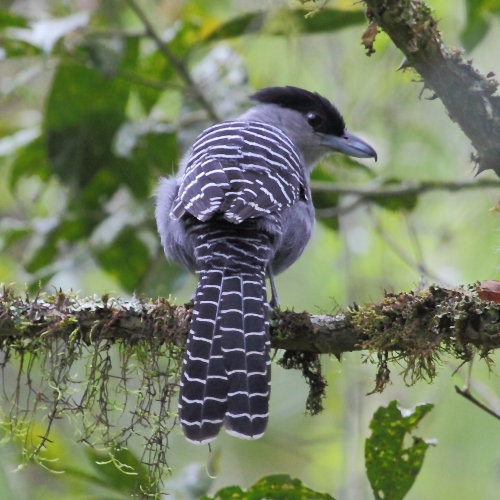
The Esmeraldas Antbird is a small bird, measuring approximately 14 to 15 cm in length, with a striking black plumage that provides excellent camouflage in the shadowy understory of its rainforest habitat. Adult males and females exhibit similar plumage, a trait that can sometimes complicate sex identification in the field. The bird's plumage is characterized by a uniform black coloration, with subtle white feather fringes on the wings and tail that can be seen up close.
Juvenile Esmeraldas Antbirds differ slightly in appearance from adults, displaying a duller brownish-black plumage that gradually darkens as they mature. This coloration helps them blend into their surroundings, providing protection from predators. The bird's eyes are a deep brown, contrasting with its otherwise monochromatic body, and its legs and beak are dark gray to black.
In flight, the Esmeraldas Antbird's silhouette is compact, with rounded wings and a relatively short tail that aid in maneuverability through dense foliage. While perched, it often adopts a horizontal posture, keeping its body close to the branch, which allows it to quickly dart into the undergrowth if threatened. Confusion with similar species like the Jet Antbird can occur, but the Esmeraldas Antbird's more restricted range and specific habitat preferences aid in differentiation.
Having trouble telling birds apart? Upload a photo to our bird identification tool for an instant species match.
Esmeraldas Antbird Habitat and Range
Preferred Habitat
The Esmeraldas Antbird primarily inhabits humid lowland and montane forests, thriving in regions where dense understory vegetation prevails. These forests are typically located at elevations ranging from sea level up to 1,200 meters, with a preference for areas that offer abundant cover and feeding opportunities.
This bird is predominantly found in the Chocó biogeographic region, a biodiversity hotspot that spans northwestern Ecuador and southwestern Colombia. The region's high rainfall and constant humidity create the perfect environment for the rich flora and fauna that the Esmeraldas Antbird depends on.
The bird shows little tolerance for habitat alteration and rarely ventures into urban or agricultural landscapes. Seasonal shifts in habitat preference are minimal, as the Esmeraldas Antbird remains in the rainforest throughout the year, relying on the forest's consistent climate and resources for survival. Its presence is strongly linked to undisturbed primary forest areas, highlighting the importance of conserving these habitats.
Geographic Range
The Esmeraldas Antbird has a relatively restricted range within South America, confined to the Chocó biogeographic region. Its primary range includes the lowland and montane forests of northwestern Ecuador and extends into southwestern Colombia. Specifically, the bird is found in Esmeraldas, Imbabura, and Carchi provinces in Ecuador and the department of Nariño in Colombia.
The species does not exhibit long-distance migration, instead maintaining a year-round presence within its established range. The bird's limited distribution makes it particularly vulnerable to habitat loss due to deforestation and land conversion for agriculture.
Population density hotspots for the Esmeraldas Antbird coincide with areas of high forest cover and minimal human disturbance. These regions provide the necessary resources for foraging and breeding, allowing the bird to sustain its populations. The bird's range overlaps with several protected areas in Ecuador and Colombia, offering some degree of conservation assurance.
Want to know which birds visit your area? Browse our backyard birds by location guides for region-specific species lists.
What Does the Esmeraldas Antbird Eat?
The Esmeraldas Antbird's diet primarily consists of insects and other small arthropods, which it skillfully gleans from the forest understory. It shows a preference for ants, spiders, and beetles, which are abundant in its rainforest habitat. During the wet season, when insect populations peak, the bird's foraging activity intensifies, allowing it to consume a larger variety of prey.
The bird employs a methodical foraging technique, moving deliberately through the vegetation to disturb insects and catch them off guard. It occasionally uses a sallying technique to capture flying insects in mid-air, showcasing its agility and precision.
Prey size varies, but the Esmeraldas Antbird typically targets small to medium-sized insects, reflecting its size and foraging strategy. The bird maintains a consistent feeding schedule throughout the day, with peaks in activity during the early morning and late afternoon when insect activity is highest. Seasonal diet variations are minimal, as the rainforest provides a stable food supply year-round.
Esmeraldas Antbird Behavior and Social Structure
The Esmeraldas Antbird exhibits intriguing social and territorial behaviors. It is primarily solitary or found in pairs, especially during the breeding season. Territoriality is a prominent aspect of its behavior, with individuals or pairs actively defending their patch of forest from intruders. This territorial defense includes vocalizations and physical displays to assert dominance.
Courtship displays involve intricate vocal exchanges and subtle movements, where the male attempts to impress the female with his prowess and vigor. Once paired, the Esmeraldas Antbird forms strong bonds, often remaining with the same mate for multiple breeding seasons.
Flocking behavior is generally uncommon, as this species tends to avoid mixed-species flocks. However, it may occasionally forage near other antbirds or insectivorous birds in the presence of abundant food resources. The Esmeraldas Antbird exhibits a curious response to predators, often freezing or retreating into dense cover when threatened.
The bird's daily activity pattern is diurnal, with peaks during cooler parts of the day. Its behavior is closely tied to the forest's microclimate and insect activity, ensuring optimal foraging and energy conservation.
Esmeraldas Antbird Nesting and Reproduction
The nesting habits of the Esmeraldas Antbird are closely attuned to its dense forest environment. It typically constructs cup-shaped nests, using twigs, leaves, and fine plant fibers, securely hidden in dense vegetation or low shrubs. This location preference provides camouflage and protection from predators.
Clutch size generally consists of two to three eggs, with both parents participating in incubation duties. The incubation period lasts approximately 14 to 16 days, during which the parents alternate sitting on the nest to maintain temperature and deter predators.
Once hatched, the chicks spend about 12 to 14 days in the nest before fledging. During this critical period, both parents actively feed and care for the young, ensuring their growth and survival. The fledging timeline is crucial, as young birds must quickly adapt to the challenges of rainforest life.
Esmeraldas Antbirds generally produce only one brood per year, aligning their breeding efforts with peak food availability during the wet season. This timing ensures that the chicks have ample resources to support their rapid growth and development.
Esmeraldas Antbird Sounds and Vocalizations
The Esmeraldas Antbird's primary song is a series of sharp, clear whistles that rise and fall in pitch, resembling the rhythm of a series of question marks. These songs serve to establish and defend territory and to attract mates. Call notes are shorter, more abrupt chips, used for communication between pairs or family groups.
Alarm calls are sharp and repetitive, alerting mates and nearby birds to potential threats. During the dawn chorus, the Esmeraldas Antbird is particularly vocal, using its distinct song to assert its presence as the forest awakens.
The bird's vocalizations are distinctive and recognizable, often compared to a series of musical notes played on a flute. These sounds carry well through the dense forest, allowing the Esmeraldas Antbird to communicate effectively over considerable distances.
Interesting Facts About the Esmeraldas Antbird
- 1The Esmeraldas Antbird is named after the province of Esmeraldas in Ecuador, reflecting its restricted range.
- 2Despite its small size, the Esmeraldas Antbird has a surprisingly loud and far-reaching song.
- 3The bird's black plumage provides excellent camouflage against the dark forest floor and dense foliage.
- 4Esmeraldas Antbirds have a unique habit of following army ants to catch insects that flee from the ants.
- 5The bird's nesting success is heavily dependent on the density of understory cover for protection.
- 6Although not migratory, the Esmeraldas Antbird's territorial movements are influenced by seasonal insect abundance.
- 7The Esmeraldas Antbird's song is often mistaken for the sound of a distant flute, echoing through the forest.
Esmeraldas Antbird Conservation Status
The Esmeraldas Antbird is currently listed as Least Concern by the IUCN, but its population trends are of concern due to ongoing habitat destruction. Deforestation for agriculture, logging, and human settlement poses significant threats to its rainforest habitat. Conservation efforts focus on preserving primary forest areas and establishing protected zones in both Ecuador and Colombia. These efforts aim to mitigate habitat loss and promote sustainable land use practices. Historically, the Esmeraldas Antbird's population has experienced fluctuations linked to habitat availability. Continued deforestation could lead to more severe declines, underscoring the importance of concerted conservation strategies. Maintaining healthy forest ecosystems is crucial for the long-term survival of this species and the biodiversity of the Chocó region.
Other Thamnophilidae Species



Birds Similar to the Esmeraldas Antbird
These species are often confused with the Esmeraldas Antbird due to similar appearance or overlapping range.

