
Five-colored Barbet
Capito quinticolor
Order: Piciformes / Family: Capitonidae

Wikimedia Commons
About the Five-colored Barbet
The Five-colored Barbet, with its scientific name Capito quinticolor, is a striking member of the family Capitonidae, notable for its vivid and multicolored plumage. This bird inhabits the tropical forests of northwestern South America, particularly in Colombia and adjacent areas of Panama and Ecuador. It plays a vital role in these ecosystems, primarily through seed dispersal, as it consumes a variety of fruits and berries, facilitating forest regeneration. The species is especially adapted to the humid and dense lowland forests, thriving at elevations up to 1,200 meters. Its presence indicates a healthy, biodiverse environment, as it relies on a rich array of fruiting trees and shrubs. The Five-colored Barbet is a non-migratory bird, residing year-round within its range. It is known for its territorial nature, often observed in pairs or small family groups, fiercely defending their feeding territories. During the breeding season, which generally coincides with the onset of the rainy season, these barbets become particularly vocal and visible, engaging in courtship displays that highlight their colorful plumage. Despite its relatively stable population, the Five-colored Barbet faces threats from habitat destruction due to logging and agricultural expansion. Conservation efforts focus on preserving its habitat through protected areas and sustainable land management practices. The Five-colored Barbet serves as an indicator species for the health of tropical ecosystems, and its continued presence in these forests underscores the importance of ongoing conservation efforts.
The Five-colored Barbet belongs to the family Capitonidae, within the order Piciformes. These birds typically live lifespan ranges from 6-9 years in the wild..
How to Identify a Five-colored Barbet
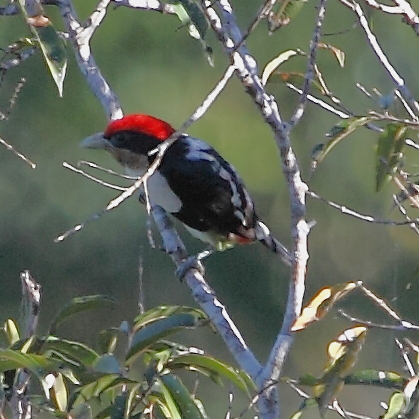
Adult Five-colored Barbets are unmistakable with their vivid red, yellow, blue, green, and black plumage. The head is primarily red, with a striking black mask extending from the beak through the eye. The throat is bright yellow, contrasting with the blue underparts and green wings. The back and tail are predominantly green with a subtle iridescence. Males and females exhibit similar coloration, though females may have slightly duller hues. Juveniles are less vibrant, with more muted and washed-out colors, lacking the full intensity of adult plumage. In flight, the Five-colored Barbet displays a compact silhouette with short, rounded wings and a slightly short tail. When perched, it often adopts a stocky posture, showcasing its robust bill adapted for fruit consumption. Confusion with similar species is unlikely, given its unique color combination, although distant views might cause a mix-up with other brightly colored birds of the region. However, the distinct coloration and the combination of red, yellow, and black on its head and breast aid in quick identification.
Having trouble telling birds apart? Upload a photo to our bird identification tool for an instant species match.
Five-colored Barbet Habitat and Range
Preferred Habitat
The Five-colored Barbet thrives in humid tropical lowland forests, a habitat rich in fruiting trees and a diverse understory. It prefers areas with dense canopy cover and plentiful epiphytes, often found near rivers or streams, which provide additional food resources and nesting sites. This species typically inhabits elevations from sea level up to 1,200 meters, with no significant seasonal shifts in habitat preference. While primarily a forest dweller, it can occasionally be observed at forest edges and partially disturbed areas, provided that some tall trees and dense foliage remain intact. Urban presence is minimal, as it depends heavily on mature forest ecosystems.
Geographic Range
The Five-colored Barbet is mainly found in the tropical regions of northwestern Colombia, with its range extending into parts of southern Panama and northwestern Ecuador. It inhabits the Chocó biogeographic region, renowned for its high biodiversity. Within this range, the bird is most commonly observed in dense, humid lowland forests, although it can also be found in foothill forests up to 1,200 meters. The species does not undertake long-distance migrations, remaining within its breeding range throughout the year. Population density is highest in areas with abundant fruiting trees, which provide essential food resources, and in regions with minimal human disturbance.
Want to know which birds visit your area? Browse our backyard birds by location guides for region-specific species lists.
What Does the Five-colored Barbet Eat?
The diet of the Five-colored Barbet is predominantly frugivorous, focusing on a wide variety of fruits and berries available within its forest habitat. Its strong bill is well-suited for breaking open tough-skinned fruits, a common feature in its diet. During the wet season, when fruit abundance peaks, the barbet consumes an array of native fruits, such as figs and palm fruits. In addition to fruits, it occasionally supplements its diet with insects and small invertebrates, particularly during the breeding season, when protein demand increases. Foraging usually occurs in the mid to upper canopy, where the bird moves methodically among branches, often hanging upside-down to reach its food. The barbet feeds primarily during the morning and late afternoon, when temperatures are cooler, taking advantage of the midday period to rest and preen.
Five-colored Barbet Behavior and Social Structure
Five-colored Barbets exhibit a territorial and mostly monogamous social structure. They are often seen in pairs or small family groups, particularly outside the breeding season. Territorial disputes involve vocal displays and occasionally physical confrontations. Courtship involves mutual preening and food offerings, emphasizing the bond between mates. During the breeding season, males perform elaborate displays to attract females, showcasing their vibrant plumage and agility. The barbet is diurnal, active during daylight hours with peak activity in the morning and late afternoon. It responds to predators with alarm calls and retreats into dense foliage for cover. Flocking behavior is uncommon, as this species prefers to maintain small, tightly-knit groups.
Five-colored Barbet Nesting and Reproduction
The Five-colored Barbet nests in tree cavities, often excavating its own nest hole in decayed trunks or large branches. The nest site is typically located several meters above ground to provide protection from ground predators. The female lays between 2 to 4 eggs per clutch, which are incubated by both parents for approximately 14 to 16 days. Both parents share in feeding the chicks, which fledge after about three weeks. The species typically raises one brood per year, although in optimal conditions, a second brood may be attempted. Parental care continues post-fledging, with juveniles staying with the parents for a few additional weeks.
Five-colored Barbet Sounds and Vocalizations
The primary song of the Five-colored Barbet is a series of melodious whistles, typically consisting of 5 to 7 notes in rapid succession. These notes are medium-pitched and clear, often repeated several times in a row. The call notes include a variety of sharp chirps and trills, used primarily for communication between mates and signaling territorial presence. During the dawn chorus, the barbet's song is particularly prominent, contributing to the early morning symphony of the tropical forest. Alarm calls are harsh and rapid, serving as an alert to nearby conspecifics and other species.
Interesting Facts About the Five-colored Barbet
- 1The Five-colored Barbet's vibrant plumage makes it one of the most visually striking birds in its native range.
- 2This species plays a crucial role in seed dispersal, aiding in the regeneration of tropical forests.
- 3Unlike many birds, the Five-colored Barbet excavates its own nest cavities, showcasing its adaptability.
- 4The bird's diet is mainly frugivorous, but it also consumes insects, especially during breeding seasons.
- 5Despite its striking appearance, the Five-colored Barbet can remain surprisingly elusive due to its dense forest habitat.
- 6Both male and female Five-colored Barbets contribute equally to raising their young, from incubation to feeding fledglings.
Five-colored Barbet Conservation Status
The Five-colored Barbet is currently classified as Least Concern by the IUCN, with populations considered stable in regions where conservation measures are enforced. Habitat loss due to deforestation and agricultural expansion poses a significant threat, although the establishment of protected areas in Colombia and Ecuador has helped mitigate some of these impacts. Conservation efforts focus on habitat preservation and sustainable land use practices. Historical population declines have stabilized in recent years, thanks to increased awareness and efforts to conserve tropical forest ecosystems.
Other Capitonidae Species


Birds Similar to the Five-colored Barbet
These species are often confused with the Five-colored Barbet due to similar appearance or overlapping range.