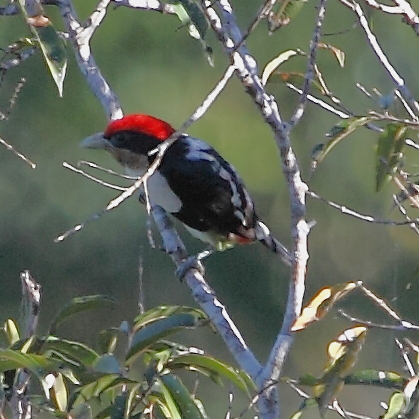
Flame-throated Barbet
Eubucco aurantiicollis
Order: Piciformes / Family: Capitonidae

Wikimedia Commons
About the Flame-throated Barbet
The Flame-throated Barbet, Eubucco aurantiicollis, captivates birdwatchers with its vivid color palette and robust presence in the Neotropical forests. Renowned for its resplendent orange throat and forehead, this bird inhabits the humid lowland and montane forests of South America, particularly in countries such as Peru, Bolivia, and Brazil. As a member of the Capitonidae family, it plays a crucial ecological role in seed dispersal, thanks to its fruit-heavy diet. This barbet's presence often indicates a healthy, biodiverse forest ecosystem. The Flame-throated Barbet's activity peaks during the wet season from November to April, when fruits and insects are plentiful, providing ample nutrition for breeding. During this time, its calls become more frequent, as males establish territories and court potential mates. The bird's behavior shifts with the seasons, with increased vocalizations and social interactions during the wet months, contrasting with a more subdued presence in the dry season. This adaptability ensures its survival and ability to thrive across various forested environments. Beyond its ecological contributions, the Flame-throated Barbet serves as a flagship species for conservation efforts in its native regions, drawing attention to the importance of preserving tropical forest habitats. Its vibrant plumage and charismatic behavior make it a favorite among birdwatchers and researchers alike, underscoring the rich avian diversity of South America's forests.
The Flame-throated Barbet belongs to the family Capitonidae, within the order Piciformes. These birds typically live typically 6-8 years, with a maximum recorded of 11 years..
How to Identify a Flame-throated Barbet
The Flame-throated Barbet is easily recognizable by its stunning orange throat and forehead, which contrast with the deep green of its wings and back. Adults also display a red crown and a yellow belly, creating a striking combination of colors. Juvenile barbets lack the vibrant orange and red, instead showing a more subdued greenish-yellow plumage that provides better camouflage. Males and females are similar in appearance, though males generally have slightly brighter coloration, particularly in the throat region. This bird's stocky build and short tail set it apart from other species, along with its thick, hooked bill, which aids in fruit consumption. In flight, the Flame-throated Barbet's silhouette is compact, with rapid wingbeats that convey its sturdy form. When perched, it often sits upright on tree branches, displaying its colorful throat prominently. Confusion with other barbet species, such as the Gilded Barbet or the Scarlet-banded Barbet, occurs, yet the unique orange throat of Eubucco aurantiicollis provides a reliable distinguishing feature.
Having trouble telling birds apart? Upload a photo to our bird identification tool for an instant species match.
Flame-throated Barbet Habitat and Range
Preferred Habitat
The Flame-throated Barbet dwells primarily in humid lowland and montane forests, thriving in elevations from 500 to 2,000 meters. It favors dense forest canopies and mid-levels, where it can forage for fruits and insects. While predominantly a forest bird, it occasionally ventures into secondary forests and forest edges, adapting to human-altered landscapes. Unlike many avian species, the Flame-throated Barbet does not typically inhabit urban areas, preferring the cover and resources of rich forest habitats. Seasonal habitat shifts are minimal, as this species remains largely within its established range throughout the year, exploiting seasonal fruiting cycles within its preferred forest environment.
Geographic Range
The Flame-throated Barbet's range encompasses a significant portion of the western Amazon basin, primarily within Peru, Bolivia, and western Brazil. It is a resident breeder, with no extensive migratory movements, though small local dispersals occur in search of food. In Peru, its presence is noted in regions such as Madre de Dios and Ucayali, while in Bolivia, it frequents the lowland forests along the eastern Andean slopes. The bird is less common in Brazil, where it occupies the southwestern Amazonian forests. Population density is higher in areas of undisturbed forest, with fewer sightings in heavily logged or fragmented regions.
Want to know which birds visit your area? Browse our backyard birds by location guides for region-specific species lists.
What Does the Flame-throated Barbet Eat?
The Flame-throated Barbet primarily consumes a diet rich in fruits, which it harvests with its powerful bill. It favors figs, berries, and other soft fruits, playing a significant role in seed dispersal within its habitat. During the wet season, its diet diversifies to include more insects, such as beetles and caterpillars, providing essential protein for breeding and chick-rearing. This barbet employs a gleaning foraging technique, meticulously picking fruits and insects from branches and foliage. Prey size varies, but it generally targets small to medium-sized insects that can be easily managed. Feeding occurs throughout the day, with peaks in activity during the early morning and late afternoon.
Flame-throated Barbet Behavior and Social Structure
Flame-throated Barbets exhibit a social structure that includes small family groups or pairs, particularly during the breeding season. Males establish and defend territories with frequent vocalizations, using their calls to ward off rivals and attract mates. Courtship displays involve both vocal and visual elements, with males showcasing their bright plumage through deliberate postures. While generally not forming large flocks, these barbets may join mixed-species foraging groups, benefiting from the collective vigilance against predators. Daily activity peaks during cooler parts of the day, with periods of rest during the midday heat. In response to predators, the Flame-throated Barbet relies on its cryptic coloration and dense foliage for concealment, often remaining motionless to avoid detection.
Flame-throated Barbet Nesting and Reproduction
Flame-throated Barbets nest in tree cavities, either in natural holes or those excavated by other birds. They prefer sites in mature forests where large trees provide suitable nest locations. The female lays a clutch of 2-3 eggs, which she incubates for approximately 14-16 days. Both parents participate in feeding the chicks, which fledge after about 30 days. The dense forest environment offers ample protection for nesting sites, though the loss of mature trees poses a significant threat to nesting success. Typically, the Flame-throated Barbet raises one brood per year, though in areas with abundant resources, a second brood may occur.
Flame-throated Barbet Sounds and Vocalizations
The primary song of the Flame-throated Barbet is a series of resonant, rhythmic notes, often described as 'tu-tu-tu' with a melodic quality. This song serves as a territorial and mating call, echoing through the forest canopy. In addition to its song, the barbet produces a variety of call notes, including sharp 'chip' sounds used for communication within family groups. Alarm calls are sharper and more insistent, alerting others to the presence of potential threats. During the dawn chorus, its song stands out, rising above the cacophony of forest sounds, a characteristic feature of its vocal behavior.
Interesting Facts About the Flame-throated Barbet
- 1The Flame-throated Barbet can consume up to 70% of its diet in fruits, making it a key player in seed dispersal.
- 2Despite its bright colors, the Flame-throated Barbet often remains undetected due to its tendency to stay motionless among foliage.
- 3Flame-throated Barbets have been observed using their strong bills to crack open tough fruit skins, aiding in fruit processing.
- 4The Flame-throated Barbet's call can be heard up to 200 meters away, a testament to its vocal strength in dense forests.
- 5This barbet's nesting cavities are sometimes reused by other species, highlighting its role in supporting forest biodiversity.
Flame-throated Barbet Conservation Status
Currently, the Flame-throated Barbet is classified as Least Concern by the IUCN, with stable population trends. However, ongoing threats such as deforestation and habitat fragmentation pose significant risks to its long-term survival. Conservation efforts focus on preserving large tracts of intact forest and promoting sustainable land-use practices that minimize habitat destruction. Historically, populations have fluctuated in response to changes in forest cover, underscoring the need for continued monitoring and habitat protection to ensure the species remains abundant across its range.