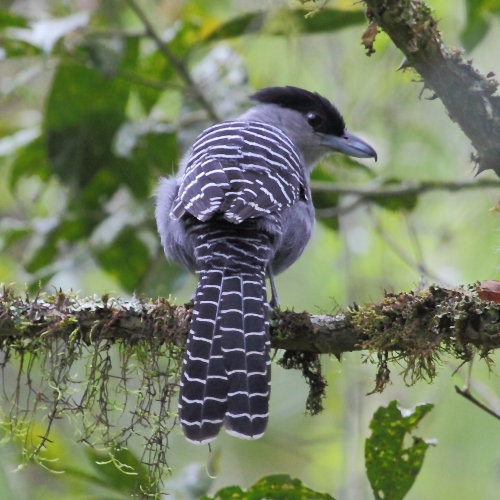
Foothill Antwren
Epinecrophylla spodionota
Order: Passeriformes / Family: Thamnophilidae

Wikimedia Commons
About the Foothill Antwren
The Foothill Antwren (Epinecrophylla spodionota) is a small passerine bird belonging to the Thamnophilidae family. This species is primarily found along the eastern slopes of the Andes, specifically in the foothills ranging from southern Colombia through eastern Ecuador and into northern Peru. These birds inhabit subtropical or tropical moist lowland forests, where they play a crucial ecological role as insectivores, helping to control insect populations in their dense understory habitats. The Foothill Antwren is a non-migratory species, maintaining territories year-round in these rich ecosystems. As an integral component of their environment, these birds contribute to the complex web of life that sustains the region's biodiversity. Their presence indicates a healthy forest ecosystem, as they rely on undisturbed areas with a rich understory for foraging and nesting. The Foothill Antwren is particularly significant in these regions due to its preference for habitats that are often threatened by deforestation and habitat fragmentation. During the breeding season, which typically aligns with the wet season, these birds engage in intricate courtship behaviors and establish territories to rear their young. The species' dependence on specific forest structures highlights the importance of conservation efforts aimed at preserving these unique and biodiverse habitats. By understanding the habits and requirements of the Foothill Antwren, conservationists can better protect the delicate balance of the ecosystems where they reside.
The Foothill Antwren belongs to the family Thamnophilidae, within the order Passeriformes. These birds typically live typically lives 3-5 years, with some reaching up to 7 years..
How to Identify a Foothill Antwren
The Foothill Antwren can be identified by its modest size, measuring approximately 10 centimeters in length. Adult males are predominantly gray with a subtle olive tint on their wings and back. They possess a distinctive white or pale gray throat and breast, contrasting with the darker gray rest of their body. Females, on the other hand, exhibit a more brownish hue with similar patterning, making gender differentiation straightforward in the field. Juveniles resemble females but with a softer gray overall coloring. One might confuse the Foothill Antwren with similar species such as the Stipple-throated Antwren, but a careful observer will note the Foothill's lack of the stippled throat pattern characteristic of its relative. In flight, the Foothill Antwren displays a rapid, fluttering motion, typical of many understory insectivores. Its perching posture is often horizontal, accentuating its streamlined body and aiding in its agile maneuvers through dense foliage.
Having trouble telling birds apart? Upload a photo to our bird identification tool for an instant species match.
Foothill Antwren Habitat and Range
Preferred Habitat
The Foothill Antwren inhabits subtropical and tropical moist lowland forests, favoring dense understory growth. These habitats are typically found between 500 to 1,500 meters above sea level along the eastern Andean slopes. The species is primarily found in primary forests but can also be seen in secondary growth areas, provided the vegetation remains thick. There is no significant seasonal habitat shift for the Foothill Antwren, as it is a resident bird within its range. Unlike some other antbirds, it does not readily adapt to urban environments, preferring the seclusion and complexity of forested areas. The presence of a rich understory is critical for its foraging and nesting activities, making habitat preservation a key factor in its conservation.
Geographic Range
The Foothill Antwren's range is concentrated along the eastern slopes of the Andes, spanning southern Colombia, eastern Ecuador, and northern Peru. Within this range, they are non-migratory and establish year-round territories in suitable forest habitats. Population density is generally higher in regions where the forest remains intact and healthy, such as in protected areas like Podocarpus National Park in Ecuador. Unlike some migratory birds, the Foothill Antwren does not venture far from its established territories, making localized conservation efforts particularly crucial. Its restricted range and habitat specificity underscore the importance of protecting Andean foothill forests to ensure the species' continued survival.
Want to know which birds visit your area? Browse our backyard birds by location guides for region-specific species lists.
What Does the Foothill Antwren Eat?
The Foothill Antwren primarily feeds on insects and other small arthropods, which it gleans from leaves and branches in the forest understory. Its diet includes beetles, caterpillars, spiders, and ants. During the wet season, when insect abundance peaks, the bird intensifies its foraging activities to take advantage of the increased food supply. The antwren employs a methodical foraging technique, often seen hopping along branches and foliage, meticulously inspecting each leaf for prey. It rarely feeds on the ground, preferring the safety and cover of elevated perches. Its small size allows it to access narrow spaces and exploit microhabitats that larger birds cannot reach. Feeding primarily during daylight hours, the Foothill Antwren adjusts its activity based on the availability of prey and the ambient temperature, often increasing foraging during cooler morning and late afternoon hours.
Foothill Antwren Behavior and Social Structure
The Foothill Antwren exhibits a complex social structure, typically found in monogamous pairs or small family groups. They maintain territories year-round, aggressively defending them from intruders, particularly during the breeding season. Courtship displays involve a series of coordinated movements and vocalizations, with males often performing aerial displays to attract females. The species is generally non-gregarious, preferring the company of its mate or immediate family rather than forming large flocks. In response to predators, the Foothill Antwren employs a combination of stealth and strategic retreat, often using dense foliage as cover. The bird's daily activity pattern revolves around foraging, with periods of rest during the hottest parts of the day. Despite their small size, they exhibit a boldness in defending their territory and young, displaying aggressive behaviors toward perceived threats.
Foothill Antwren Nesting and Reproduction
The Foothill Antwren constructs a small, cup-shaped nest, typically made from twigs, leaves, and other plant materials. Nests are usually located within the dense understory, often in a shrub or small tree. The female lays a clutch of two to three eggs, which she incubates for approximately 14 days. Both parents participate in feeding the chicks, which fledge after about 12 to 14 days. The nesting period coincides with the rainy season when food resources are abundant. The species typically raises one brood per year, although in optimal conditions, a second brood may occur. Parental care extends beyond fledging, with both parents continuing to feed and protect the young until they are fully independent.
Foothill Antwren Sounds and Vocalizations
The primary song of the Foothill Antwren is a series of sharp, high-pitched notes delivered in rapid succession, reminiscent of a quick, rhythmic tapping on hollow wood. This song serves as both a territorial declaration and a mate attraction call. Calls include a variety of short, sharp notes, often used in communication between mates or family members. Alarm calls are more urgent and harsh, serving as a warning to conspecifics about potential threats. During the dawn chorus, the Foothill Antwren's song adds a distinctive, lively cadence to the forest soundscape. Their vocalizations, while not as varied as some other passerines, are effective and recognizable to those familiar with the species.
Interesting Facts About the Foothill Antwren
- 1The Foothill Antwren is named for its preference for foothill forests, often found between 500 and 1,500 meters in elevation.
- 2Despite its small size, the Foothill Antwren plays a significant role in controlling insect populations within its habitat.
- 3The species exhibits a fascinating courtship behavior where males perform aerial displays to attract females during the breeding season.
- 4Unlike many birds, the Foothill Antwren is non-migratory, maintaining its territory throughout the year in the Andean foothills.
- 5The dense understory of subtropical forests provides the perfect setting for the Foothill Antwren's foraging and nesting activities.
Foothill Antwren Conservation Status
Currently, the IUCN lists the Foothill Antwren as Least Concern, but its population shows signs of decrease due to ongoing habitat loss. Deforestation for agriculture and human settlement poses the most significant threat to its habitat. Conservation efforts focus on preserving remaining forests and promoting sustainable land-use practices. Historically, the species thrived in larger continuous tracts of forest, but fragmentation has led to isolated populations, making them more vulnerable to environmental changes. Initiatives to expand protected areas and restore degraded habitats are critical for the Foothill Antwren's future survival.