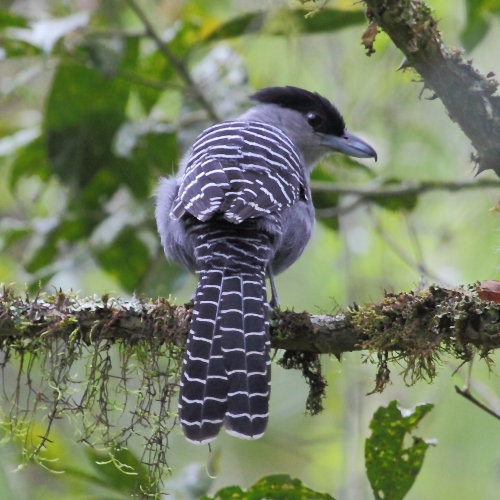
Formicivora nigricollis
Formicivora nigricollis
Order: Passeriformes / Family: Thamnophilidae
About the Formicivora nigricollis
The Black-throated Antbird, scientifically known as Formicivora nigricollis, is an intriguing member of the Thamnophilidae family. This small passerine bird, characterized by its distinctive black throat and chest, inhabits the tropical rainforests of South America. It thrives in the dense understory, often found in the Amazon Basin, where it plays a crucial role in the ecosystem by controlling insect populations. The bird's presence is a marker of the forest's health, as it is highly sensitive to habitat disturbance. This species is primarily found in countries such as Brazil, Colombia, Venezuela, and Peru, often inhabiting lowland rainforests and occasionally venturing into secondary forests and bamboo thickets. The Black-throated Antbird is an indicator species, reflecting the biodiversity and ecological balance of its habitat. Its ecological significance extends beyond insect control, as it also contributes to seed dispersal through its diet. During the breeding season, which typically coincides with the rainy season, males and females engage in complex courtship displays that involve vocalizations and wing fluttering. These behaviors not only cement pair bonds but also ensure the continuation of their lineage in these lush environments. Seasonal behaviors include altitudinal migrations within their range, where they adjust their habitat preferences according to the availability of food and nesting sites. Despite their elusive nature, Black-throated Antbirds are an essential component of the forest's intricate web of life.
The Formicivora nigricollis belongs to the family Thamnophilidae, within the order Passeriformes. These birds typically live average 3-5 years, with a maximum recorded of 7 years..
How to Identify a Formicivora nigricollis
Field identification of the Black-throated Antbird involves noting key characteristics. Adult males display a prominent black throat and upper chest, which contrasts sharply with their otherwise light gray and brown plumage. Their wings are brown with white spots, and they possess a white stripe above the eye. Females, on the other hand, share the black throat but have a more subdued brown overall plumage, lacking the stark contrast seen in males. Juveniles resemble females but are generally duller. Similar species that may cause confusion include other antbirds within the Formicivora genus, such as the Rusty-backed Antwren. However, the distinct black throat is a reliable differentiator. In flight, the Black-throated Antbird's silhouette is compact with rounded wings and a short tail. When perched, they often sit horizontally on branches, making it easier to spot the contrasting plumage. Observers should note the bird's preference for thick underbrush, as this is where they are most commonly encountered.
Having trouble telling birds apart? Upload a photo to our bird identification tool for an instant species match.
Formicivora nigricollis Habitat and Range
Preferred Habitat
The Black-throated Antbird is predominantly found in tropical lowland rainforests, where it favors the dense understory and thickets. Its habitat ranges from primary forests to secondary growth, where it can navigate the dense foliage with ease. Elevation-wise, it typically resides below 1000 meters, although sightings have been recorded at slightly higher altitudes during seasonal movements. In contrast to some other antbirds, Formicivora nigricollis shows limited adaptability to urban environments, as it requires the dense cover of forests to thrive. Seasonal habitat shifts are generally limited to movements within its established range, dictated by food availability and breeding requirements.
Geographic Range
The breeding range of the Black-throated Antbird extends across much of northern South America. It is commonly found in Brazil, particularly within the Amazon Basin, as well as in Colombia, Venezuela, and parts of Peru. This species does not undertake large-scale migrations but may perform local movements in response to seasonal changes in food supply. Within its range, certain areas such as the lowland rainforests of Brazil are hotspots for population density, offering abundant resources and suitable nesting sites. The bird's distribution is confined to tropical regions, with no significant range extensions into temperate zones.
Want to know which birds visit your area? Browse our backyard birds by location guides for region-specific species lists.
What Does the Formicivora nigricollis Eat?
The diet of the Black-throated Antbird is primarily insectivorous, focusing on ants, beetles, and other small arthropods found in the forest underbrush. During the wet season, when food is abundant, it may also consume spiders and small invertebrates. Foraging techniques involve gleaning insects from leaves and branches, often in the company of mixed-species flocks. This cooperation allows the antbird to capitalize on disturbances caused by other birds, flushing insects from their hiding spots. Prey size is generally small, with the bird targeting easily manageable insects. Feeding occurs throughout the day, with peaks during early morning and late afternoon when insect activity is highest.
Formicivora nigricollis Behavior and Social Structure
The Black-throated Antbird exhibits a variety of interesting behaviors, particularly in its social and territorial interactions. It is typically monogamous, with pairs maintaining territories throughout the year. Territorial boundaries are defended vigorously, especially during the breeding season, with both vocal displays and physical confrontations. Courtship involves a series of vocal duets and wing displays, strengthening pair bonds. While not as gregarious as some birds, they often join mixed-species flocks, benefiting from increased foraging efficiency. In response to predators, the Black-throated Antbird will emit alarm calls and engage in distraction displays to protect its nest. Daily activities are largely diurnal, with the bird remaining active from dawn until dusk.
Formicivora nigricollis Nesting and Reproduction
Nesting for the Black-throated Antbird takes place in well-concealed locations within the forest understory. Nests are cup-shaped and constructed with leaves, fibers, and twigs, typically positioned in dense vegetation to avoid detection. The clutch size is usually two to three eggs, which are incubated by both parents for a period of approximately 14 days. After hatching, the young are fed and cared for by both adults until fledging, which occurs around two weeks post-hatching. The species may raise one or two broods per year, depending on environmental conditions and food availability. Parenting duties are shared, with males often taking a more active role in territory defense.
Formicivora nigricollis Sounds and Vocalizations
The primary song of the Black-throated Antbird is a series of clear, melodic whistles that rise and fall in pitch. This song serves both to establish territory and to communicate with mates. Call notes are sharp and quick, often used to maintain contact within dense vegetation. Alarm calls are harsher and more abrupt, designed to alert other birds to the presence of predators. During the dawn chorus, the Black-throated Antbird is among the first to begin singing, its voice cutting through the morning mist. Comparatively, its song is more musical than the harsher calls of some sympatric antbirds.
Interesting Facts About the Formicivora nigricollis
- 1The Black-throated Antbird often joins mixed-species flocks, benefiting from the vigilance of other birds.
- 2Its distinctive black throat patch helps it blend into the dappled shadows of the forest understory.
- 3Despite its small size, the Black-throated Antbird exhibits fierce territorial behavior during the breeding season.
- 4The species is an indicator of forest health, often the first to disappear in disturbed habitats.
- 5Its foraging technique involves following army ant swarms to catch insects fleeing the ants.
- 6The Black-throated Antbird's song can be heard up to 100 meters away in dense forests.
- 7It plays a role in seed dispersal by eating small fruits in addition to its insect diet.
Formicivora nigricollis Conservation Status
Currently, the Black-throated Antbird is listed as Least Concern by the IUCN, with a stable population trend. However, habitat destruction, particularly deforestation in the Amazon Basin, poses a significant threat to its future. Conservation efforts focus on preserving large tracts of continuous rainforest and implementing sustainable land-use practices. Historically, the bird's population has remained relatively stable, but continued habitat loss could alter this trend. Efforts to educate local communities on the importance of biodiversity and sustainable practices are crucial for the long-term conservation of this species.