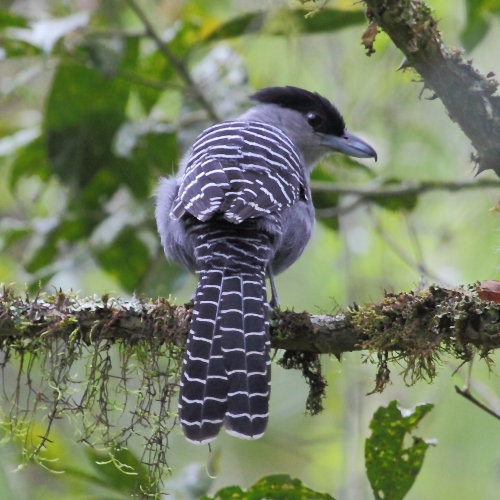
Fringe-backed Fire-eye
Pyriglena atra
Order: Passeriformes / Family: Thamnophilidae

Wikimedia Commons
About the Fringe-backed Fire-eye
The Fringe-backed Fire-eye, scientifically known as Pyriglena atra, is an intriguing member of the Thamnophilidae family, endemic to the Atlantic Forests of southeastern Brazil. This bird is notable not only for its striking appearance but also for its ecological role within its native habitats. The Fringe-backed Fire-eye thrives in the dense understorey of humid forests, playing a crucial part in the ecosystem as both a predator and prey. Its presence indicates a healthy, biodiverse environment, making it a key species for conservationists monitoring the health of these vital forests. During the breeding season, which typically spans from September to February, this bird is more vocal and active, engaging in complex behaviors that include territorial displays and courtship rituals. The Fringe-backed Fire-eye is largely sedentary, but some altitudinal migration can occur, with movements influenced by food availability and changes in climate. Its role in the ecosystem extends to seed dispersal and insect population control, contributing to the forest's overall health and resilience. Despite its relatively stable population, the Fringe-backed Fire-eye faces threats from habitat destruction due to logging and urban expansion. Conservation efforts are essential to safeguard its habitat and ensure the survival of this species, along with the myriad other creatures that share its environment.
The Fringe-backed Fire-eye belongs to the family Thamnophilidae, within the order Passeriformes. These birds typically live average 5-7 years, with a maximum recorded of 10 years..
How to Identify a Fringe-backed Fire-eye
The Fringe-backed Fire-eye is a medium-sized bird distinguished by its glossy black plumage and vivid red eyes. Adult males and females share similar coloring, though males typically exhibit a slightly more pronounced fringe on the back, a characteristic feature that gives the species its common name. Juveniles appear duller, with a brownish tinge to their feathers, which gradually darken as they mature. Compared to other antbirds, the Fringe-backed Fire-eye has a more robust build and a distinctive eye stripe, which helps differentiate it from similar species like the White-shouldered Fire-eye. In flight, its silhouette is compact, with broad wings and a short tail, allowing it to maneuver deftly through dense foliage. When perched, the bird often adopts a slightly hunched posture, with its tail angled downward, a common stance among antbirds that facilitates quick movements through the undergrowth.
Having trouble telling birds apart? Upload a photo to our bird identification tool for an instant species match.
Fringe-backed Fire-eye Habitat and Range
Preferred Habitat
The Fringe-backed Fire-eye inhabits the lowland and montane rainforests of southeastern Brazil, particularly thriving in the Atlantic Forest biome. It favors dense understorey vegetation, often found in areas with plentiful leaf litter and fallen logs that support its insectivorous diet. This bird can be found at elevations ranging from sea level to approximately 1,500 meters. While primarily a forest-dwelling species, it displays some adaptability to secondary growth and edge habitats, though it remains largely absent from urban environments. Seasonal habitat shifts are minimal, as the bird tends to remain within its forest home year-round, provided that food resources remain adequate.
Geographic Range
The Fringe-backed Fire-eye's range is restricted to the Atlantic Forests of southeastern Brazil, particularly in the states of Rio de Janeiro, São Paulo, and Espírito Santo. This bird is largely non-migratory, residing year-round within this specific region. Population densities are highest in undisturbed forest patches, where dense understorey provides ample cover and foraging opportunities. Unlike many other bird species, the Fringe-backed Fire-eye does not engage in long-distance migrations, but some local movements may occur in response to seasonal changes in food availability. The bird's limited range makes it particularly vulnerable to habitat loss, emphasizing the importance of conservation efforts in these areas.
Want to know which birds visit your area? Browse our backyard birds by location guides for region-specific species lists.
What Does the Fringe-backed Fire-eye Eat?
The diet of the Fringe-backed Fire-eye consists primarily of insects and other arthropods, which it forages for in the leaf litter and lower vegetation of its forest habitat. This bird employs a methodical foraging technique, using its sharp bill to pick prey from leaves and branches. During the wet season, when insect abundance peaks, its diet may diversify to include small reptiles and amphibians. In drier months, the bird may focus more on ants and beetles, which remain consistently available. The Fringe-backed Fire-eye typically forages alone or in pairs, though it may occasionally join mixed-species flocks to exploit temporary food surges. Its feeding schedule aligns with daylight hours, with peak activity occurring in the early morning and late afternoon.
Fringe-backed Fire-eye Behavior and Social Structure
The Fringe-backed Fire-eye exhibits a variety of behaviors that reflect its social structure and ecological niche. This bird is typically solitary or found in pairs, with each pair maintaining a defined territory vigorously defended through vocalizations and physical displays. During the breeding season, males engage in elaborate courtship displays, characterized by wing flicking and tail fanning, to attract mates. Unlike some other antbird species, the Fringe-backed Fire-eye does not form large flocks, though it may participate in mixed-species foraging groups when advantageous. In response to predators, this bird employs a combination of stealth and distraction, often retreating to denser cover while vocalizing to confuse and deter threats. Its daily activity patterns show a preference for early morning and late afternoon foraging, coinciding with cooler temperatures and peak prey activity.
Fringe-backed Fire-eye Nesting and Reproduction
The nesting habits of the Fringe-backed Fire-eye involve careful selection of concealed sites within dense understorey vegetation. Nests are typically cup-shaped structures constructed from twigs, leaves, and vines, strategically placed low to the ground to avoid detection. The typical clutch consists of two to three eggs, which both parents incubate over a period of approximately 14-16 days. After hatching, both parents participate in feeding and caring for the chicks, which fledge in about 12-14 days. The species generally produces one brood per year, though favorable conditions may occasionally allow for a second. Parental roles are fairly evenly divided, with both male and female sharing in the responsibilities of nest building, incubation, and chick-rearing.
Fringe-backed Fire-eye Sounds and Vocalizations
The primary song of the Fringe-backed Fire-eye is a series of sharp, metallic notes delivered in rapid succession, resembling the sound of a ratchet being turned. These calls serve both territorial and mate-attraction purposes and are most often heard during the breeding season. In addition to their song, these birds produce a variety of call notes, including short, harsh 'chack' sounds used in communication between mates and as alarm calls. The dawn chorus features prominently in their vocal repertoire, with males often beginning their singing at first light to establish territorial boundaries. Compared to other forest birds, the Fringe-backed Fire-eye's vocalizations are notably loud and penetrating, cutting through the dense forest understorey.
Interesting Facts About the Fringe-backed Fire-eye
- 1The Fringe-backed Fire-eye is one of a few antbird species with bright red eyes, which may play a role in mate selection.
- 2Despite its name, the Fringe-backed Fire-eye does not actively follow army ant swarms, unlike many other antbirds.
- 3The species' endemic range is confined to a mere fraction of Brazil's Atlantic Forest, highlighting its vulnerability.
- 4Fringe-backed Fire-eyes exhibit strong site fidelity, often returning to the same nesting territory year after year.
- 5Researchers have discovered that these birds may alter their song in response to urban noise, a rare adaptation.
- 6Unlike many songbirds, the Fringe-backed Fire-eye's vocal repertoire is relatively limited but highly distinctive.
- 7The bird's ability to thrive in secondary growth areas offers hope for its adaptability amidst forest degradation.
Fringe-backed Fire-eye Conservation Status
The Fringe-backed Fire-eye is currently listed as Near Threatened on the IUCN Red List, with its population trend considered stable but facing potential threats. Primary threats to this species include deforestation and habitat fragmentation, driven by logging, agriculture, and urban development. Conservation efforts focus on protecting remaining tracts of Atlantic Forest and promoting sustainable land-use practices. Historical records indicate a decline in population due to habitat loss, underscoring the need for continued vigilance. Conservationists advocate for the expansion of protected areas and restoration projects to bolster habitat connectivity and resilience.