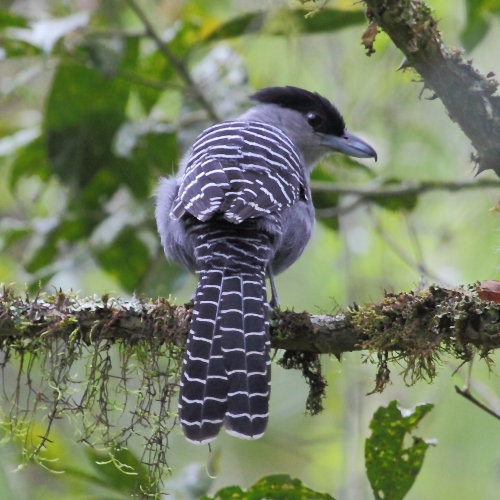
Fulvous Antshrike
Frederickena fulva
Order: Passeriformes / Family: Thamnophilidae

Wikimedia Commons
About the Fulvous Antshrike
The Fulvous Antshrike, known scientifically as Frederickena fulva, is an intriguing member of the Thamnophilidae family, which comprises the antbirds. This elusive bird inhabits the dense tropical rainforests of South America. It is typically found in the understory and midstory layers of the forest, where it forages for insects and other small invertebrates. The bird is particularly prevalent in regions like the Amazon Basin, demonstrating a preference for humid and densely vegetated areas. The Fulvous Antshrike plays a crucial role in its ecosystem as a predator of insects, helping to control the populations of these small creatures. Its presence is also indicative of a healthy forest ecosystem, as it tends to avoid heavily disturbed areas. During the breeding season, which usually spans from September to February in most parts of its range, the Fulvous Antshrike becomes slightly more vocal and active, though it remains challenging to observe due to its shy nature. This bird is often heard rather than seen, with its distinctive calls echoing through the forest. The Fulvous Antshrike's ecological role extends beyond just predator-prey dynamics. As it forages through the leaf litter and among branches, it inadvertently aids in seed dispersal by disturbing the leaf litter and the forest floor, ensuring the healthy regeneration of the forest. Its activities also contribute to the aeration of the soil, benefiting the plant life that forms the foundation of the rainforest. Observing the Fulvous Antshrike offers insights into the complex interdependencies of rainforest life. Its preference for undisturbed, mature forests underscores the importance of conserving these habitats amidst rising deforestation pressures. Understanding the Fulvous Antshrike's behaviors and habitat preferences is crucial for conservationists working to protect these vital ecosystems.
The Fulvous Antshrike belongs to the family Thamnophilidae, within the order Passeriformes. These birds typically live average 6 years, with a maximum recorded of 8 years..
How to Identify a Fulvous Antshrike
The Fulvous Antshrike can be identified by its rich fulvous or tawny-brown plumage, which provides excellent camouflage against the forest floor and foliage. Adult males and females have similar coloration, but males typically exhibit a slightly darker, more uniform plumage. The bird's underparts are paler, with a subtle white streaking that can be difficult to discern from a distance. Juveniles often possess a more mottled appearance with less distinct streaking, making them somewhat harder to identify. The Fulvous Antshrike has a robust body, a short tail, and a slightly curved bill adapted for insectivory. Its eyes are dark, and its legs are strong, aiding in its ability to navigate through dense vegetation. In flight, this bird displays a fast, direct pattern with rapid wingbeats, though it is more often seen hopping or flitting between branches. The Fulvous Antshrike is sometimes confused with similar species such as the Black-throated Antshrike. However, the absence of a black throat and the more uniform fulvous coloration aid in distinguishing it. Observers should note its tendency to remain low in the forest, often in pairs or family groups, which differs from some other antshrike species that prefer higher canopy levels.
Having trouble telling birds apart? Upload a photo to our bird identification tool for an instant species match.
Fulvous Antshrike Habitat and Range
Preferred Habitat
The Fulvous Antshrike resides primarily in the lowland tropical rainforests of South America, particularly within the Amazon Basin region. It favors dense, humid forests with a rich understory and midstory, which provide ample cover and foraging opportunities. These birds are typically found at elevations ranging from sea level to about 1000 meters, rarely venturing into mountainous or open areas. Seasonal habitat shifts are minimal for the Fulvous Antshrike, as it tends to be a year-round resident in its preferred environment. Unlike some other antbirds, it does not typically adapt well to urban or heavily altered landscapes, relying instead on unfragmented, mature forests for survival. Within these forests, it selects areas with dense foliage, avoiding open spaces and edges where it would be more vulnerable to predators.
Geographic Range
The Fulvous Antshrike is native to the tropical regions of South America, with its range predominantly covering the Amazon Basin. It is found in countries such as Brazil, Peru, Colombia, and Bolivia. In Brazil, its presence is particularly noted in the states of Amazonas and Pará. The bird's range does not extend significantly beyond the Amazon rainforest, although isolated populations might exist in adjacent forested regions. The Fulvous Antshrike does not undertake long-distance migrations, instead remaining within its established breeding and foraging territories throughout the year. Its population density is highest in undisturbed, continuous forest tracts, where it can find suitable nesting and feeding sites. Decreasing habitat quality due to deforestation poses a threat to its range, potentially leading to localized declines if current trends continue.
Want to know which birds visit your area? Browse our backyard birds by location guides for region-specific species lists.
What Does the Fulvous Antshrike Eat?
The diet of the Fulvous Antshrike consists primarily of insects and other small invertebrates. It forages by gleaning from leaves and branches, sometimes joining mixed-species flocks to increase foraging efficiency. Ants, beetles, and spiders constitute a significant portion of its diet, although it will also consume other arthropods opportunistically. Seasonal changes in food availability can slightly alter its diet composition, but the Fulvous Antshrike generally maintains a consistent insectivorous diet throughout the year. This bird employs a patient, methodical foraging technique, often pausing to scrutinize the foliage before striking. It tends to feed during the early morning and late afternoon hours, taking advantage of the cooler parts of the day when insect activity is heightened.
Fulvous Antshrike Behavior and Social Structure
The Fulvous Antshrike exhibits intriguing behavioral patterns characterized by its secretive and solitary nature. It is typically found in pairs or small family groups, displaying strong territoriality, especially during the breeding season. Males and females engage in quiet, complex courtship displays that include mutual preening and soft vocalizations. The bird's territorial defense involves vocal displays and occasional physical confrontations with intruders. Although primarily solitary, the Fulvous Antshrike may occasionally join mixed-species flocks, enhancing foraging success and reducing predation risk. Its response to predators involves seeking dense cover and issuing sharp alarm calls to alert others. This antshrike's daily activity peaks during the cooler parts of the day, as it takes advantage of lower temperatures and increased insect activity. Its predictable routine contributes to its success in the dense rainforest environment.
Fulvous Antshrike Nesting and Reproduction
The Fulvous Antshrike constructs a simple yet effective cup-shaped nest, typically located in the understory of its tropical forest habitat. Made primarily of twigs, leaves, and other plant fibers, the nest is well camouflaged against predation. The bird prefers to place its nest in dense foliage, often choosing a forked branch or a concealed area within a bush. Clutch size usually ranges from two to three eggs, with an incubation period of approximately 14 to 16 days. Both male and female Fulvous Antshrikes participate in incubation duties, sharing responsibilities evenly. After hatching, the chicks are altricial and require significant parental care, fledging in about 14 to 18 days. Typically, the Fulvous Antshrike raises one brood per year, although favorable conditions might allow for a second.
Fulvous Antshrike Sounds and Vocalizations
The Fulvous Antshrike's vocalizations are a key aspect of its identification, with a primary song consisting of a series of clear, melodious whistles that gradually rise in pitch. These musical notes are often delivered in a repetitive sequence, creating a haunting echo through the dense rainforest. Call notes are shorter and sharper, used primarily for communication between mates and during territorial disputes. The bird's alarm calls are harsher and more rapid, alerting others to potential threats. During the dawn chorus, the Fulvous Antshrike's song becomes more pronounced, contributing to the rich tapestry of sounds in its environment. Its vocalizations are reminiscent of other antshrikes but possess a unique, melodious quality.
Interesting Facts About the Fulvous Antshrike
- 1The Fulvous Antshrike often forages in the company of other ant-following birds, taking advantage of their collective efforts to flush out prey.
- 2Despite its secretive nature, the Fulvous Antshrike's song is one of the most melodious among antbirds, often described as flute-like.
- 3Its name 'fulvous' refers to the tawny, yellow-brown coloration that characterizes its plumage, a key feature for its identification.
- 4The Fulvous Antshrike's diet mainly consists of ants and beetles, but it occasionally preys on small vertebrates when the opportunity arises.
- 5This antshrike is a year-round resident of its habitat, showing little to no migratory behavior, unlike some other rainforest species.
- 6During the breeding season, both male and female Fulvous Antshrikes participate actively in nest building, incubation, and chick rearing.
- 7The bird's presence in an area is a strong indicator of the health of the forest ecosystem, as it relies on dense, undisturbed habitats.
Fulvous Antshrike Conservation Status
The International Union for Conservation of Nature (IUCN) currently lists the Fulvous Antshrike as a species of Least Concern. However, its population trend shows signs of decline due to habitat loss and fragmentation, primarily driven by deforestation in the Amazon Basin. Conservation efforts focus on preserving large tracts of undisturbed rainforest, which are crucial for the species' survival. Historical changes in land use and increased human activity in its range pose ongoing threats. To counter these challenges, protected areas and sustainable forestry practices are essential. Continued research and monitoring are necessary to ensure the Fulvous Antshrike's long-term viability in its natural habitat.