Glossy Antshrike
Sakesphorus luctuosus
Order: Passeriformes / Family: Thamnophilidae

Wikimedia Commons
About the Glossy Antshrike
The Glossy Antshrike, known scientifically as Sakesphorus luctuosus, is a captivating bird species native to the dense tropical forests of South America. Primarily found in the Amazon Basin, this bird thrives in the humid lowland forests of Brazil, Peru, and Bolivia. Its presence is emblematic of the health of these ecosystems, as it plays a crucial role in regulating insect populations. The bird's striking appearance, with its glossy black plumage and contrasting white markings, makes it a favorite among birdwatchers who venture into its habitat. This antbird is a member of the Thamnophilidae family, a group known for their specialized feeding strategies involving ant swarms. Unlike some of its relatives, the Glossy Antshrike does not rely solely on following army ants but also forages independently. Throughout the year, the Glossy Antshrike maintains a resident status, showing little migratory behavior. This sedentary lifestyle is supported by the year-round abundance of food in its environment. The bird's ecological role extends beyond predation; by controlling insect populations, it indirectly supports the growth and health of plant life in the understorey. The Glossy Antshrike's adaptability to different forest types, including terra firme and várzea, underscores its robustness in the face of environmental variability. However, it is not invulnerable to the threats posed by deforestation and habitat fragmentation. As forests are cleared for agriculture and logging, the integrity of the bird's habitat is compromised. Conservation efforts aimed at preserving large tracts of continuous forest are essential to ensure the survival of Sakesphorus luctuosus. During the breeding season, which coincides with the onset of the rainy period, these antshrikes become more territorial. Males engage in vocal displays, marking their presence and warding off rivals. The Glossy Antshrike's song, a series of sharp, metallic notes, carries well through the dense forest, allowing them to communicate over long distances.
The Glossy Antshrike belongs to the family Thamnophilidae, within the order Passeriformes. These birds typically live typically 4-6 years, with records of some living up to 8 years..
How to Identify a Glossy Antshrike
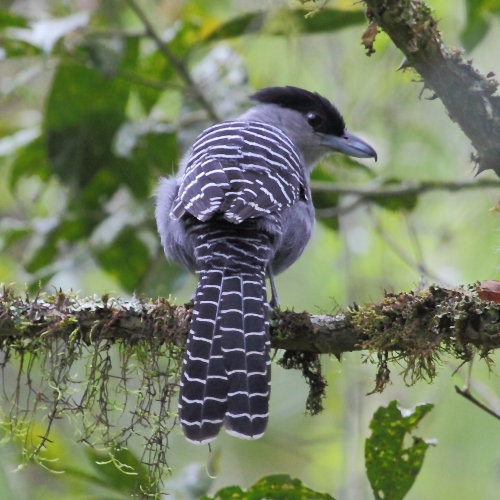
The Glossy Antshrike is a medium-sized bird, measuring approximately 17 centimeters in length. Its most striking feature is the glossy black plumage that covers most of its body, giving it a sleek, polished appearance. Males and females display sexual dimorphism, with males sporting more pronounced gloss on their feathers. In contrast, females have a slightly duller appearance with a more subdued sheen. Juveniles resemble females but are even less glossy. The bird's wings and tail present a stark contrast with white tips and bars, which are particularly noticeable during flight. When perched, the Glossy Antshrike maintains an upright posture, often flicking its tail or wings as part of its characteristic behavior. This antbird can be confused with other members of the Thamnophilidae family, such as the Barred Antshrike, but the latter can be distinguished by its barred plumage pattern. The Glossy Antshrike's silhouette in flight is compact, with a rapid wingbeat that aids its maneuverability through dense foliage.
Having trouble telling birds apart? Upload a photo to our bird identification tool for an instant species match.
Glossy Antshrike Habitat and Range
Preferred Habitat
The habitat of the Glossy Antshrike is primarily tropical lowland forests. It favors areas with dense undergrowth, where it can effectively forage and take cover. These birds are prevalent in both terra firme forests, which are not seasonally flooded, and várzea forests, which experience seasonal inundation. They can be found at elevations ranging from sea level to about 900 meters. Although their presence is more common in undisturbed forest areas, they can also adapt to secondary growth forests as long as there is sufficient vegetation density. Seasonal habitat shifts are minimal due to their non-migratory nature. Urban or suburban presence is rare since they prefer the complexities of natural forest structures.
Geographic Range
The range of the Glossy Antshrike is confined to the Amazon Basin, primarily in countries such as Brazil, Peru, and Bolivia. Its distribution extends through parts of the Guianas, although it is less common there. The species does not migrate, so its presence is consistent year-round within these regions. Within this range, the Glossy Antshrike is most densely populated in the central Amazon, where the habitat conditions are optimal. It avoids open areas and heavily disturbed regions, leading to fragmented populations where deforestation is prevalent. The bird's distribution is largely influenced by the availability of suitable forest habitats, which are increasingly under threat from human activities.
Want to know which birds visit your area? Browse our backyard birds by location guides for region-specific species lists.
What Does the Glossy Antshrike Eat?
The diet of the Glossy Antshrike primarily consists of insects and other arthropods. Ants, beetles, and spiders make up a significant portion of their diet. During the wetter months, they may incorporate more varied prey, including small lizards and frogs. The bird employs a methodical foraging technique, moving through the undergrowth and gleaning prey from leaves and branches. Occasionally, they will follow ant swarms to catch insects flushed by the ants, although they do not specialize in this behavior as some other antbirds do. The Glossy Antshrike forages throughout the day, with peak activity occurring during the early morning and late afternoon.
Glossy Antshrike Behavior and Social Structure
The Glossy Antshrike exhibits a monogamous social structure, often seen in pairs or family groups. They are territorial, with males engaging in vocal displays to defend their territory from intruders. Courtship involves elaborate displays where the male fluffs its feathers and sings to attract the female. During the breeding season, these birds become more vocal and active, with males and females participating in the defense of their nesting territory. Glossy Antshrikes are not inclined to flock, preferring the company of their mate or immediate family. Their response to predators includes alarm calls and evasive maneuvers, often retreating to denser cover if threatened. Daily activity patterns show peaks in foraging during cooler parts of the day, with rest periods during midday heat. The bird's interactions with other species are generally non-aggressive unless its territory is threatened.
Glossy Antshrike Nesting and Reproduction
The nesting habits of the Glossy Antshrike involve constructing cup-shaped nests, often placed low in dense shrubs or small trees. The nest materials include twigs, leaves, and plant fibers, woven to create a sturdy structure. The typical clutch size ranges from two to three eggs, which are incubated by both parents. The incubation period lasts about 14 days, with both parents taking turns keeping the eggs warm. Once hatched, the chicks remain in the nest for approximately two weeks before fledging. Parental roles are shared, with both male and female participating in feeding and caring for the young. The species typically produces one brood per year, although favorable conditions may lead to a second brood.
Glossy Antshrike Sounds and Vocalizations
The Glossy Antshrike's song is composed of a series of sharp, metallic notes delivered in quick succession. This song is used primarily for territorial defense and mate attraction. Call notes are shorter and less melodious, serving as signals between mates or alerts to potential danger. Alarm calls are more frantic and higher-pitched, intended to warn of approaching predators. During the dawn chorus, the Glossy Antshrike's song is pronounced, contributing to the symphony of sounds that define the early morning in the rainforest. Comparatively, its song resembles the metallic clinking of a small bell, distinctive among the background chatter of the forest.
Interesting Facts About the Glossy Antshrike
- 1The Glossy Antshrike is named for its iridescent plumage, which reflects light to create a metallic sheen.
- 2This bird is part of a family known for its association with ant swarms, but it often forages independently.
- 3Despite its striking appearance, the Glossy Antshrike is adept at hiding among dense foliage, evading predators.
- 4The Glossy Antshrike's vocalizations are unique, resembling the tinkling of a small bell, which aids in territory defense.
- 5Unlike some of its relatives, the Glossy Antshrike can thrive in both terra firme and várzea forests within its range.
- 6Its non-migratory behavior makes it particularly vulnerable to habitat changes and deforestation.
- 7The territories of Glossy Antshrikes are relatively small, often confined to a few hectares of dense forest.
Glossy Antshrike Conservation Status
The Glossy Antshrike currently holds a status of Least Concern according to the IUCN Red List. However, its population trend is declining due to ongoing habitat destruction. Primary threats include deforestation for agriculture, logging, and infrastructure development, which fragment its habitat. Conservation efforts focus on preserving large expanses of forest and establishing protected areas to mitigate habitat loss. Historically, the bird's population was more stable, with declines closely tied to increased human activity in its range. Continued monitoring and habitat protection are crucial to prevent further population decreases.