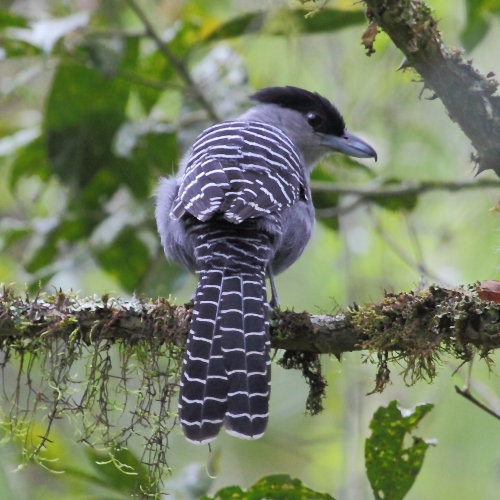
Goeldi's Antbird
Myrmeciza goeldii
Order: Passeriformes / Family: Thamnophilidae

Wikimedia Commons
About the Goeldi's Antbird
The Goeldi's Antbird (Myrmeciza goeldii) inhabits the dense understory of Amazonian forests, primarily in Brazil, Bolivia, and Peru. This bird plays a significant role in the ecosystem by participating in mixed-species flocks, a behavior that enhances foraging efficiency and reduces predation risk. Its presence indicates healthy forest ecosystems, as it relies on undisturbed habitats. The Goeldi's Antbird is often found in terra firme forests, which are non-flooded areas that provide a stable environment year-round. It also frequents várzea forests, which are seasonally flooded, showcasing its adaptability.
Ecologically, Myrmeciza goeldii contributes to the control of insect populations, as it primarily feeds on small arthropods. During the dry season, when insect abundance decreases, this bird demonstrates remarkable adaptability by shifting its diet to include small fruits and seeds. This dietary flexibility helps maintain its role in seed dispersal and forest regeneration.
The Goeldi's Antbird is also of interest to researchers studying avian species interactions in the Amazon. Its participation in mixed-species flocks highlights the complex social structures present in these biodiverse regions. During the breeding season, the bird's activity increases, with pairs becoming more territorial and vocal to defend their nesting sites. This behavior is crucial for understanding the dynamics of avian breeding strategies in tropical environments.
The Goeldi's Antbird belongs to the family Thamnophilidae, within the order Passeriformes. These birds typically live average 5 years, with a maximum recorded of 9 years..
How to Identify a Goeldi's Antbird
The Goeldi's Antbird is medium-sized, measuring around 15-17 cm in length. Males exhibit a striking black plumage, which can make them difficult to spot in dense forest shadows. Females, in contrast, have a brownish hue, particularly on the back and wings, aiding in camouflage while nesting. Juveniles resemble females but are often slightly duller.
One of the key identification features of the Goeldi's Antbird is its conspicuous white throat patch, which stands out against its darker feathers when it vocalizes. This patch is crucial for distinguishing it from similar species such as the Spot-backed Antbird, which lacks this distinct marking.
In flight, the Goeldi's Antbird has a compact silhouette with short, rounded wings adapted for maneuvering through dense vegetation. When perching, it often adopts a horizontal posture, staying low to the ground and frequently flicking its tail, which is a common behavior among antbirds.
Having trouble telling birds apart? Upload a photo to our bird identification tool for an instant species match.
Goeldi's Antbird Habitat and Range
Preferred Habitat
The Goeldi's Antbird thrives in the Amazon Basin's terra firme forests, preferring areas with dense, tangled understory. These forests, found primarily in lowland regions, offer shelter and abundant food sources. The bird also occupies várzea forests, which are seasonally flooded but rich in biodiversity.
Typically found at elevations below 500 meters, the Goeldi's Antbird rarely ventures into urban or heavily altered landscapes, as it relies on intact forest cover. During the wet season, it may shift slightly within its habitat to avoid flooding areas, demonstrating its adaptability to environmental changes.
The bird's preference for secluded, forested areas makes it a reliable indicator of low human disturbance zones, contributing to its importance in ecological studies.
Geographic Range
The Goeldi's Antbird is native to the western Amazon Basin, with its range primarily encompassing western Brazil, northern Bolivia, and eastern Peru. Within Brazil, it is particularly prevalent in the states of Acre and Amazonas, where large tracts of uninterrupted forest remain.
This species is non-migratory, maintaining a stable presence in its preferred habitats year-round. Its population density is highest in areas with minimal deforestation and human encroachment. While the bird does not engage in long-distance migration, it may exhibit local movements in response to seasonal flooding in várzea forests.
Due to its reliance on specific forest types, the Goeldi's Antbird's distribution is patchy, forming population hotspots in regions with extensive wilderness. Conservation efforts in these areas are crucial for maintaining its habitat and ensuring the species' persistence.
Want to know which birds visit your area? Browse our backyard birds by location guides for region-specific species lists.
What Does the Goeldi's Antbird Eat?
The Goeldi's Antbird primarily consumes insects and other small arthropods, which it forages from leaf litter and understory vegetation. Its diet includes ants, beetles, and spiders, essential for controlling insect populations within its habitat.
During the wet season, when insect abundance peaks, the bird intensifies its foraging activity, often joining mixed-species flocks to increase efficiency and reduce the risk of predation. In the dry season, it supplements its diet with small fruits and seeds, showcasing its dietary adaptability.
This antbird employs a methodical foraging technique, moving slowly and deliberately through the underbrush, flipping leaves and twigs to uncover hidden prey. It typically forages in the early morning and late afternoon, avoiding the heat of midday.
Goeldi's Antbird Behavior and Social Structure
Goeldi's Antbird exhibits solitary or paired behaviors, though it frequently joins mixed-species flocks for foraging. This social structure enhances foraging success and predator avoidance. Its territorial nature becomes evident during the breeding season, with pairs defending their nesting areas vigorously.
Courtship displays involve the male singing persistently, showcasing his vocal abilities to attract a mate. Once paired, both sexes engage in nest building and caring for the young. The Goeldi's Antbird's daily activity peaks in the early morning and late afternoon, taking advantage of cooler temperatures for foraging.
The bird's response to predators includes alarm calls and, when threatened, retreating into dense vegetation. Its reliance on foliage for cover is a key aspect of its survival strategy in the wild.
Goeldi's Antbird Nesting and Reproduction
The Goeldi's Antbird builds its nest close to the ground, often hidden in dense underbrush or among roots. The nest is cup-shaped, constructed from twigs, leaves, and plant fibers, providing camouflage and protection from predators.
Typically, the female lays 2-3 eggs, which both parents incubate for about 14-16 days. After hatching, the chicks remain in the nest for approximately 10-12 more days before fledging. During this period, both parents share feeding duties, ensuring the chicks receive a steady supply of insects.
This species usually raises one brood per year, although in optimal conditions with abundant food, a second brood may occur. The bird's nesting habits reflect its adaptation to the dense and often unpredictable tropical environment.
Goeldi's Antbird Sounds and Vocalizations
The Goeldi's Antbird's primary song is a series of clear, melodious notes with a steady rhythm, often delivered from a concealed perch. These vocalizations serve to establish territory and attract mates during the breeding season.
Its call notes are short and sharp, used for communication between mates or to signal alarm. When threatened, the bird emits a rapid series of harsh notes, alerting nearby flock members to potential danger.
At dawn, the Goeldi's Antbird participates in the forest's chorus, adding its unique voice to the symphony of the Amazon. Its song, while not as complex as some songbirds, is distinct and recognizable to those familiar with the forest's soundscape.
Interesting Facts About the Goeldi's Antbird
- 1The Goeldi's Antbird was named after Swiss-Brazilian naturalist Emil Goeldi, who contributed significantly to South American zoology.
- 2Despite its elusive nature, the Goeldi's Antbird can be quite vocal, particularly during the breeding season, making it easier to hear than see.
- 3The Goeldi's Antbird is a key participant in mixed-species flocks, sometimes associating with woodcreepers and other antbirds for efficient foraging.
- 4This antbird's preference for lowland terra firme and flooded várzea forests makes it a reliable indicator of forest health.
- 5The Goeldi's Antbird has a specialized foraging strategy, moving slowly and methodically through the underbrush to locate hidden prey.
- 6Although primarily insectivorous, the bird adapts its diet seasonally, consuming small fruits and seeds during lean periods.
- 7The Goeldi's Antbird's territorial song, a series of melodious notes, is crucial for maintaining its presence in the dense Amazonian understory.
Goeldi's Antbird Conservation Status
The IUCN currently lists the Goeldi's Antbird as Least Concern, though its population trend is decreasing due to habitat loss. Deforestation for agriculture and logging poses the most significant threat, reducing available habitat. Conservation efforts focus on protecting large tracts of the Amazon forest, establishing reserves, and promoting sustainable land use practices. The bird's sensitivity to habitat disturbance makes it an important species for monitoring ecosystem health. Historically, the Goeldi's Antbird's population remained stable, but increased human activity in the Amazon poses challenges for its future. Continued conservation actions are needed to ensure its survival in the wild.