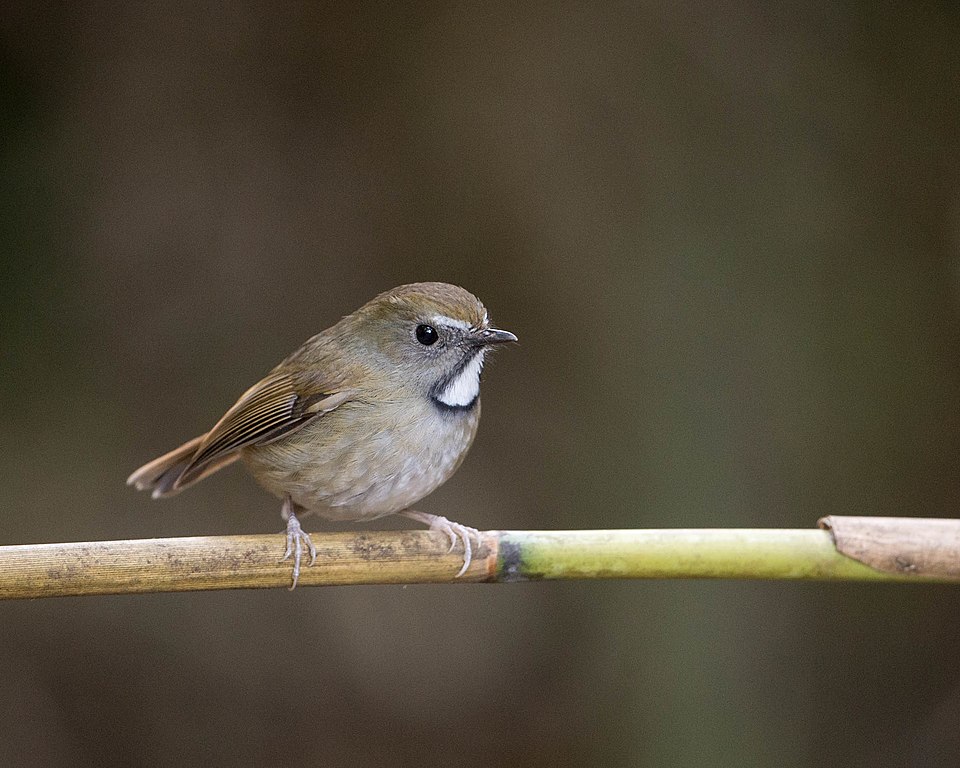
Great Shortwing
Heinrichia calligyna
Order: Passeriformes / Family: Muscicapidae

Wikimedia Commons
About the Great Shortwing
The Great Shortwing (Heinrichia calligyna) is a captivating bird species belonging to the Muscicapidae family, renowned for its vibrant blue plumage and enchanting vocalizations. This elusive bird thrives in the dense, humid forests of Southeast Asia, particularly in regions like the mountains of Sumatra and Borneo. Its preference for high-altitude, undisturbed habitats makes it a key indicator of forest health in these biodiverse ecosystems.
The Great Shortwing's ecological role extends beyond its aesthetic appeal, as it plays a vital part in the intricate web of life within its habitat. It contributes to insect population control by preying on various invertebrates, thus aiding in maintaining ecological balance. Additionally, its presence signifies the continuity of mature forests, as the species relies on such habitats for breeding and foraging.
Seasonally, the Great Shortwing exhibits subtle behavioral changes. During the breeding season, males become highly territorial, using their melodious songs to attract mates and defend their territory. Outside the breeding period, these birds tend to be more secretive, often retreating deeper into the forest underbrush. Despite their reclusive nature, they remain a subject of interest for ornithologists and birdwatchers alike, owing to their rarity and the allure of their song.
The Great Shortwing belongs to the family Muscicapidae, within the order Passeriformes. These birds typically live average 5 years with a max recorded of 8 years.
How to Identify a Great Shortwing
The Great Shortwing is unmistakable with its deep blue plumage that covers most of its body. Adult males boast a brilliant cobalt blue that shimmers under the forest canopy, while females, though similarly colored, exhibit slightly duller hues with a hint of brownish tones. Juveniles, on the other hand, are more subdued in color, presenting a brownish-gray plumage that serves as effective camouflage.
One can distinguish the Great Shortwing from other birds by its compact, robust build and short wings. This morphology contributes to its name and reflects its adaptation to a life spent largely on or near the forest floor, where it forages among leaf litter. In flight, the Great Shortwing exhibits a direct, rapid flight pattern, but it is more often seen perched low in the understory, where its posture is upright, and its tail slightly cocked.
Although there are few species with which it might be confused, its closest lookalikes are other forest-dwelling birds like the White-browed Shortwing. However, the latter can be differentiated by the distinctive white eyebrow and a more varied vocal range. Observing the Great Shortwing requires patience, as its elusive nature often means a fleeting glimpse is all one might catch.
Having trouble telling birds apart? Upload a photo to our bird identification tool for an instant species match.
Great Shortwing Habitat and Range
Preferred Habitat
The Great Shortwing inhabits montane forests, typically at elevations ranging from 1,000 to 3,500 meters above sea level. It prefers densely vegetated areas with a rich understory, where it can find adequate cover and food resources. These habitats are primarily found in Southeast Asian countries, such as Indonesia and Malaysia, where the bird is most frequently recorded.
Seasonal habitat shifts are minimal, given its preference for stable, undisturbed environments. While it does not venture into urban areas, the Great Shortwing may occasionally be found in the outskirts of rural villages that border suitable forest habitats. Its presence is almost always indicative of a relatively intact forest ecosystem, away from the disturbances common in more developed areas.
Geographic Range
The Great Shortwing is endemic to Southeast Asia, with its primary range encompassing the islands of Sumatra and Borneo. Within these islands, it occupies highland regions where montane forests provide the ideal conditions for its survival. The species does not undertake long migrations, remaining relatively stationary throughout the year, though it may exhibit minor altitudinal movements in response to food availability and climatic conditions.
The bird's population density is generally highest in regions with the least human disturbance, such as protected national parks and forest reserves. However, habitat fragmentation and deforestation pose significant threats, potentially constraining its range and leading to isolated populations that are more vulnerable to environmental changes.
Want to know which birds visit your area? Browse our backyard birds by location guides for region-specific species lists.
What Does the Great Shortwing Eat?
The Great Shortwing primarily feeds on insects and other small invertebrates, which it diligently searches for among the leaf litter and low vegetation of the forest floor. Its diet includes beetles, ants, and caterpillars, supplemented by occasional berries and fruits, particularly during the non-breeding season when insect availability may decline.
The bird employs a foraging technique characterized by short, deliberate hops and pauses as it investigates potential prey hiding under leaves and debris. This methodical approach allows it to efficiently exploit the resources within its habitat. Feeding is typically a solitary activity, though pairs may forage together during the breeding season, maintaining a low profile to avoid attracting predators.
Great Shortwing Behavior and Social Structure
The Great Shortwing exhibits a primarily solitary lifestyle, with pair bonding occurring during the breeding season. Males become notably vocal during this period, using their song to establish and defend territories. This territoriality is crucial, as it ensures access to necessary resources for raising young.
Courtship displays involve both visual and auditory elements, where males may perform subtle wing flicks and tail spreads while singing. The bird's response to predators involves a blend of vocal alarms and evasive maneuvers, often retreating into dense cover to evade detection.
Daily activity patterns revolve around foraging in the early morning and late afternoon when temperatures are more conducive. During the hottest part of the day, the Great Shortwing tends to rest in shaded areas, minimizing energy expenditure. Despite its secretive nature, it remains alert to its surroundings, ever vigilant for potential threats or opportunities.
Great Shortwing Nesting and Reproduction
The Great Shortwing constructs its nest with remarkable precision, utilizing natural materials such as moss, leaves, and twigs. Nests are typically cup-shaped and placed close to the ground, often nestled within the root mass of a tree or shrub to provide concealment and protection.
A typical clutch consists of two to three eggs, which both parents incubate over a period of approximately two weeks. Once hatched, the chicks require attentive care and feeding, with both male and female sharing in the responsibilities. Fledging occurs in about 12 to 15 days, with the young remaining dependent on parental support for some time afterward.
The species usually produces one brood per year, though in favorable conditions, a second brood may occur. This reproductive strategy emphasizes the importance of stable and secure nesting sites, which are increasingly threatened by habitat destruction.
Great Shortwing Sounds and Vocalizations
The Great Shortwing's song is a melodious and complex series of whistles and trills, varying in pitch and rhythm. Its primary song often starts with a clear, flute-like note followed by a rapid sequence of descending tones. This vocalization serves dual purposes: attracting mates and establishing territory.
In addition to its primary song, the bird emits a variety of call notes, including sharp 'tik-tik' sounds used as contact calls between mates or as alarms when danger is near. During the dawn chorus, the Great Shortwing's song can be heard resonating through the forest, a clear and distinct melody against the backdrop of the morning cacophony. Its vocal repertoire, while not as extensive as some other songbirds, is distinctive and a pleasure for any birder fortunate enough to experience it.
Interesting Facts About the Great Shortwing
- 1The Great Shortwing's scientific name, Heinrichia calligyna, honors German ornithologist Gerd Heinrich.
- 2Despite its vivid coloration, the Great Shortwing is notoriously difficult to spot due to its preference for dense, shaded undergrowth.
- 3The bird's song can be heard from over 100 meters away, a testament to its powerful vocal abilities.
- 4The Great Shortwing's foraging style is so methodical that it leaves distinct patterns in the leaf litter.
- 5This species plays a critical role in controlling pest populations, benefiting the forest ecosystem as a whole.
- 6The Great Shortwing is one of the few species that remains in its montane habitat year-round, illustrating its adaptation to stable environments.
- 7During courtship, the male Great Shortwing may present the female with food, a behavior that strengthens pair bonds.
Great Shortwing Conservation Status
The Great Shortwing is currently classified as Near Threatened on the IUCN Red List, with its population trend showing a decline. The primary threats to its survival include habitat loss due to logging, agricultural expansion, and infrastructure development, all of which have led to significant fragmentation of its forest habitat. Conservation efforts focus on preserving and restoring these critical habitats, particularly through the establishment of protected areas and promoting sustainable land use practices. Historical population changes have seen a reduction in range, emphasizing the need for ongoing conservation action to ensure the species' survival. Efforts are also being made to raise awareness about the Great Shortwing's plight and the importance of biodiversity in maintaining healthy ecosystems. Collaborative initiatives with local communities aim to balance human needs with conservation priorities.