
Greater Honeyguide
Indicator indicator
Order: Piciformes / Family: Indicatoridae

Wikimedia Commons
About the Greater Honeyguide
The Greater Honeyguide, scientifically named Indicator indicator, holds a remarkable place in the ecosystems of sub-Saharan Africa due to its cooperative behavior with humans and other animals. This bird is a member of the family Indicatoridae, known for its specialized feeding habits, predominantly focusing on beeswax and larvae. Found in a variety of woodland and savanna habitats spanning countries like Kenya, Tanzania, and South Africa, the Greater Honeyguide exhibits a unique behavior: it actively leads humans and other mammals to beehives. Once the hive is broken open, often by humans using smoke or tools, the bird takes advantage of the opportunity to feed on the wax and larvae left behind.
Ecologically, the Greater Honeyguide plays a pivotal role in its environment. Its interaction with human populations highlights a complex ecological relationship that has evolved over generations. Beyond its mutualistic relationship with humans, the bird also benefits several animal species, including badgers. Its ability to consume beeswax, which is generally indigestible for other species, sets it apart as a key player in the recycling of wax and nutrients within its habitat.
In terms of behavior, the Greater Honeyguide is particularly active during the breeding season, which varies by region but often coincides with the rainy season when food is abundant. During this time, the males are known to become more vocal and territorial. Outside the breeding season, these birds are less conspicuous, focusing on foraging and maintaining their energy reserves. Despite their reliance on beeswax, they also consume a variety of insects, supplementing their diet with other protein sources when available. Their adaptability to different environments and interactions with both natural and human-modified landscapes underscore their ecological significance.
The Greater Honeyguide belongs to the family Indicatoridae, within the order Piciformes. These birds typically live average 6-8 years, with longer lifespans occasionally recorded..
How to Identify a Greater Honeyguide
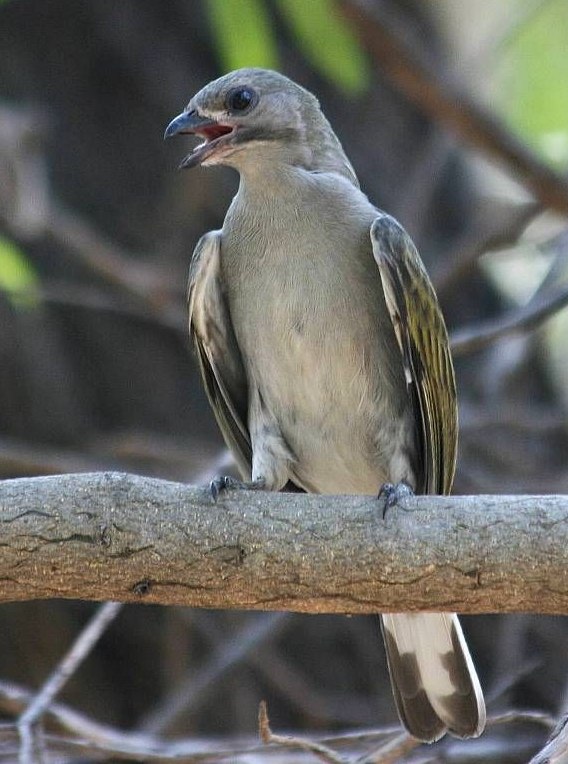
The Greater Honeyguide is a medium-sized bird, approximately 20 cm in length. It exhibits distinct sexual dimorphism. Adults have a pale gray head, with a dark eye stripe and a white outer tail which flares during flight, making them easy to distinguish. Their underparts are paler, and they have a yellowish wash on the throat and breast. The male features a pinkish-orange gape, which becomes more vivid during the breeding season, while females tend to have a duller appearance.
Juvenile Greater Honeyguides are more uniformly colored, with a drab brown plumage that lacks the contrast seen in adults. This coloration provides them with better camouflage from predators during their vulnerable early months. When compared to similar species, such as the Lesser Honeyguide, the Greater Honeyguide is larger and more robustly built, with a distinctive flight pattern characterized by rapid wingbeats followed by short glides.
In flight, the Greater Honeyguide's silhouette showcases its relatively broad wings and short tail, differing from smaller, more streamlined species. When perched, it sits upright, often flicking its tail and wings as if in anticipation, especially when actively seeking human or animal partners to guide to hives.
Having trouble telling birds apart? Upload a photo to our bird identification tool for an instant species match.
Greater Honeyguide Habitat and Range
Preferred Habitat
The Greater Honeyguide primarily inhabits open woodlands, savannas, and forest edges across sub-Saharan Africa. It thrives in regions like the miombo woodlands of Zambia and the acacia-dominated savannas of Tanzania. These habitats provide the bird with ample foraging opportunities and nesting sites. Typically, it is found at elevations ranging from sea level to about 2,000 meters, with a preference for areas that offer a mix of trees and open spaces.
Unlike many birds, the Greater Honeyguide adapts well to both rural and semi-urban environments, often following humans in agricultural areas. Seasonal migrations are minimal, as the bird tends to remain within its established territory year-round. However, some local movements may occur in response to changes in food availability, particularly during dry spells when access to bee colonies may diminish.
Geographic Range
The Greater Honeyguide is widely distributed across sub-Saharan Africa. Its range extends from Senegal and Gambia in the west to the eastern countries such as Kenya and Tanzania, and southwards to the northern parts of South Africa. The bird is non-migratory, residing in these regions throughout the year, though it may undertake short-distance dispersal in response to environmental conditions.
Breeding populations are concentrated in areas where human activity is prevalent, due to the bird's unique feeding strategy that relies on guiding humans to bee nests. This bird is especially common in the woodlands and savannas of East Africa, with notable population densities in the Serengeti and Kruger National Park. Despite its wide range, the Greater Honeyguide is less frequently found in dense forest interiors or deserts, where bee populations are sparse.
Want to know which birds visit your area? Browse our backyard birds by location guides for region-specific species lists.
What Does the Greater Honeyguide Eat?
The diet of the Greater Honeyguide primarily consists of beeswax and bee larvae, which it accesses by guiding humans or animals to beehives. This diet is supplemented by a variety of insects, including ants, termites, and beetles, which the bird captures through hawking or gleaning from foliage.
During different seasons, the Greater Honeyguide may adjust its diet based on the availability of bee colonies. In the dry season, when fewer active hives are present, it increases its intake of other insects. The bird employs a unique foraging technique, relying on its keen eyesight and memory to locate potential foraging partners, be they human or animal, and lead them to hidden hives.
The Greater Honeyguide typically forages throughout the day, but is most active in the cooler morning and late afternoon hours. It takes advantage of the reduced competition from other birds during these times to maximize its foraging success.
Greater Honeyguide Behavior and Social Structure
Socially, the Greater Honeyguide is a solitary bird outside the breeding season. It is highly territorial, with males defending their areas aggressively against intruders. During the breeding season, which aligns with the regional rainy season, males engage in elaborate displays to attract mates. These displays include vocalizations and flight exhibitions, showcasing their plumage and agility.
The Greater Honeyguide is known for its guiding behavior, where it actively seeks out humans or animals that can assist in breaking open beehives. This mutualistic behavior is not just opportunistic but is a learned behavior passed down through generations. In response to predators, the bird takes advantage of its agility and flight skills, often retreating to dense foliage or using its knowledge of the terrain to evade capture.
Daily activity patterns of the Greater Honeyguide include periods of foraging, resting, and vocalizing. The bird is diurnal, with most of its activities occurring during daylight hours. It often perches conspicuously on branches or power lines while waiting for potential partners to guide.
Greater Honeyguide Nesting and Reproduction
The Greater Honeyguide is a brood parasite, meaning it lays its eggs in the nests of other bird species. It primarily targets hole-nesting birds such as barbets and woodpeckers. The female honeyguide lays a single egg per host nest, often removing or destroying one of the host's eggs to reduce competition for the host's care.
The incubation period for the honeyguide egg is typically 11-14 days, after which the chick hatches and often eliminates its nest mates to monopolize the food provided by the unsuspecting host parents. The young honeyguide fledges in about 30-40 days, during which time it grows rapidly, developing the necessary skills for independence.
Greater Honeyguides can lay multiple clutches per year, depending on the availability of suitable host nests. This reproductive strategy allows them to maximize their reproductive success across a broad range of environments.
Greater Honeyguide Sounds and Vocalizations
The Greater Honeyguide's primary song is a series of high-pitched, melodious whistles that vary in rhythm and pitch. These whistles often serve as contact calls during their guiding behavior, alerting potential partners to their presence.
The bird's call notes include a distinctive trilling sound, often described as "ti-ti-ti-ti," which can be heard from a considerable distance. In addition to these calls, the Greater Honeyguide may produce alarm calls, consisting of sharp, repetitive notes when threatened by predators or rival males.
During the early morning dawn chorus, the Greater Honeyguide's song is especially prominent, contributing to the acoustic landscape of its habitat. Its vocalizations, both melodic and functional, play a crucial role in its interactions with humans and other animals.
Interesting Facts About the Greater Honeyguide
- 1Greater Honeyguides are known to lead honey hunters to hives by making specific calls and flying from tree to tree.
- 2These birds have a unique adaptation that allows them to digest beeswax, a diet that few other animals can process.
- 3A single Greater Honeyguide can guide humans several kilometers to a hive, showing remarkable memory and navigation skills.
- 4Their brood parasitism strategy involves laying eggs in the nests of specific host species, particularly those in the Piciformes order.
- 5The mutualistic relationship between humans and honeyguides has been documented for centuries, appearing in traditional stories and songs.
- 6Greater Honeyguides can recognize individual humans and favor those with whom they have successfully foraged in the past.
- 7Unlike many brood parasites, Greater Honeyguides do not mimic the eggs of their host species, relying on the destruction of host eggs instead.
Greater Honeyguide Conservation Status
The Greater Honeyguide is currently listed as a species of Least Concern by the IUCN, with a stable population trend across its range. Despite this status, the bird faces threats from habitat destruction and changes in land use, which can affect the availability of both natural beehives and suitable host nests for reproduction. Conservation efforts focus on maintaining natural habitats and promoting traditional honey-harvesting practices that support the mutualistic relationship between honeyguides and humans. In areas where these practices are preserved, the Greater Honeyguide continues to thrive. Historically, the bird has maintained stable population levels, but ongoing monitoring is essential to ensure that changing environmental conditions do not negatively impact its numbers.
Other Indicatoridae Species



Birds Similar to the Greater Honeyguide
These species are often confused with the Greater Honeyguide due to similar appearance or overlapping range.