
Least Honeyguide
Indicator exilis
Order: Piciformes / Family: Indicatoridae

Wikimedia Commons
About the Least Honeyguide
The Least Honeyguide, Indicator exilis, belongs to the family Indicatoridae and is renowned for its unique brood parasitic behavior. This small bird, often elusive and hard to spot, inhabits the dense forests and savannas across sub-Saharan Africa. Unlike many birds, the Least Honeyguide does not build its own nest. Instead, it lays its eggs in the nests of other bird species, particularly hole-nesting birds. This behavior relieves the honeyguide of parental duties, allowing it to focus on foraging and survival.
Ecologically, the Least Honeyguide plays a subtle yet crucial role in its habitat. By parasitizing the nests of other birds, it influences the population dynamics of its host species. The presence of the Least Honeyguide can affect the reproductive success of its hosts, which in turn impacts the broader avian community. In this way, the Least Honeyguide indirectly contributes to the ecological balance within its range.
Behaviorally, this bird is adapted to a vagabond lifestyle. It does not establish permanent territories, instead moving across vast areas in search of suitable hosts and food sources. Seasonal movements are largely dictated by the availability of insects and the nesting cycles of potential host species. This adaptability is key to the Least Honeyguide's survival, as it must synchronize its reproductive cycle with that of its hosts. The bird's presence is often more audible than visible, with its distinctive calls alerting birders to its presence in the field.
The Least Honeyguide's habitat preferences are varied, yet it primarily favors regions with a mix of forest and open savanna. It thrives in areas where its host species are abundant, often near water sources which support a high density of avian life. While it can be found at various elevations, it tends to avoid the highest altitudes, favoring lowland and mid-elevation habitats. Its ecological role and adaptability make the Least Honeyguide a fascinating subject of study for ornithologists and bird enthusiasts alike.
The Least Honeyguide belongs to the family Indicatoridae, within the order Piciformes. These birds typically live average 5-6 years, with up to 10 years recorded..
How to Identify a Least Honeyguide
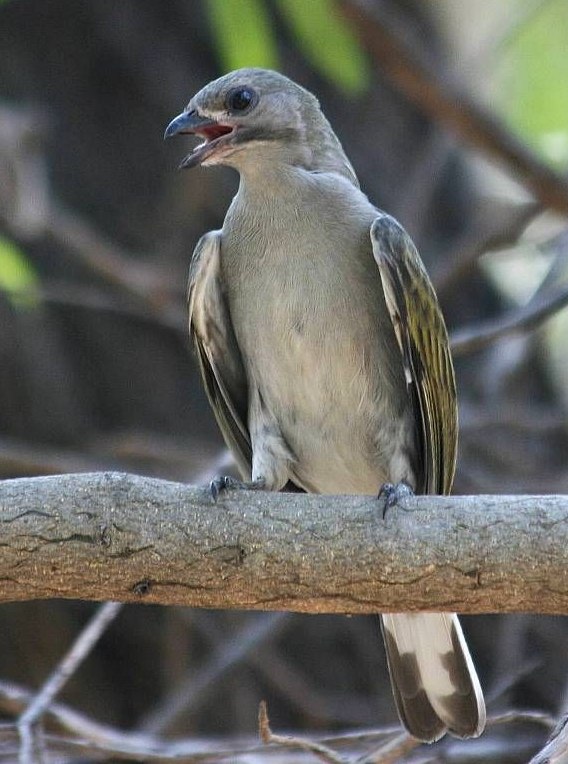
Identifying the Least Honeyguide, Indicator exilis, requires attention to detail due to its small size and cryptic plumage. Adult birds are typically olive-brown above with paler, more muted underparts. The head displays subtle streaking that blends seamlessly with its overall coloration. One of the key features that aid in identifying this bird is its relatively short, stubby bill, which is an adaptation to its insectivorous diet. Juvenile Least Honeyguides resemble adults but may show slightly duller plumage, lacking the distinct patterns seen in mature birds.
There is little sexual dimorphism in the Least Honeyguide, meaning males and females appear quite similar. This can pose a challenge for birders attempting to distinguish between the sexes in the field. When comparing the Least Honeyguide to similar species, such as other honeyguides, its smaller size and less pronounced markings are distinguishing features. Its flight silhouette is compact, with rapid wingbeats that give it a distinctive fluttering appearance. When perched, it maintains an upright posture, often favoring the protection of dense foliage.
The Least Honeyguide's cryptic nature can lead to confusion with other small, drab birds within its range, particularly those sharing its habitat. However, its unique vocalizations and behavior, especially during the breeding season, can be key indicators to its presence. Birders should listen for its calls and observe its interactions with other bird species to make a confident identification.
Having trouble telling birds apart? Upload a photo to our bird identification tool for an instant species match.
Least Honeyguide Habitat and Range
Preferred Habitat
The Least Honeyguide inhabits a variety of habitat types across sub-Saharan Africa, predominantly favoring open forests and mixed savanna landscapes. It is frequently found in areas where dense vegetation meets open clearings, providing both foraging opportunities and the presence of potential host species for nesting. This bird is adapted to a range of elevations, typically occupying lowland and mid-elevation regions where its ecological needs are met.
During the breeding season, the Least Honeyguide tends to frequent habitats rich in cavity-nesting birds, which serve as hosts for its brood parasitism. Seasonal changes in habitat use are minimal, as the bird's movements are more closely tied to the availability of its insect prey and the distribution of host species rather than distinct migratory patterns. While it is not commonly found in urban settings, it may be spotted near rural settlements that are adjacent to suitable natural habitats. The Least Honeyguide's presence in both forested and savanna environments underscores its adaptability to different ecological conditions.
Geographic Range
The Least Honeyguide's range spans across the vast expanse of sub-Saharan Africa, with its distribution extending from West Africa, through Central Africa, and into parts of East and Southern Africa. Countries such as Nigeria, Cameroon, Uganda, Kenya, and Tanzania are known hotspots for this species. It is primarily a resident bird, showing limited migratory behavior, though it may undertake local movements in response to seasonal changes in food availability and host species distribution.
In West Africa, the Least Honeyguide is commonly found in the forest-savanna mosaics, which provide an ideal mix of habitat types. Moving eastward, its range encompasses the dense woodlands and savannas of the Central African Republic and the Democratic Republic of Congo. In the southern reaches of its range, the bird frequents the miombo woodlands and open savannas of Zambia and Zimbabwe.
Population densities of the Least Honeyguide are generally sparse, as it is a bird that relies on specific ecological conditions and host availability. However, in regions where suitable habitats overlap with abundant host species, such as the forest edges of Kenya and Tanzania, the bird can be locally common. Its presence across a wide geographic area highlights its adaptability to various environmental conditions across the African continent.
Want to know which birds visit your area? Browse our backyard birds by location guides for region-specific species lists.
What Does the Least Honeyguide Eat?
The Least Honeyguide's diet primarily consists of insects, with a strong preference for beeswax and the larvae of bees and wasps. This specialized diet is facilitated by the bird's unique digestive adaptations, allowing it to process the waxy substances found in its prey. The bird employs an opportunistic foraging strategy, often taking advantage of other species' activities, such as following honey badgers or humans to locate beehives.
During different seasons, the Least Honeyguide's diet may shift slightly depending on the availability of its primary food sources. In times of scarcity, it may supplement its diet with other insects, such as ants or termites, which are abundant in its savanna habitats. The bird typically forages alone or in pairs, utilizing its acute sense of hearing and sight to locate nests of bees or wasps.
Foraging activities are generally concentrated in the morning and late afternoon, when the bird is most active. The Least Honeyguide is known for its persistence in extracting larvae and wax from difficult-to-reach places, demonstrating a remarkable level of dexterity and patience. This dietary specialization not only defines the bird's ecological niche but also influences its interactions with other species in its environment.
Least Honeyguide Behavior and Social Structure
The Least Honeyguide exhibits fascinating behavioral adaptations, including its well-documented brood parasitism. Unlike many bird species, it does not construct its own nest, instead relying on the nests of cavity-nesting birds such as barbets and woodpeckers. This behavior involves laying eggs in the host's nest, where the honeyguide's chicks typically outcompete the host's offspring for resources.
Socially, the Least Honeyguide is primarily solitary, only coming together with other individuals during the breeding season. Males may engage in vocal displays to attract females, often using specific call sequences to establish presence and dominance in a given area. Territorial behaviors are less pronounced compared to other avian species, as the bird's range is influenced more by host availability and food resources than strict territorial boundaries.
The bird's daily activity patterns include periods of intense foraging interspersed with rest and preening. It remains vigilant to potential threats, especially when near host nests. When faced with predators, the Least Honeyguide relies on its cryptic coloration and the dense cover of its habitat to evade detection. Its interactions with other species, both as a brood parasite and a forager, underscore its complex role within the ecosystems it inhabits.
Least Honeyguide Nesting and Reproduction
Nesting for the Least Honeyguide is a unique process, given its reliance on brood parasitism. The bird does not build its own nest, opting instead to lay its eggs in the nests of other bird species. The preferred hosts are typically cavity-nesting birds, such as barbets and woodpeckers, whose nesting habits align well with the honeyguide's needs.
Once the Least Honeyguide locates a suitable host nest, the female deposits her eggs, often removing one or more of the host's eggs to increase the likelihood of her offspring's survival. The incubation period is entirely managed by the unsuspecting host parents, who continue their parental duties unaware of the intruder's presence. This process allows the Least Honeyguide to invest its energy in other survival activities rather than parental care.
After hatching, the young honeyguides display aggressive behaviors towards the host's chicks, often leading to the latter's demise. This ensures that the resources provided by the host are directed entirely towards the honeyguide's offspring. The fledging period varies depending on the host species, but the young honeyguides are typically ready to leave the nest around the same time as their host counterparts. The number of broods per year for the Least Honeyguide aligns with the availability of host nests and the seasonal abundance of food resources.
Least Honeyguide Sounds and Vocalizations
The Least Honeyguide's vocalizations are an essential aspect of its identification in the wild. Its primary song consists of a series of clear, whistled notes delivered in a rhythmic sequence. These notes are often repeated in rapid succession, creating a distinctive auditory pattern that can carry over considerable distances. The pitch of the song is moderately high, with a clear tonal quality that sets it apart from the calls of other birds in its habitat.
In addition to its primary song, the Least Honeyguide employs a variety of call notes, including short, sharp whistles and softer, more subdued murmurs. These calls are used in various contexts, from mate attraction to territory establishment. Alarm calls are less frequent but may occur when the bird perceives a threat near its chosen host nest.
During the dawn chorus, the Least Honeyguide's song can often be heard alongside those of other forest and savanna birds. Its vocalizations serve as an important tool for communication and play a crucial role in its reproductive and social behaviors. For birders, learning the distinctive calls of the Least Honeyguide can greatly enhance the chances of observing this elusive species in the field.
Interesting Facts About the Least Honeyguide
- 1The Least Honeyguide's diet includes beeswax, a unique adaptation among birds made possible by specialized enzymes.
- 2While the Least Honeyguide is parasitic, it relies on the same host species across its range, showing remarkable ecological consistency.
- 3In some regions, the Least Honeyguide follows honey badgers to locate bee nests, exploiting their digging prowess to access wax.
- 4Unlike many cuckoos, the Least Honeyguide does not remove host eggs; instead, its chicks outcompete the host's young after hatching.
- 5The bird's presence in a region can influence local avian population dynamics, affecting host species' reproductive success.
- 6The Least Honeyguide's song is particularly distinctive, with clear, whistled notes that serve as a key identification feature.
- 7Brood parasitism in the Least Honeyguide leads to complex interspecific interactions, showcasing evolutionary adaptations.
Least Honeyguide Conservation Status
The Least Honeyguide is currently classified as Least Concern by the IUCN, reflecting a stable population trend across its range. However, like many species, it faces potential threats from habitat loss and degradation, particularly as a result of deforestation and agricultural expansion in parts of Africa. The bird's reliance on specific host species for reproduction means that any decline in those populations could have repercussions for the honeyguide. Conservation efforts for the Least Honeyguide are largely focused on preserving its natural habitats and promoting sustainable land use practices. Protecting key forest and savanna regions ensures that both the honeyguide and its host species can continue to thrive. While historical population data is limited, current observations suggest that the species remains widespread and adaptable, capable of withstanding moderate environmental pressures. Continued monitoring and habitat preservation are essential to maintaining the Least Honeyguide's stable status. Efforts to raise awareness about the ecological importance of brood parasitic birds can also contribute to broader conservation goals, ensuring that these unique avian strategies are valued and protected within their ecosystems.
Other Indicatoridae Species



Birds Similar to the Least Honeyguide
These species are often confused with the Least Honeyguide due to similar appearance or overlapping range.