
Malaysian Honeyguide
Indicator archipelagicus
Order: Piciformes / Family: Indicatoridae

Wikimedia Commons
About the Malaysian Honeyguide
The Malaysian Honeyguide, known scientifically as Indicator archipelagicus, inhabits the tropical rainforests of Southeast Asia, particularly in Malaysia and parts of Indonesia. This bird is part of the Indicatoridae family, a group renowned for their peculiar feeding habits and nesting behavior. The Malaysian Honeyguide plays a crucial ecological role by facilitating the pollination process and acting as a biological control agent for insect populations.
The significance of the Malaysian Honeyguide extends beyond its role in the ecosystem. It is a bird of fascinating behavioral complexity, particularly noted for its brood parasitism. Unlike many other species, it does not raise its own young. Instead, it lays its eggs in the nests of other bird species, which then incubate and rear the honeyguide's offspring. This behavior ensures the propagation of the species with minimal parental investment.
Ecologically, the Malaysian Honeyguide is a vital component of its habitat. It frequents regions such as the lowland rainforests of Borneo and the montane forests of Sumatra, where it is well-adapted to the dense canopy and rich biodiversity. The bird exhibits seasonal behaviors, including slight altitudinal migrations, likely in response to food availability. By its presence and activities, the Malaysian Honeyguide contributes to the health and sustainability of the forest ecosystems it inhabits, making it an invaluable species for biodiversity conservation.
The Malaysian Honeyguide belongs to the family Indicatoridae, within the order Piciformes. These birds typically live estimated to be 8-10 years..
How to Identify a Malaysian Honeyguide
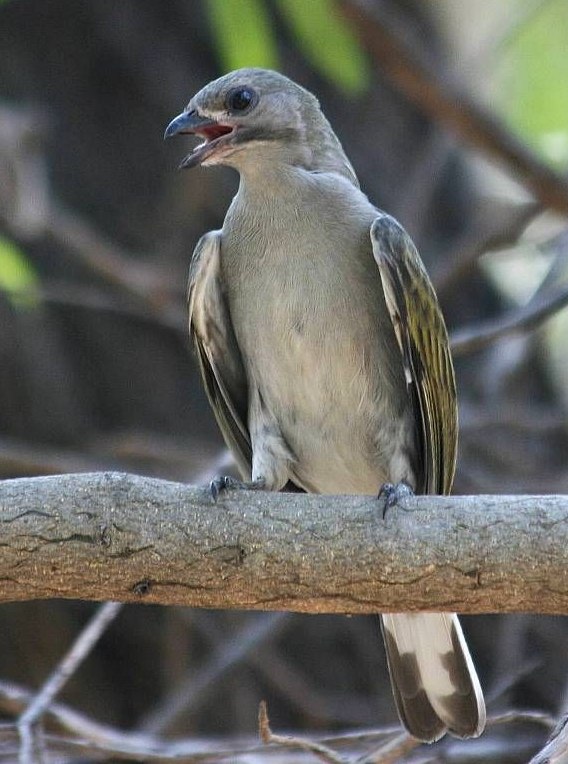
The Malaysian Honeyguide is a medium-sized bird, measuring approximately 15 to 20 centimeters in length. It displays a predominantly olive-brown plumage, which provides excellent camouflage amidst the forest foliage. The adult plumage is marked by a slight greenish sheen on the wings and tail, with a subtle yellow wash on the underparts. These colors blend seamlessly into its environment, aiding in its elusive nature.
Juveniles exhibit a duller version of the adult plumage, with more prominent streaking on the underparts. This streaking gradually fades as the bird matures. There is little sexual dimorphism in the Malaysian Honeyguide, making it difficult to distinguish males from females based solely on appearance. However, slight size differences, with males typically being marginally larger, can sometimes be noted.
In flight, the Malaysian Honeyguide shows a distinctive silhouette characterized by short, rounded wings and a slightly forked tail. When perched, it often adopts a horizontal stance, which helps it blend with the branches. Its behavior and appearance can lead to confusion with other small forest birds, but its unique feeding habits and brood parasitic behavior set it apart.
Having trouble telling birds apart? Upload a photo to our bird identification tool for an instant species match.
Malaysian Honeyguide Habitat and Range
Preferred Habitat
The Malaysian Honeyguide thrives in tropical rainforest habitats. It is commonly found in both lowland and montane forests, with a preference for areas with dense canopy cover. These environments offer abundant food sources and nesting opportunities.
The bird is typically observed at elevations ranging from sea level up to 1,500 meters, with some populations residing even higher in montane regions. Although primarily a forest dweller, the Malaysian Honeyguide occasionally ventures into secondary growth and forest edges, especially when foraging.
Seasonal habitat shifts are minimal, as the bird is largely sedentary. However, slight movements in elevation might occur in response to changes in food availability. While generally absent from urban areas, the Malaysian Honeyguide can sometimes be spotted in rural landscapes close to forested regions, particularly if suitable foraging grounds are present.
Geographic Range
The Malaysian Honeyguide's range is concentrated in Southeast Asia, with primary populations found in Malaysia and Indonesia, particularly on the islands of Borneo and Sumatra. In Malaysia, the bird is more frequently observed in regions such as Sabah and Sarawak, where extensive forested areas still exist.
This species is non-migratory, largely remaining within its established range throughout the year. However, it might undertake local movements, particularly altitudinal migrations, to exploit seasonal food resources. Such movements are typically observed between lowland and montane forests.
Population density hotspots include the extensive rainforest regions of Borneo and the highland areas of Sumatra, where the Malaysian Honeyguide finds both suitable nesting sites and ample food supplies. While its range is relatively restricted compared to some other bird species, the Malaysian Honeyguide remains a consistent presence in its preferred habitats.
Want to know which birds visit your area? Browse our backyard birds by location guides for region-specific species lists.
What Does the Malaysian Honeyguide Eat?
The Malaysian Honeyguide exhibits a specialized diet predominantly composed of beeswax and insects. It is one of the few bird species with the ability to digest beeswax, a trait that sets it apart from many other avian species. This dietary preference is facilitated by symbiotic gut bacteria that aid in breaking down the complex wax.
In addition to beeswax, the Malaysian Honeyguide consumes a variety of insects, including bees, wasps, and other arthropods. These insects are typically captured in flight or gleaned from foliage. The bird's foraging technique involves actively searching through the canopy and mid-levels of the forest, utilizing its agility to maneuver through dense vegetation.
Seasonal changes in diet are minimal, as the Malaysian Honeyguide's food sources are relatively consistent year-round in the tropical rainforest. However, during certain times of the year, it may increase its consumption of insects when they are more abundant. The bird is an opportunistic feeder, adjusting its diet based on availability, but always maintaining its core reliance on beeswax.
Malaysian Honeyguide Behavior and Social Structure
The Malaysian Honeyguide exhibits solitary behavior, although it might occasionally be seen in loose associations where food is abundant. Its territorial instincts are pronounced, with individuals often defending feeding and nesting areas vigorously from intruders. This behavior is particularly evident during the breeding season.
Courtship displays in the Malaysian Honeyguide are subtle compared to other birds. Males often engage in aerial displays and song to attract females, with successful courtship leading to the brief union required for mating. The bird does not form long-term pair bonds due to its brood parasitic nature.
Daily activity patterns of the Malaysian Honeyguide are largely diurnal, with peak activity occurring during the cooler morning and late afternoon hours. Flocking patterns are minimal, as the bird tends to operate independently, reflecting its need to remain inconspicuous to host species and predators. In response to predators, the Malaysian Honeyguide relies on its camouflage and stealth, often freezing in place to avoid detection.
Malaysian Honeyguide Nesting and Reproduction
The nesting strategy of the Malaysian Honeyguide is unique due to its brood parasitic behavior. It does not build its own nest; instead, it lays its eggs in the nests of other bird species. Typical host species include small passerines, which unwittingly incubate the honeyguide's eggs alongside their own.
A female Malaysian Honeyguide can lay multiple eggs in different host nests within a single breeding season. Clutch size usually consists of one egg per host nest to maximize the chances of the chick's survival. The incubation period aligns with that of the host species, usually ranging from 11 to 14 days.
Upon hatching, the honeyguide chick often exhibits aggressive behaviors, such as ejecting or outcompeting host chicks to secure food and resources. Parental roles are minimal, with the adult honeyguides contributing solely through egg-laying. Typically, the Malaysian Honeyguide manages one brood per year, depending on the availability of suitable host nests.
Malaysian Honeyguide Sounds and Vocalizations
The vocalizations of the Malaysian Honeyguide are distinct, characterized by a series of sharp, high-pitched notes that can be likened to a repetitive 'cheep-cheep-cheep'. These notes are often delivered in rapid succession, with a rhythm that resembles a short, persistent call.
In addition to its primary song, the Malaysian Honeyguide emits various call notes used for communication between individuals. Alarm calls are more abrupt and harsh, serving to alert others of potential threats. During the dawn chorus, the honeyguide's song blends with other forest sounds, adding to the rich auditory tapestry of its habitat.
Compared to other forest birds, the Malaysian Honeyguide's song is less melodious and more functional, serving primarily as a mechanism for territory marking and mate attraction. Its calls are easily distinguishable due to their repetitive nature and specific pitch.
Interesting Facts About the Malaysian Honeyguide
- 1The Malaysian Honeyguide can digest beeswax, a rare ability among birds, thanks to specialized gut bacteria.
- 2Brood parasitism in the Malaysian Honeyguide involves laying eggs in nests of small passerines, exploiting their parental care.
- 3The Malaysian Honeyguide's diet consists largely of beeswax and insects, a unique adaptation among birds.
- 4Unlike many birds, the Malaysian Honeyguide does not build its own nest, relying entirely on host species for chick rearing.
- 5During courtship, male Malaysian Honeyguides perform aerial displays and sing to attract females, despite their parasitic lifestyle.
- 6The species primarily inhabits dense lowland and montane rainforests of Borneo and Sumatra, avoiding urban areas.
- 7Despite its reliance on brood parasitism, the Malaysian Honeyguide contributes to ecosystem health through insect predation.
Malaysian Honeyguide Conservation Status
Currently, the Malaysian Honeyguide is categorized as 'Least Concern' on the IUCN Red List. While its populations are considered stable, ongoing habitat loss due to deforestation poses a significant threat. Primary threats include logging and agricultural expansion, which lead to habitat fragmentation and degradation. Conservation efforts focus on protecting rainforest habitats and maintaining ecological corridors to ensure the species' continued survival. Historically, the Malaysian Honeyguide has maintained a stable population, largely due to its adaptability and specialized feeding behavior. Conservationists emphasize the importance of sustainable forest management to mitigate human impact and preserve this unique species for future generations.
Other Indicatoridae Species


Birds Similar to the Malaysian Honeyguide
These species are often confused with the Malaysian Honeyguide due to similar appearance or overlapping range.