
Grey-bellied Antbird
Myrmeciza pelzelni
Order: Passeriformes / Family: Thamnophilidae

Wikimedia Commons
About the Grey-bellied Antbird
The Grey-bellied Antbird (Myrmeciza pelzelni) inhabits the dense, humid forests of the Amazon basin, an ecosystem rich with biodiversity. As a member of the Thamnophilidae family, it plays a significant role in the ecological balance by contributing to insect population control. This bird is particularly adapted to life in the understory of tropical lowland forests, where it is adept at navigating through tangled vegetation. The Grey-bellied Antbird is often seen near or following army ant swarms, taking advantage of the insects flushed out by the ants. Its presence is vital for maintaining the delicate balance of the rainforest ecosystem. This bird is mostly sedentary, showing little to no migratory behavior, which makes it vulnerable to habitat destruction and fragmentation. It is found predominantly in countries such as Brazil, Peru, and Bolivia, where vast stretches of intact forest provide its preferred environment. Its ecological role extends beyond mere insect control, as it also serves as a pollinator and seed disperser, although these roles are less pronounced than its insectivorous habits. Observing the Grey-bellied Antbird in its natural habitat provides insights into the complex interactions within the Amazon rainforest, an area that is crucial for global biodiversity. Despite its stable population, the ongoing deforestation in the Amazon poses a significant threat, potentially disrupting its habitat and the broader ecological community.
The Grey-bellied Antbird belongs to the family Thamnophilidae, within the order Passeriformes. These birds typically live average 4 years, with a max recorded of 7 years..
How to Identify a Grey-bellied Antbird
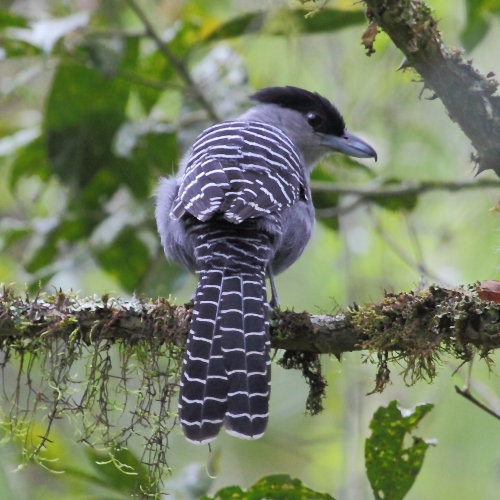
The adult Grey-bellied Antbird is medium-sized, characterized by its dark upperparts and contrasting gray belly, which gives the bird its name. Males and females exhibit similar plumage, though females may have slightly duller tones. Juveniles can be distinguished by their more muted coloration and less defined features. The bird's strong legs and curved beak are adapted for its insectivorous diet, aiding in foraging through leaf litter. One might confuse the Grey-bellied Antbird with other antbirds, such as the Spot-backed Antbird, but its distinctive belly color and vocalizations help in accurate identification. In flight, this bird exhibits a rapid, fluttering pattern, which is quite different from its more deliberate movements when perching. When perched, it typically displays an alert posture, often with its tail slightly cocked.
Having trouble telling birds apart? Upload a photo to our bird identification tool for an instant species match.
Grey-bellied Antbird Habitat and Range
Preferred Habitat
The Grey-bellied Antbird thrives in the lowland rainforests of the Amazon, favoring dense understory and shrub layers. It is typically found at elevations up to 1000 meters, although it prefers areas below 500 meters. This bird remains in forested regions throughout the year, as it does not migrate. While predominantly a forest dweller, it occasionally ventures to forest edges but rarely into open or urban areas. Seasonal changes do not significantly alter its habitat preferences, as the tropical climate maintains a consistent environment.
Geographic Range
The Grey-bellied Antbird's range is confined primarily to the western and central Amazon basin. Its presence is notable in Brazil, Peru, and Bolivia, with the densest populations found in areas of undisturbed rainforest. It does not exhibit migratory behavior, instead maintaining a year-round presence within this region. The bird's range is closely tied to the availability of intact forest, making it an indicator species for habitat health. Despite its restricted range, it remains relatively common within suitable habitats.
Want to know which birds visit your area? Browse our backyard birds by location guides for region-specific species lists.
What Does the Grey-bellied Antbird Eat?
This antbird primarily feeds on insects and other small invertebrates found in the leaf litter and low vegetation. Its diet consists mainly of ants, beetles, and spiders, which it captures using a technique known as 'gleaning,' where it picks prey off leaves and branches. The Grey-bellied Antbird follows army ant swarms, taking advantage of the prey flushed out by these aggressive insects. Seasonal changes in food availability can affect its diet, but its reliance on insects remains consistent. Typically, the bird forages during the early morning and late afternoon when insect activity peaks.
Grey-bellied Antbird Behavior and Social Structure
The Grey-bellied Antbird is predominantly a solitary bird, although it may form loose associations with mixed-species flocks. It exhibits strong territorial behavior, with males often engaging in vocal exchanges to establish dominance and secure their territory. Courtship involves subtle displays, including soft calls and wing fluttering. While not highly social outside of breeding, it does show some tolerance towards conspecifics during foraging. The bird remains active throughout the day, with peak activity during early morning and late afternoon. Alarm calls are issued in response to predators, such as snakes and raptors, providing early warnings to other birds.
Grey-bellied Antbird Nesting and Reproduction
The Grey-bellied Antbird constructs its nest in the dense understory, typically using twigs, leaves, and plant fibers. The nest is cup-shaped and positioned a few meters above the ground to avoid predation. A typical clutch consists of two eggs, with both parents sharing incubation duties over approximately 14 days. After hatching, the chicks remain in the nest for about 10-12 days before fledging. Both parents are involved in feeding and protecting the young, ensuring a high rate of survival. The species usually raises one brood per year, although in some cases, a second brood may occur if conditions are favorable.
Grey-bellied Antbird Sounds and Vocalizations
The Grey-bellied Antbird's primary song consists of a series of sharp, clear whistles, often described as 'whee-ee, whee-ee,' repeated several times. These calls are used for territorial defense and mate attraction. In addition to its song, it produces a range of call notes, including soft chattering sounds and harsh alarm calls when disturbed. The dawn chorus of the rainforest amplifies its presence, with the antbird's whistles piercing the morning air. The vocalizations are reminiscent of other Thamnophilidae species but are distinctive in their rhythm and intensity.
Interesting Facts About the Grey-bellied Antbird
- 1The Grey-bellied Antbird follows army ant swarms to capture insects disturbed by the ants, showcasing an interesting foraging strategy.
- 2This antbird species rarely ventures beyond the dense lowland forests, making its presence a sign of untouched primary rainforest.
- 3Despite its name, the Grey-bellied Antbird is not a true ant eater, although ants form a part of its diet.
- 4The bird's vocalizations are sometimes used to identify the presence of army ant swarms, aiding other birdwatchers in finding mixed-species flocks.
- 5The Grey-bellied Antbird's preference for dense understory makes it a challenging yet rewarding species to observe in the wild.
Grey-bellied Antbird Conservation Status
Currently, the Grey-bellied Antbird is listed as Least Concern by the IUCN, with a stable population trend. Its primary threat is habitat destruction due to deforestation in the Amazon basin. Conservation efforts focus on preserving large tracts of rainforest to ensure the survival of this and other forest-dependent species. Although the population remains stable, continued deforestation could lead to declines, emphasizing the importance of sustainable land management and conservation policies.
Other Thamnophilidae Species



Birds Similar to the Grey-bellied Antbird
These species are often confused with the Grey-bellied Antbird due to similar appearance or overlapping range.

