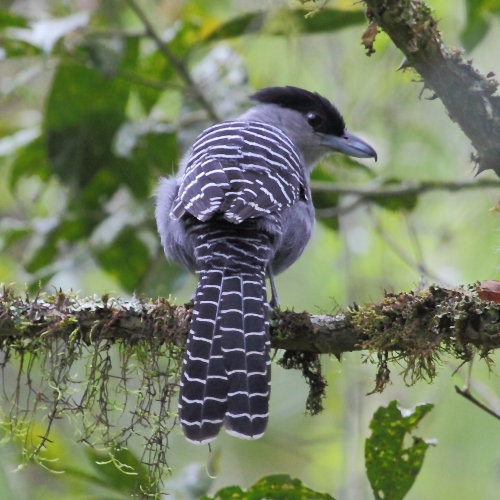
Harlequin Antbird
Rhegmatorhina berlepschi
Order: Passeriformes / Family: Thamnophilidae

Wikimedia Commons
About the Harlequin Antbird
The Harlequin Antbird, scientifically known as Rhegmatorhina berlepschi, is a remarkable species within the Thamnophilidae family. This bird is particularly famous for its association with army ants, a relationship that highlights its role in the intricate web of the Amazonian ecosystem. Found predominantly in the Amazon rainforest, the Harlequin Antbird thrives in the dense understory of mature, lowland forests. Its range is primarily limited to certain regions in the central Amazon Basin, notably within Brazil's Pará and Amazonas states. This bird is an essential part of the ecosystem as it thrives on the prey disturbed by the roving swarms of army ants, thereby contributing to the dynamic ecological balance of the rainforest.
Rhegmatorhina berlepschi plays a significant role in its habitat by acting as a predatory sentinel, particularly in areas where the presence of army ants is frequent. It helps control insect populations, thereby indirectly influencing the structure of the forest floor community. The Harlequin Antbird is primarily a resident species, but its movement patterns are closely tied to the nomadic behavior of army ants. During the wet season, when ant activity peaks, these birds exhibit increased foraging activity, often following ant swarms over considerable distances. During the drier months, they may rely more heavily on individual or small groups of insects as their primary food source.
The ecological role of the Harlequin Antbird extends beyond its feeding habits. It serves as an indicator species for the health of the Amazon rainforest, as its presence correlates with the integrity of its habitat. Conservation efforts aimed at protecting this bird also benefit a myriad of other species that share its environment. Human activities, such as deforestation and land conversion for agriculture, pose significant threats to the Harlequin Antbird's habitat, making its conservation a priority for maintaining biodiversity in the Amazon.
Overall, the Harlequin Antbird stands as a testament to the complex interdependencies within tropical ecosystems. Its specialized lifestyle and reliance on a healthy forest environment underscore the importance of preserving the Amazon rainforest for future generations. As habitats continue to face pressure from human activities, the Harlequin Antbird serves as a reminder of the delicate balance that sustains the rich biodiversity of tropical regions.
The Harlequin Antbird belongs to the family Thamnophilidae, within the order Passeriformes. These birds typically live 6-10 years, with a maximum recorded of 12 years..
How to Identify a Harlequin Antbird
The Harlequin Antbird exhibits a distinctive plumage pattern that aids in its identification. Adult males typically showcase a striking combination of black and white feathers, with an intricate patchwork design that can be likened to a harlequin costume, lending the bird its common name. The upperparts are predominantly black with white spotting, while the underparts are mostly white with black streaks, providing a stark contrast that is unmistakable in its natural habitat.
Females, while sharing the general pattern, display more subdued colors compared to males. They often have brownish tones mixed with the black and white, which can make them appear less conspicuous in the dense forest understory. Juveniles resemble females but have even more muted colors, lacking the sharp contrasts seen in mature males. This sexual dimorphism helps in the identification of the species across different age groups.
In terms of behavior, the Harlequin Antbird has a distinctive perching posture, often seen clinging to vertical stems or hopping along the forest floor in pursuit of insects. Its flight silhouette is compact, with rounded wings that facilitate quick, agile movements through the undergrowth. While it bears some resemblance to other antbirds, the unique plumage pattern and behavioral traits of Rhegmatorhina berlepschi make it relatively easy to distinguish from similar species when observed closely.
Having trouble telling birds apart? Upload a photo to our bird identification tool for an instant species match.
Harlequin Antbird Habitat and Range
Preferred Habitat
The Harlequin Antbird occupies the dense understory of the Amazon rainforest, specifically favoring mature, lowland forests with abundant leaf litter and dense foliage. It thrives in regions where army ants are active, as these insects are crucial to the bird's foraging strategy. Typical habitat areas include the central Amazon Basin, particularly in the Brazilian states of Pará and Amazonas.
This bird is seldom found outside primary forest habitats, making it an indicator of pristine forest conditions. It does not typically venture into urban or heavily altered landscapes, and its presence in secondary forests is limited. The Harlequin Antbird remains at elevations ranging from sea level to about 300 meters, where the forest provides ample cover and food resources.
Seasonal habitat shifts are minimal for the Harlequin Antbird, as its movements are more closely tied to the availability of army ants rather than seasonal changes. Thus, preserving its habitat requires maintaining large, contiguous tracts of primary rainforest, which support both the bird and the ant populations critical to its survival.
Geographic Range
The Harlequin Antbird's range is confined to the central Amazon Basin, with a significant concentration in Brazil's Pará and Amazonas states. It is a non-migratory species, residing year-round in its preferred forest habitats. This bird's distribution is closely tied to the presence of army ants, which are more abundant in certain parts of the Amazon, thereby limiting its geographical spread.
Within its range, population density hotspots occur in areas with optimal conditions for army ants, often in mature, undisturbed forests. These regions support the highest concentrations of Harlequin Antbirds, as the availability of prey is a critical factor in their distribution. Unlike many other bird species that undertake seasonal migrations, the Harlequin Antbird remains within its established territories, following ant swarms rather than pursuing long-distance travel.
The limited range and specialized habitat requirements of Rhegmatorhina berlepschi underscore the importance of protecting its forest environment. Any alteration to its habitat, such as deforestation or fragmentation, poses a direct threat to its survival, emphasizing the need for targeted conservation efforts in the central Amazon Basin.
Want to know which birds visit your area? Browse our backyard birds by location guides for region-specific species lists.
What Does the Harlequin Antbird Eat?
The diet of the Harlequin Antbird primarily consists of insects and other invertebrates, with a strong dependency on prey flushed out by army ants. This bird has evolved as an ant-following specialist, relying on the swarming behavior of ants to disturb insects, which the antbirds then capture. The Harlequin Antbird exhibits a particular preference for arthropods such as spiders and beetles, which form the bulk of its diet.
During the wet season, when army ant activity is at its peak, the Harlequin Antbird intensively follows these swarms, taking advantage of the increased availability of disturbed prey. Conversely, in the drier months, this bird may broaden its diet, supplementing its intake with other invertebrates found independently of ant swarms.
Foraging occurs primarily in the morning and late afternoon, coinciding with peak times for ant activity. The Harlequin Antbird employs a technique of closely shadowing ant swarms, picking off insects that attempt to escape the advancing ants. This specialized foraging strategy not only maximizes its feeding efficiency but also highlights the bird's intricate relationship with the rainforest's ecosystem dynamics.
Harlequin Antbird Behavior and Social Structure
The Harlequin Antbird is known for its complex social and territorial behaviors. It typically forages in pairs or small family groups, rarely forming large flocks. The bird exhibits strong territoriality, maintaining defined boundaries which it defends vigorously against intruders. This territorial behavior is crucial during the breeding season when resources become a focal point for competition.
Courtship displays in Rhegmatorhina berlepschi involve elaborate vocalizations and physical displays. Males often perform fluttering displays accompanied by calls to attract females. Once paired, these birds exhibit strong pair bonds, often remaining together across multiple breeding seasons.
In response to predators, the Harlequin Antbird uses a combination of vocal alarms and cryptic behavior to evade capture. It relies on its camouflaged plumage and quick, darting movements to escape potential threats. Daily activity patterns are largely centered around foraging, with peak activity occurring in the early morning and late afternoon, synchronized with the movements of army ant swarms. This adaptation ensures optimal feeding opportunities and highlights the bird's intricate link to its environment.
Harlequin Antbird Nesting and Reproduction
The nesting habits of the Harlequin Antbird reflect its adaptation to the dense forest understory. Nests are typically constructed close to the ground, often within 1-2 meters of the forest floor, using leaves, twigs, and plant fibers. The nest itself is an open cup structure, strategically placed in locations that offer concealment from predators.
Clutch size for Rhegmatorhina berlepschi is generally two eggs, with both parents sharing incubation duties. The incubation period lasts approximately 14 to 16 days, after which chicks hatch and are cared for by both parents. During the nestling phase, which lasts another 12 to 15 days, adults actively feed and protect the young, ensuring their growth and survival.
The Harlequin Antbird typically raises one brood per year, although in optimal conditions, a second brood may be attempted. Parental roles are well-balanced, with both male and female participating in feeding and guarding the chicks. This cooperative breeding strategy enhances the survival rate of the offspring in the challenging rainforest environment.
Harlequin Antbird Sounds and Vocalizations
The vocalizations of the Harlequin Antbird are distinctive and play a crucial role in communication. Its primary song consists of a series of sharp, rhythmic notes that rise and fall in pitch, creating a musical sequence that can be heard echoing through the forest understory. This song serves both to attract mates and to establish territorial boundaries.
Call notes are typically short and sharp, often used as alarm signals or to maintain contact between paired birds. Alarm calls are more urgent in tone and are employed when potential threats are detected, alerting nearby antbirds of danger. During the dawn chorus, the Harlequin Antbird's song is particularly prominent, as males vocalize energetically to assert their presence at the start of the day.
The sound of Rhegmatorhina berlepschi can be likened to a combination of whistles and trills, distinctly different from the harsher calls of many other antbird species. Its vocal repertoire reflects its role in the social and territorial dynamics of the forest.
Interesting Facts About the Harlequin Antbird
- 1The Harlequin Antbird relies on army ants to flush out prey insects, showcasing a unique ecological relationship.
- 2Despite its striking appearance, the Harlequin Antbird is rarely seen beyond the dense Amazonian understory.
- 3This bird's name, 'harlequin', refers to its checkered black and white plumage, resembling a harlequin's costume.
- 4The Harlequin Antbird's song is an essential part of its territorial defense, helping it maintain boundaries in dense forests.
- 5Rhegmatorhina berlepschi forms strong pair bonds, often breeding with the same partner over multiple seasons.
- 6Unlike many birds, the Harlequin Antbird is a non-migratory species, residing year-round in its Amazonian habitat.
- 7The bird's reliance on army ants means it often follows these swarms for miles, showcasing its adaptability.
Harlequin Antbird Conservation Status
The Harlequin Antbird is currently listed as Near Threatened on the IUCN Red List. Its population trend is considered stable, but it remains vulnerable due to ongoing habitat loss. Deforestation for agriculture and logging in the Amazon poses significant threats to its habitat, impacting the availability of suitable forest environments. Conservation efforts for Rhegmatorhina berlepschi focus on habitat preservation and restoration. Protected areas within its range, such as national parks and reserves, are crucial for safeguarding its population. Additionally, efforts to promote sustainable land-use practices help mitigate the impact of human activities on its habitat. Historically, the Harlequin Antbird's population has fluctuated with changes in forest cover, but concerted conservation initiatives have contributed to maintaining its current status. Continuous monitoring and habitat protection are essential to ensure its long-term survival in the Amazon.