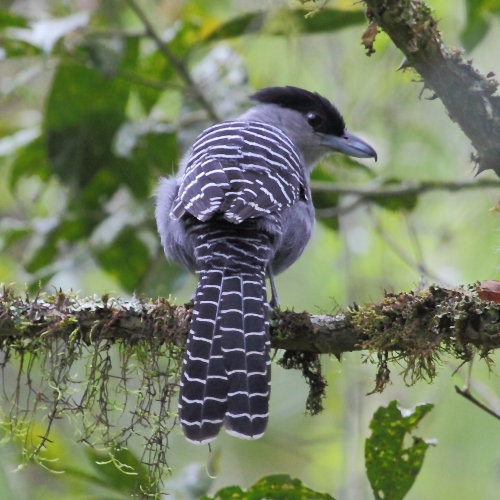
Hypsibamon andicolus
Hypsibamon andicolus
Order: Passeriformes / Family: Thamnophilidae

Wikimedia Commons
About the Hypsibamon andicolus
Hypsibamon andicolus, commonly known as the Andean Antbird, is a remarkable species in the family Thamnophilidae. This small but striking bird inhabits the dense montane forests of the Andes, primarily found in countries such as Colombia, Ecuador, and Peru. The Andean Antbird plays a significant role in the ecosystem as an insectivore, helping to control insect populations within its habitat. Typically, this bird forages in the understory and lower levels of forests, often seen hopping from branch to branch with agility and precision. The bird's presence is a key indicator of forest health, as it thrives in undisturbed environments with rich biodiversity. During the breeding season, which varies slightly depending on the geographic location, the Hypsibamon andicolus becomes more vocal and visible. It engages in elaborate courtship displays that showcase its vibrant plumage and intricate vocalizations. Outside of the breeding season, the Andean Antbird's behavior shifts slightly. It becomes more elusive, often remaining hidden among dense vegetation as it searches for food. Seasonal movements are not pronounced in this species, but some local migration may occur along elevational gradients in response to food availability. The bird's adaptability to different forest types, from cloud forests to subtropical moist forests, highlights its ecological importance and resilience. As a member of the Thamnophilidae family, the Andean Antbird is part of a diverse group of antbirds that have evolved unique feeding strategies. Unlike many of its relatives that specialize in following army ant swarms, the Hypsibamon andicolus adopts a more generalist approach, allowing it to exploit a wide range of prey items. This flexibility is crucial in maintaining its population across varying environmental conditions. The Andean Antbird is a critical part of the avian community in its range, contributing to the rich tapestry of life in South America's Andean regions.
The Hypsibamon andicolus belongs to the family Thamnophilidae, within the order Passeriformes. These birds typically live average 4 years with max recorded 7 years.
How to Identify a Hypsibamon andicolus
The Hypsibamon andicolus, or Andean Antbird, exhibits several distinctive field marks that aid in its identification. Adult plumage features a striking combination of deep slate gray and contrasting white markings on the wings and tail. Males and females exhibit similar coloration, though females may have slightly duller tones. Juveniles, on the other hand, tend to have browner plumage with less conspicuous markings, gradually acquiring adult coloration as they mature. In terms of size, the Andean Antbird falls into the small category, with a length of approximately 14 to 16 centimeters and a weight ranging from 25 to 30 grams. This bird's perching posture is typically upright, with a slightly tilted head, which aids in spotting potential prey. Its flight silhouette is compact and swift, characterized by rapid wing beats and short bursts of flight, followed by quick dives into the dense foliage. This species can occasionally be confused with similar antbirds, such as the Slaty Antwren, but the Andean Antbird's distinct wing patterns and vocalizations usually provide clear differentiation. Observers should note the bird's preference for low to mid-level forest strata during foraging, as this behavior is a reliable identification clue. The Andean Antbird's vocal presence also aids birders in the field, as its calls are distinctive and often heard before the bird is seen.
Having trouble telling birds apart? Upload a photo to our bird identification tool for an instant species match.
Hypsibamon andicolus Habitat and Range
Preferred Habitat
The Andean Antbird thrives in the montane forests of the Andes, favoring dense, humid environments. It is primarily found at elevations ranging from 1,200 to 3,000 meters, often inhabiting areas with rich understory vegetation and ample insect prey. This bird is a common resident of cloud forests, subtropical moist forests, and occasionally, secondary forests that retain sufficient cover. Its presence in these habitats indicates a preference for regions with high humidity and consistent rainfall. Seasonal habitat shifts are minimal, though the bird may move slightly in response to local food availability. While the Andean Antbird is primarily a forest dweller, it is not typically found in urban settings. Instead, it remains closely associated with undisturbed or minimally disturbed forest areas. Its reliance on intact forest ecosystems highlights the importance of preserving these habitats for the continued survival of the species.
Geographic Range
The Hypsibamon andicolus is primarily distributed along the Andean mountain range in South America. It breeds and resides year-round in countries such as Colombia, Ecuador, and Peru. Within these regions, the Andean Antbird occupies suitable forest habitats that provide ample food and shelter. This bird's range does not extend significantly beyond the Andean regions, as it is specialized to thrive in montane environments. While the species does not undertake long-distance migrations, it may exhibit altitudinal movements, adjusting its range according to seasonal variations in food resources. Population density hotspots are often found in areas of pristine forest with high insect activity, which supports the bird's insectivorous diet. The species' restricted range and habitat preferences make it vulnerable to habitat destruction, highlighting the importance of conservation efforts focused on preserving Andean forests.
Want to know which birds visit your area? Browse our backyard birds by location guides for region-specific species lists.
What Does the Hypsibamon andicolus Eat?
The diet of the Hypsibamon andicolus primarily consists of insects and other small arthropods. The Andean Antbird employs a variety of foraging techniques, including gleaning insects from leaves and branches, as well as occasionally sallying to catch airborne prey. Its diet shifts slightly with seasonal changes, with an increased reliance on caterpillars and beetles during the breeding season when nutritional demands are higher. Prey size typically ranges from small ants and spiders to larger beetles, which the bird deftly captures using its sharp beak. Foraging occurs throughout the day, with peak activity often observed during the early morning and late afternoon when insect availability is highest. The Andean Antbird's feeding schedule is opportunistic, allowing it to adapt to varying prey availability within its environment. Its role as a predator of insects contributes to natural pest control within its habitat, underscoring its ecological importance.
Hypsibamon andicolus Behavior and Social Structure
The Andean Antbird exhibits fascinating behavior patterns that reflect its social and ecological adaptations. This bird is typically seen in pairs or small family groups, although it may join mixed-species flocks while foraging. Territorial behavior is pronounced during the breeding season, with pairs vigorously defending their chosen nesting sites against intruders. Courtship displays involve a series of vocalizations and physical gestures, including wing flicking and tail spreading, to attract mates and establish pair bonds. The Andean Antbird's response to predators includes a combination of vocal alarms and evasive maneuvers, often retreating into dense foliage to avoid detection. Throughout the day, this bird maintains a consistent activity pattern, interspersing periods of foraging with rest and preening. Its ability to adapt to different social structures and environmental pressures highlights its resilience and versatility within its ecological niche.
Hypsibamon andicolus Nesting and Reproduction
The nesting habits of Hypsibamon andicolus reflect its adaptation to dense forest environments. The Andean Antbird constructs a cup-shaped nest, intricately woven from plant fibers, moss, and leaves, typically located in low bushes or small trees within the understory. Nest location preferences include sites that offer concealment and protection from predators. The clutch size generally ranges from two to three eggs, with both parents participating in incubation duties. The incubation period lasts approximately 14 to 16 days, after which the chicks hatch and are fed by both parents. Fledging occurs approximately two weeks post-hatching, with the young birds remaining under parental care for several additional weeks as they learn essential survival skills. The Andean Antbird typically produces one to two broods per year, depending on environmental conditions and food availability. This reproductive strategy ensures the continued success of the species in its native habitat.
Hypsibamon andicolus Sounds and Vocalizations
The vocalizations of the Andean Antbird are a key feature for identification in the field. Its primary song consists of a series of clear, whistled notes delivered in a rhythmic pattern, often described as melodious and somewhat mournful. Apart from its song, the bird produces a variety of call notes, including sharp 'chip' and 'chuck' sounds, used for communication between individuals or as alarm calls in response to threats. During the early morning hours, the Andean Antbird participates in a dawn chorus, adding to the vibrant soundscape of its forest habitat. The bird's vocal repertoire serves as an important means of maintaining social bonds and establishing territory within its densely vegetated environment.
Interesting Facts About the Hypsibamon andicolus
- 1The Andean Antbird can hop over 50 times a minute while foraging through dense foliage.
- 2Despite its small size, the Andean Antbird's song can be heard over 100 meters away in the forest.
- 3During breeding season, the Andean Antbird's plumage becomes more vibrant, enhancing its courtship displays.
- 4This bird's scientific name, Hypsibamon andicolus, reflects its exclusive association with the Andean region.
- 5The Andean Antbird contributes to insect population control, consuming over 500 insects daily during peak feeding periods.
- 6Unlike many antbirds, the Andean Antbird does not rely on following ant swarms, preferring solitary foraging.
- 7Studies suggest the Andean Antbird's vocalizations vary slightly between populations, indicating regional dialects.
Hypsibamon andicolus Conservation Status
The Andean Antbird is currently listed as Least Concern by the IUCN, though its population is suspected to be declining due to habitat loss. Deforestation and agricultural expansion pose primary threats to its montane forest habitat. Conservation efforts focus on protecting large tracts of forest and promoting sustainable land-use practices. Historically, population changes have mirrored the extent of habitat destruction, with localized declines noted in areas of significant forest clearance. Continued conservation action is necessary to ensure the long-term survival of this species, emphasizing the importance of habitat preservation and restoration.