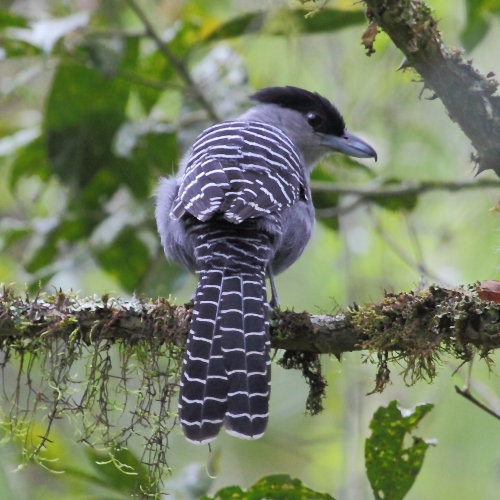
Immaculate Antbird
Myrmeciza immaculata
Order: Passeriformes / Family: Thamnophilidae

Wikimedia Commons
About the Immaculate Antbird
The Immaculate Antbird, Myrmeciza immaculata, is a distinctive bird species residing primarily in the humid tropical forests of South America. Known for its striking appearance, the Immaculate Antbird plays a crucial role in its ecosystem as an insectivore, helping control insect populations. This bird is most commonly found in Colombia and Ecuador, where it inhabits lowland and montane forests. With an elevation range typically between 500 to 2000 meters, it shows a preference for dense undergrowth, often concealing itself in thickets and tangled underbrush.
A member of the Thamnophilidae family, the Immaculate Antbird is significant for its role in mixed-species flocks. These flocks can include a variety of antbird species, each occupying a unique niche within the forest ecosystem. The Immaculate Antbird contributes to the ecological balance by feeding on insects and other arthropods, which helps maintain the health of the forest floor.
Seasonally, the Immaculate Antbird demonstrates varying behaviors. During the breeding season, which generally occurs in the rainy months, these birds become more territorial and vocal. Their calls and songs are essential for mate attraction and territory defense. Outside the breeding season, they may be less vocal but remain active in their pursuit of food. This species also participates in following army ant swarms, capturing prey that escape the advancing ants.
The Immaculate Antbird's ecological role extends beyond simple insect predation. By participating in complex avian communities, it supports biodiversity within its habitat, ensuring the continuation of diverse forest dynamics. Its presence is indicative of healthy forest ecosystems, making it a key species for ecological studies and conservation efforts.
The Immaculate Antbird belongs to the family Thamnophilidae, within the order Passeriformes. These birds typically live average 5-7 years, with a maximum recorded of 10 years..
How to Identify a Immaculate Antbird
Adult Immaculate Antbirds stand out with their contrasting black and white plumage. The males typically exhibit a more vibrant black, which covers their head, back, and wings, while the underparts are predominantly white. Females, however, may show a slightly browner tinge in their black areas, along with a less pronounced white belly.
Juveniles can be distinguished from adults by their duller coloration. They tend to have brownish tones where adults are black, and their white areas are less bright and more mottled. This coloration helps juveniles blend into the forest floor, providing camouflage from predators.
In flight, the Immaculate Antbird displays a relatively short and rounded silhouette. Its wings beat rapidly, indicative of its forest-dwelling lifestyle, allowing it to navigate through dense foliage. When perched, the bird often remains low to the ground, favoring branches and twigs close to the forest floor. This low perching habit, combined with its distinct coloration, helps distinguish it from other species within its habitat.
Having trouble telling birds apart? Upload a photo to our bird identification tool for an instant species match.
Immaculate Antbird Habitat and Range
Preferred Habitat
The Immaculate Antbird thrives in the dense, humid forests of the neotropical region, particularly in Colombia and Ecuador. It prefers lowland and montane forests, often found in areas with thick underbrush and dense vegetation. These habitats provide ample cover and abundant food resources, crucial for its diet of insects and small arthropods.
Typically, the species occupies elevations ranging from 500 to 2000 meters, although it is more frequently encountered at the higher end of this range. The bird is not common in urban areas, preferring the undisturbed forest environments where it can find shelter and sustenance.
Seasonal habitat shifts are minimal for the Immaculate Antbird, as it generally remains in its preferred forest areas year-round. However, slight movements may occur in response to changes in food availability or during the breeding season, when it may seek out optimal nesting sites within its home range.
Geographic Range
The Immaculate Antbird is primarily found in the northwestern regions of South America, with its distribution concentrated in Colombia and Ecuador. Its range extends into adjacent areas, but it is most populous in the humid tropical forests of these countries.
During the breeding season, the Immaculate Antbird remains within its established range, as it does not undertake long-distance migrations. The species is considered a resident bird, maintaining territories and feeding grounds throughout the year.
Population densities are typically higher in areas with well-preserved forest habitats, as habitat fragmentation and deforestation reduce their available territory. Despite this, the Immaculate Antbird can adapt to some degree of habitat modification, as long as sufficient cover and food sources remain. This resilience allows it to persist in areas where other species might decline.
Want to know which birds visit your area? Browse our backyard birds by location guides for region-specific species lists.
What Does the Immaculate Antbird Eat?
The Immaculate Antbird's diet consists primarily of insects and other small arthropods. It forages by gleaning insects from leaves and branches in the understory of the forest. Its insectivorous diet includes ants, beetles, spiders, and occasionally small lizards.
Seasonal changes can influence its diet, as it may consume a higher proportion of certain prey types when they become more abundant. During the rainy season, when insect activity peaks, the Immaculate Antbird benefits from a plentiful food supply.
This bird employs a methodical foraging technique, often following army ant swarms. As the ants disturb the forest floor, the antbird seizes the opportunity to catch fleeing insects. This behavior is not only efficient but also integral to its survival strategy, allowing it to exploit a reliable food source.
The feeding schedule of the Immaculate Antbird is largely diurnal, with peak activity occurring during the early morning and late afternoon. This timing coincides with periods of heightened insect activity, maximizing its foraging success.
Immaculate Antbird Behavior and Social Structure
The social structure of the Immaculate Antbird is characterized by monogamous pair bonds, often lasting for several breeding seasons. During the breeding season, these pairs become more territorial, displaying aggressive behaviors to defend their nesting sites from intruders.
Courtship displays involve vocalizations and physical demonstrations, such as wing flapping and tail fanning. These displays serve to strengthen pair bonds and signal readiness for breeding. Outside of the breeding season, Immaculate Antbirds are generally solitary or found in pairs, although they may join mixed-species flocks when foraging.
The Immaculate Antbird exhibits a strong response to predators, employing various alarm calls to warn conspecifics and other species of potential threats. This behavior is vital for survival in the dense forest environment, where visual cues may be limited.
Daily activity patterns revolve around foraging and territory maintenance. The Immaculate Antbird is most active during the cooler hours of the day, with periods of rest during the heat of midday. Its alertness and agility allow it to navigate the complex forest terrain efficiently.
Immaculate Antbird Nesting and Reproduction
The Immaculate Antbird constructs a cup-shaped nest, typically located low to the ground in dense vegetation. Nest materials include twigs, leaves, and plant fibers, carefully woven together to provide a secure structure for the eggs.
Preferred nesting sites are often found in thickets or understory shrubs, providing concealment from predators. The typical clutch size ranges from two to three eggs, which are incubated by both parents.
The incubation period lasts approximately 14 to 16 days, after which the chicks hatch. Both parents participate in feeding and caring for the young, ensuring their rapid growth and development. Fledging occurs around 14 to 18 days post-hatching, with the fledglings remaining dependent on the adults for additional weeks.
The Immaculate Antbird generally raises one to two broods per year, depending on environmental conditions and food availability. This reproductive strategy allows the species to maintain its population in the dynamic forest environment.
Immaculate Antbird Sounds and Vocalizations
The Immaculate Antbird's primary song is a series of melodious notes, delivered in a rhythmic pattern that rises and falls in pitch. This song serves as both a territorial marker and a courtship display, essential during the breeding season.
Call notes are shorter and more abrupt, often used in communication between mates or to signal alarm. These calls can vary in tone and intensity, depending on the urgency of the situation.
Alarm calls are sharper and more piercing, designed to alert other birds to the presence of predators. During the dawn chorus, the Immaculate Antbird's song contributes to the symphony of sounds that characterize the awakening forest.
Comparatively, the sounds of the Immaculate Antbird are less complex than those of some other songbirds, but their clarity and consistency make them distinctive within its habitat.
Interesting Facts About the Immaculate Antbird
- 1The Immaculate Antbird was first described scientifically in the early 19th century, highlighting its long-standing recognition among ornithologists.
- 2This bird gets its name from its spotless appearance, with 'immaculata' meaning 'unstained' or 'spotless' in Latin.
- 3Immaculate Antbirds often follow army ant swarms, a behavior known as 'ant-following,' allowing them to catch prey disturbed by the ants.
- 4Despite its reliance on dense forests, the Immaculate Antbird can sometimes be spotted in secondary growth areas, demonstrating its adaptability.
- 5The Immaculate Antbird's diet consists mainly of insects, but it occasionally consumes small amphibians and reptiles.
- 6Vocalizations play a crucial role in this species' behavior, with their songs and calls serving multiple social functions within their habitat.
- 7With a relatively small size of about 15 to 17 cm, the Immaculate Antbird is well suited to navigating the dense underbrush of its forest home.
Immaculate Antbird Conservation Status
Currently, the Immaculate Antbird is classified as Least Concern by the IUCN due to its relatively stable population numbers. However, habitat destruction poses a significant threat, as deforestation in South America reduces its available habitat. Conservation efforts focus on preserving forest habitats through protected areas and sustainable land management practices. These efforts aim to mitigate the impacts of logging and agricultural expansion, which contribute to habitat fragmentation. Historically, the Immaculate Antbird has maintained stable populations, thanks in part to its adaptability in forested environments. However, continued habitat loss could lead to future declines, underscoring the importance of ongoing conservation initiatives. Monitoring population trends and habitat conditions remains critical to ensure the long-term survival of the Immaculate Antbird, highlighting the need for international cooperation and conservation funding.