
Japanese Leaf Warbler
Phylloscopus xanthodryas
Order: Passeriformes / Family: Phylloscopidae

Wikimedia Commons
About the Japanese Leaf Warbler
The Japanese Leaf Warbler (Phylloscopus xanthodryas) is a small yet vibrant songbird that plays a vital role in its ecosystem by controlling insect populations. This warbler, a member of the Phylloscopidae family, is primarily found in the forests of Japan, with a range extending to parts of eastern Asia. Its presence in these regions is significant due to its role in maintaining the health of forest ecosystems. By predating on insects, it helps control pest populations, thus contributing to the ecological balance.
In terms of its ecological role, the Japanese Leaf Warbler is an insectivore, feeding largely on small insects and spiders. This diet makes it an integral part of the food web, as it helps manage insect populations, which if left unchecked, could lead to significant ecological imbalances. Its feeding habits also indirectly support plant health by reducing the number of herbivorous insects. During the breeding season, this bird can be found in deciduous and mixed forests, where it nests and raises its young.
The Japanese Leaf Warbler exhibits fascinating seasonal behaviors. In spring, males establish territories and sing to attract mates. The bird’s migration patterns are equally noteworthy, as it travels considerable distances between its breeding and wintering grounds. During migration, many warblers navigate through various habitats, showcasing adaptability but also their dependence on diverse environments to complete their life cycle. Their seasonal movements highlight the interconnectedness of ecosystems across regions, underscoring the need for widespread conservation efforts.
The Japanese Leaf Warbler belongs to the family Phylloscopidae, within the order Passeriformes. These birds typically live average 2-4 years..
How to Identify a Japanese Leaf Warbler
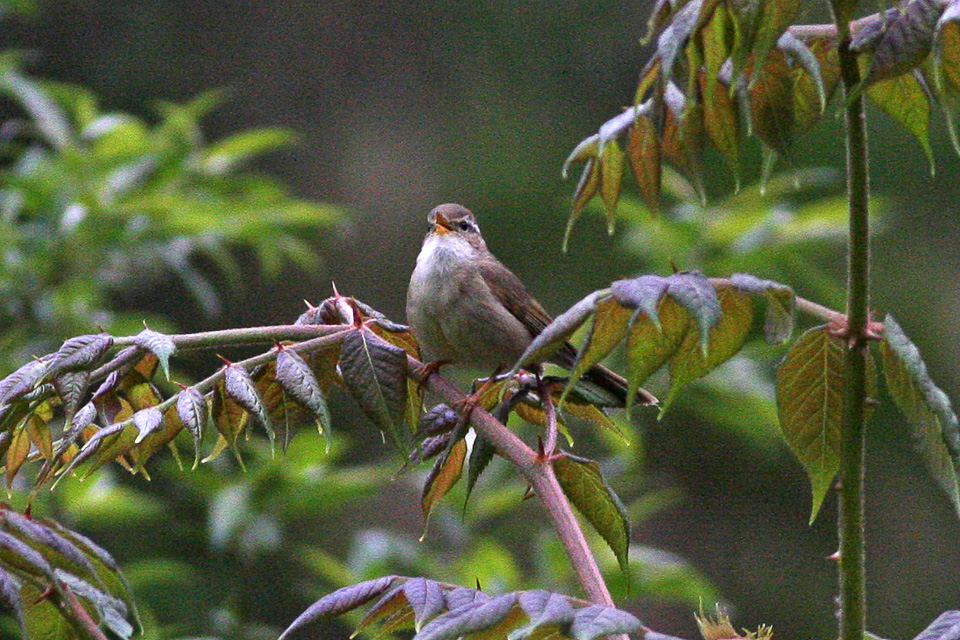
The Japanese Leaf Warbler is a small bird, measuring approximately 11 to 12 cm in length, with a wingspan of 18 to 20 cm. Its plumage is predominantly yellow-green, a trait that provides excellent camouflage among the leaves. The underparts are typically paler, with a creamy white to yellow hue, while the upperparts are more vibrant green. The bird's crown may exhibit a slightly darker shade, setting it apart from similar species. A distinctive feature is its long, thin beak, adapted for gleaning insects from foliage.
Juvenile Japanese Leaf Warblers resemble adults but may display slightly duller plumage, lacking the full vibrancy of mature birds. There is little sexual dimorphism, making it challenging to distinguish males from females in the field. However, during the breeding season, males are often more vocal, which can aid in identification.
In flight, the Japanese Leaf Warbler presents a swift, undulating motion typical of small passerines. Its perching posture is alert, often seen with its tail slightly cocked, a behavior that can help differentiate it from similar species. The bird may be mistaken for other Phylloscopus warblers, but its unique song and subtle plumage variations provide clues for accurate identification.
Having trouble telling birds apart? Upload a photo to our bird identification tool for an instant species match.
Japanese Leaf Warbler Habitat and Range
Preferred Habitat
The Japanese Leaf Warbler predominantly inhabits temperate deciduous and mixed forests. These forests provide the dense canopy cover and abundant insect prey necessary for the warbler’s survival. In Japan, it can be found in areas like Honshu, Shikoku, and Kyushu, favoring altitudes ranging from lowland forests to mountainous regions up to 1500 meters.
During the breeding season, it selects habitats with dense foliage, which offers protection and ample resources for raising young. In winter, the warbler may migrate to lower altitudes or southern regions where temperatures are milder. This seasonal habitat shift highlights its adaptability, allowing it to exploit different ecological niches throughout the year.
The Japanese Leaf Warbler is less commonly found in urban environments, preferring the tranquility and resource-rich settings of rural and forested landscapes. However, during migration, it might occasionally be spotted in more open areas or parks, illustrating its flexibility in habitat use when necessary.
Geographic Range
The breeding range of the Japanese Leaf Warbler spans across Japan, including major islands such as Honshu, Shikoku, and Kyushu. It is also found in some parts of the Korean Peninsula and eastern China during the breeding season. In winter, this warbler migrates southward, reaching as far as Southeast Asia, including regions like Taiwan and the Philippines.
Migration corridors for the Japanese Leaf Warbler are well-defined, with birds typically passing through coastal areas and river valleys that support their journey. These corridors are crucial for the warbler’s survival, providing stopover sites where they can rest and refuel.
Population density tends to be higher in regions of suitable habitat, such as the forested areas of central and southern Japan. During migration, they can be seen in larger numbers at key stopover sites, indicating the importance of these regions in their life cycle. The Japanese Leaf Warbler is not an isolated species; its presence throughout these areas highlights the interconnectedness of ecosystems across Asia.
Want to know which birds visit your area? Browse our backyard birds by location guides for region-specific species lists.
What Does the Japanese Leaf Warbler Eat?
The Japanese Leaf Warbler primarily feeds on a diet of small insects and arachnids. Its foraging technique is highly adapted to gleaning from foliage, allowing it to capture prey such as caterpillars, beetles, and ants. The bird’s slender bill is particularly effective for picking insects off leaves and branches, a behavior known as foliage-gleaning.
Seasonal changes in diet are notable, with the warbler consuming more insects during the breeding season when nutritional demands are highest. As insects become less abundant in colder months, it may diversify its diet slightly to include other arthropods or small invertebrates.
The warbler typically forages during daylight hours, with peak activity in the early morning and late afternoon. By concentrating their foraging efforts during these times, Japanese Leaf Warblers maximize their energy intake while avoiding the heat of midday, demonstrating a keen adaptation to their environment.
Japanese Leaf Warbler Behavior and Social Structure
Japanese Leaf Warblers exhibit a solitary or paired social structure, particularly during the breeding season when males become highly territorial. They establish and defend territories through song, a behavior that signals both presence and reproductive fitness to potential mates. Courtship displays involve males performing a series of fluttering flights and vocalizations to attract females.
Outside the breeding season, these warblers may join mixed-species flocks, enhancing foraging efficiency and predator avoidance. Flocking becomes more common during migration and winter, illustrating a shift in social behavior based on seasonal demands.
Daily activity patterns of the Japanese Leaf Warbler are prominently diurnal, with peak vocal and foraging activities occurring in early morning and late afternoon. In response to predators, these warblers rely on their cryptic plumage and agility to evade capture, often freezing or flitting to dense cover to avoid detection.
Japanese Leaf Warbler Nesting and Reproduction
The Japanese Leaf Warbler constructs an open cup nest, typically situated low in a shrub or small tree to provide concealment. Nest materials include grasses, leaves, and moss, woven together to create a structure that blends seamlessly with its surroundings. The choice of nesting site is crucial, as it must offer protection from predators and harsh weather.
A typical clutch consists of 4 to 6 eggs, which are incubated for approximately 11 to 14 days. Both parents share in the incubation duties, although the female often takes a more active role. After hatching, the chicks remain in the nest for another 12 to 15 days before fledging. During this period, both parents are involved in feeding and caring for the young, ensuring they receive sufficient food and protection.
The Japanese Leaf Warbler typically raises one to two broods per year, depending on environmental conditions and food availability. This reproductive strategy reflects a balance between maximizing reproductive output and ensuring the survival of offspring in a dynamic environment.
Japanese Leaf Warbler Sounds and Vocalizations
The primary song of the Japanese Leaf Warbler is a high-pitched, melodious series of notes that can be described as a rapid trill, often lasting several seconds. This song is crucial for territory establishment and mate attraction during the breeding season. The rhythm is consistent, with a clear and penetrating quality that carries well through dense foliage.
Call notes are short and sharp, often used in communication between mates or signaling alarm. These calls differ from the song by being less melodic and more abrupt, serving functional rather than aesthetic purposes.
The warbler participates in a dawn chorus, particularly during the peak of the breeding season, contributing to the vibrant acoustic landscape of its habitat. Its song is sometimes compared to the tinkling of a small bell, providing a pleasant and recognizable soundscape for those familiar with its habitats.
Interesting Facts About the Japanese Leaf Warbler
- 1The Japanese Leaf Warbler migrates up to 2000 kilometers between breeding and wintering grounds, showcasing its endurance.
- 2Despite its small size, the Japanese Leaf Warbler's song can be heard over 100 meters away in dense forest.
- 3This warbler can consume up to 50% of its body weight in insects daily during the breeding season.
- 4Japanese Leaf Warblers have a unique flight call that helps them stay in contact with each other during migration.
- 5The species' scientific name 'xanthodryas' refers to its yellowish hue, derived from Greek words for yellow and tree.
- 6During courtship, males perform a fluttering flight display while singing to impress potential mates.
- 7The Japanese Leaf Warbler's population is resilient, maintaining stability despite significant habitat changes in its range.
Japanese Leaf Warbler Conservation Status
The Japanese Leaf Warbler is currently listed as Least Concern by the IUCN, with a stable population trend. Despite this status, it faces threats from habitat destruction and fragmentation, particularly in breeding and stopover sites. Urban development and deforestation in parts of its range pose significant risks to its habitats. Conservation efforts focus on protecting critical habitats and ensuring that migratory routes remain viable for the warbler’s seasonal journeys. Historical population changes have been minimal, but ongoing monitoring is essential to detect any shifts due to environmental changes. Collaborative conservation initiatives across its range are vital, as they ensure the warbler can continue to thrive in its natural environments. Maintaining healthy forest ecosystems not only benefits the Japanese Leaf Warbler but also the myriad other species that share its habitat.
Other Phylloscopidae Species



Birds Similar to the Japanese Leaf Warbler
These species are often confused with the Japanese Leaf Warbler due to similar appearance or overlapping range.

